Cell size and caste timing directly determine whether a hive produces workers, drones, or queens—and therefore which foundation, frames, and queen-management hardware should be supplied. Standard worker foundation uses approximately 5 mm cells, while drone foundation uses larger cells of approximately 6 mm. Queens are not produced in ordinary flat foundation cells; they require large, vertically oriented queen-cell cups or specialized queen-rearing equipment. Because adult queens and drones are broader than workers, queen excluders must use calibrated spacing that permits worker movement while restricting the queen.
The practical rule is simple: match foundation cell size to the intended brood type, use frames that maintain the correct comb geometry and bee space, and select queen excluders according to the body dimensions of the species or subspecies being managed.
Why Caste Biology Determines Equipment Selection
Workers require standard brood foundation
Worker bees emerge after approximately 21 days: about 3 days as eggs, 5–6 days as larvae, and 11–12 days as pupae.
They develop in horizontal hexagonal cells typically manufactured at approximately 5 cells per 25 mm, or about 5 mm per cell. This is the standard foundation specification for colonies managed primarily for honey production, pollination, and population growth.
Accurately embossed worker foundation encourages uniform worker comb and reduces the tendency of the colony to construct excessive drone comb.
Drones require larger cells and longer development
Drones emerge after approximately 24 days, including roughly 7 days as larvae and 14 days as pupae.
Their larger bodies require wider cells, commonly around 6 mm, or approximately 4 cells per 25 mm. Drone foundation therefore has a different embossing pattern and should not be treated as interchangeable with standard worker foundation.
Commercial operators may use drone-sized foundation deliberately for drone production, breeding programs, or certain integrated pest-management strategies. However, excessive drone comb can reduce the space available for worker brood and honey storage.
Queens require specialized vertical cells
Queens emerge after approximately 16 days, making their development substantially faster than that of workers or drones.
Queen larvae are raised in large, vertically protruding, peanut- or acorn-shaped cells. These are structurally different from both worker and drone cells, so ordinary foundation sheets cannot produce queen cells reliably without colony modification.
Queen-rearing systems therefore use cell cups, starter strips, grafting frames, and queen-rearing kits designed to imitate the natural shape and orientation of queen cells.
How Foundation Cell Size Controls Comb Construction
Worker foundation is the default commercial specification
For most honey-production colonies, the principal requirement is consistent worker-cell foundation.
Uniform worker cells help the queen lay fertilized eggs in the intended areas and support a dense, predictable worker population. They also improve interchangeability across standardized frames and supers.
For distributors and resellers, standard worker foundation should generally be treated as the core inventory item, supported by compatible frames, foundation fasteners, and hive dimensions.
Drone foundation must be selected intentionally
Drone-sized foundation is appropriate when the beekeeper wants to produce drones or provide controlled drone comb.
It should not be substituted casually for worker foundation. Larger cells occupy more comb volume and can alter the colony’s worker-to-drone balance, affecting honey-production capacity and brood management.
Foundation tolerances matter
Foundation-making machinery and embossed sheets must maintain tight cell-size tolerances.
Poorly formed or inconsistent embossing can encourage irregular comb, mixed cell sizes, excessive drone construction, or gaps that complicate inspection and frame handling. For commercial supply chains, manufacturing precision is therefore as important as the nominal cell specification.
Species and ecotype differences require caution
The approximately 5 mm worker-cell standard is primarily associated with common commercial honeybee equipment, particularly systems designed around managed Apis mellifera colonies.
Other species, subspecies, or ecotypes may build different cell sizes. Reported dimensions vary among Apis cerana populations and other honeybees, so foundation and frame products should be matched to the target bee population rather than marketed as universally interchangeable.
How Frame Design Supports Correct Cell Geometry
Frames must preserve standardized comb spacing
A frame is more than a wooden or plastic support. Its dimensions, top-bar spacing, side-bar clearance, and relationship to neighboring frames determine whether bees can maintain usable comb and passageways.
Frames must preserve the colony’s required bee space so that comb is neither fused to adjacent equipment nor built with unusable gaps. Correct spacing supports inspection, extraction, transport, and replacement.
Foundation and frames must be sold as a compatible system
A foundation sheet with the correct cell diameter can still perform poorly if it does not fit the frame securely or align with the hive body.
Suppliers should verify compatibility across:
- Frame dimensions
- Foundation sheet size
- Top-bar and bottom-bar arrangements
- Hive body and super standards
- Foundation attachment method
- Plastic, wax, or hybrid foundation formats
This system-level compatibility is particularly important for wholesalers and B2B resellers supplying complete apiary packages.
Brood and honey frames serve different operating needs
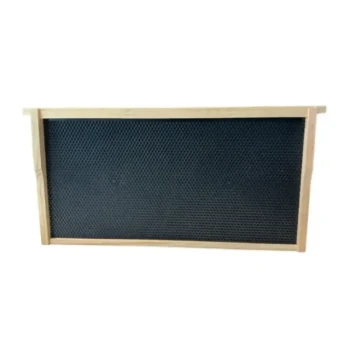
Brood frames must support stable, inspectable comb capable of holding worker, drone, or queen-rearing cells.
Honey-super frames are generally selected for efficient storage and extraction, but they still need to maintain consistent spacing and comb alignment. Mixing incompatible frame standards can lead to cross-comb, damaged foundation, and slower colony acceptance.
Frame selection should reflect local bee morphology
Body size and cell construction can vary between bee populations.
For commercial operations working with regional or nonstandard bees, frame and foundation specifications should be validated through field performance rather than assumed from a generic catalog description. A reliable supplier should be able to provide dimensional information and recommend compatible equipment for the managed species.
How Queen Excluders Use Adult Body Dimensions
The excluder separates brood and honey zones
A queen excluder is installed between the brood chamber and honey supers.
Its purpose is to allow smaller worker bees to pass upward while restricting the larger queen to the brood chamber. This keeps the queen from laying eggs in honey-storage comb, which protects the harvestable honey area from brood contamination.
Grid spacing must be calibrated, not arbitrary
Queens have a broader thorax than workers, so excluder openings are designed around the difference in body dimensions.
The correct spacing depends on the target bee population and the equipment standard. An opening that is too wide may allow the queen through; one that is too narrow can obstruct workers, reduce super access, and create congestion.
For this reason, queen excluders should be selected by verified grid spacing and species compatibility, not simply by external dimensions or visual similarity.
Drone passage is a separate consideration
Drones are also larger than workers and have broad thoraxes.
Most standard queen excluders restrict drones as well as queens. This may be acceptable in ordinary honey production, but it should be considered when managing mating colonies, drone-producing colonies, or breeding yards where drone movement is operationally important.
Queen cages and excluders solve different problems
A queen excluder separates the queen from a hive section while allowing worker traffic.
A queen cage or temporary isolation device confines the queen to a specific area or frame for a defined period. This can support synchronized egg-laying and age-controlled brood studies, but it is not a substitute for a permanent brood-to-super excluder.
Developmental Timing and Hive Management
Timing affects inspections and equipment turnover
Because queens, workers, and drones remain in the comb for different periods, brood appearance changes according to caste and age.
Workers emerge at 21 days, drones at 24 days, and queens at 16 days. These differences help beekeepers schedule inspections, assess brood development, and identify whether foundation is producing the intended caste.
Capped brood requires different monitoring decisions
Eggs and feeding larvae occupy open cells, while pupae develop in sealed or capped cells.
The longer drone development period and shorter queen development period affect the timing of brood inspections, queen-cell checks, and targeted treatments. Equipment planning should therefore include access for inspection rather than focusing only on initial installation.
Queen-rearing equipment must support rapid turnover
Queen cells develop faster than worker and drone brood.
Commercial queen-rearing operations need cell cups, bars, frames, and handling tools that allow frequent transfers and inspections without damaging the vertically oriented cells. Durable, accurately sized components improve repeatability across batches.
Understanding the Trade-offs
Smaller worker cells do not automatically guarantee better performance
Worker foundation is useful for standardization and population management, but cell size alone does not determine colony productivity.
Genetics, nutrition, disease pressure, climate, queen quality, and management practices also affect brood success and honey yield. Foundation should be treated as a control variable, not a complete productivity solution.
Queen excluders can restrict colony movement
An excluder may reduce the queen’s access to supers, but it can also create a movement barrier if poorly fitted or incorrectly spaced.
Workers may avoid a super that is difficult to access, particularly when the colony is weak or the excluder is introduced too early. Fit, bee population, and timing all matter.
Cross-species standardization can create failures
A product designed for one bee population may not perform correctly with another.
This is especially relevant for cell dimensions and excluder spacing. Distributors should avoid universal claims and should clearly identify the intended species, subspecies, frame standard, and cell specification.
Mixed foundation increases inspection complexity
Using worker and drone foundation in the same operation can be valuable, but it requires clear labeling and management discipline.
If the purpose of each frame is not recorded, beekeepers may unintentionally move drone comb into honey-production areas or treat queen-rearing components as ordinary brood equipment.
Making the Right Choice for Your Goal
Equipment should be specified as a coordinated package rather than as isolated hive components.
- If your primary focus is honey production: Prioritize accurately manufactured approximately 5 mm worker foundation, compatible standardized brood and honey frames, and a correctly fitted queen excluder.
- If your primary focus is drone production or breeding: Stock larger-cell drone foundation and dedicated frames, while accounting for the 24-day drone development period and restricted drone passage through many excluders.
- If your primary focus is queen rearing: Use vertically oriented queen-cell cups, cell bars, starter or grafting frames, and equipment designed around the 16-day queen-development cycle.
- If your primary focus is multi-species or regional beekeeping: Confirm local cell dimensions, frame standards, and excluder spacing before committing to high-volume procurement.
- If your primary focus is B2B distribution: Offer a full compatibility range—worker and drone foundation, standardized frames, queen-rearing kits, and species-appropriate excluders—with clear specifications and rapid fulfillment.
The right equipment aligns cell geometry, frame standards, adult body dimensions, and developmental timing into one coherent hive-management system.
Summary Table:
| Caste | Development Time | Cell Size | Equipment Selection |
|---|---|---|---|
| Worker | 21 days | ~5 mm | Standard worker foundation, frames, queen excluder |
| Drone | 24 days | ~6 mm | Drone foundation, dedicated frames, consider excluder restriction |
| Queen | 16 days | Specialized vertical cells | Cell cups, queen-rearing kits, grafting frames |
Ensure your hive equipment aligns with honeybee caste biology for maximum productivity and colony health. HONESTBEE offers a comprehensive range of foundation, frames, and queen excluders tailored to your operation's needs. Our one-stop sourcing, fast delivery, and expert support help distributors and beekeepers achieve seamless hive management. Contact us today to discuss your requirements and benefit from our wholesale solutions.
Related Products
- Plastic Bee Frame Beekeeping Hive Frames for Wholesale
- Assembled Wooden Bee Frames with Plastic Foundation for Durability and Convenience by HONESTBEE
- Solid Bottom Board Australian Pine Wood Langstroth Bottom Board for Wholesale
- Durable Plastic Hive Number Set for Beekeeping
- Langstroth Solid Bottom Board for Beekeeping
People Also Ask
- Under what circumstances should bee frames be destroyed? Protect Your Apiary from American Foulbrood
- Do bee frames need foundation? Choose the Right Approach for Your Apiary
- How should frames be rearranged as a bee colony grows? Master Hive Expansion and Nest Management
- How do you re-wax bee frames? A Simple Guide to Faster Comb Building
- Can beekeepers switch between wooden and plastic frames? Optimize Your Hive's Performance