Honey’s acidity and osmotic behavior directly determine the materials, sealing, and flow-control requirements of commercial storage and filling equipment. With a typical pH of 3.2–4.5, honey can gradually attack unsuitable metals, potentially causing corrosion and metal leaching. Its high sugar concentration also makes it hyper-osmotic and hygroscopic, so tanks and filling systems must limit moisture exchange while handling a dense, high-viscosity product.
The essential specification is a hygienic, corrosion-resistant, sealed system: high-grade food-contact stainless steel protects against acidic wear, while airtight storage and controlled filling prevent honey from absorbing humidity and losing shelf stability.
How Honey’s Acidity Affects Material Selection
Acidic honey requires corrosion-resistant contact surfaces
Honey contains organic acids and active enzymes, making it chemically active even though it is not strongly acidic in the same way as industrial chemicals. Over extended storage or repeated processing cycles, unsuitable metals may corrode and contaminate the product.
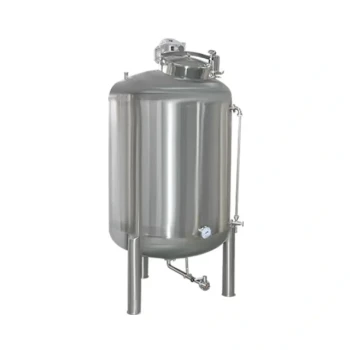
Commercial tanks, valves, pumps, piping, filling heads, and other product-contact components should therefore use high-grade, food-grade, corrosion-resistant stainless steel. The specification should apply to every wetted surface, not only the main tank body.
Corrosion resistance protects both equipment and inventory
Acid-resistant materials serve two purposes: they preserve the mechanical integrity of the equipment and reduce the risk of metal migration into wholesale honey inventory. This is particularly important for systems used continuously across extraction, storage, transfer, and packaging operations.
Distributors and resellers should verify that the quoted material specification covers tanks, fittings, valves, nozzles, seals, and internal transfer components. A corrosion-resistant tank paired with unsuitable contact parts does not provide a complete solution.
Hygienic construction is part of the material requirement
Food-grade construction must support effective cleaning and minimize areas where honey can accumulate. Smooth, accessible product-contact surfaces and compatible seals help reduce residue retention during product changeovers and routine sanitation.
For commercial procurement, documentation covering food-contact suitability, corrosion resistance, and cleaning compatibility is as important as the headline equipment capacity.
How Osmotic and Hygroscopic Properties Affect Equipment Design
High sugar concentration creates low water activity
Honey’s concentrated fructose and glucose content gives it a hyper-osmotic composition and normally low water activity. This helps inhibit many microorganisms during proper storage, but it does not make honey immune to moisture-related deterioration.
The equipment must preserve this condition rather than allow the product to absorb water from the surrounding environment.
Honey absorbs moisture from humid air
Fructose makes honey highly hygroscopic. When exposed to humid air, honey can absorb moisture until it approaches equilibrium with its surroundings.
If water content rises above approximately 23–24.5%, yeast growth and fermentation become more likely. This makes atmospheric exposure a genuine equipment-design concern during bulk holding, processing, and filling.
Airtight storage protects product stability
Commercial storage tanks and processing vats should use hermetic or airtight closures to limit contact between the honey and ambient air. Tank openings, inspection ports, transfer connections, and filling interfaces should be designed to avoid unnecessary exposure during operation.
Where tanks require air exchange, the system should use appropriately controlled or desiccated venting rather than leaving the product exposed to humid plant air.
Sealing must extend through the filling line
Moisture control cannot stop at the storage tank. Open hoppers, poorly sealed transfer lines, and exposed filling nozzles can reintroduce humidity immediately before packaging.
A complete specification should address tank lids, vent systems, pumps, valves, nozzles, and container-handling areas as one moisture-control system.
How These Properties Influence Flow and Filling Hardware
Viscosity changes the required pump and drive capacity
Honey’s water content strongly affects viscosity. Below approximately 20% moisture, viscosity rises rapidly; it can roughly double as moisture decreases from 20% to 18%.
This increases flow resistance through filters, pipes, valves, and nozzles. Equipment may therefore require high-torque pumps, suitable drive systems, and controlled operating temperatures to maintain consistent transfer without excessive mechanical strain.
Filling systems must control pressure and volume
High viscosity and surface tension can cause slow starts, interrupted streams, stringing, or inconsistent fill weights. Filling machines should use precision nozzles, suitable pressure regulation, and flow controls matched to the honey’s viscosity and filling format.
The correct system is not necessarily the fastest pump. Excessive pressure or unsuitable nozzle geometry can create turbulence, foaming, splashing, or inaccurate dosing.
Temperature control must preserve product quality
Moderate, controlled heating may be needed to improve flow, especially for thick or crystallized honey. However, thermal processing and mechanical handling should avoid unnecessary heat exposure that could degrade active enzymes and natural quality attributes.
The equipment specification should therefore include controllable heating or jacketed zones where required, rather than relying on uncontrolled high-temperature treatment.
Honey variety changes the hardware requirement
Different honey varieties behave differently during storage and filling. Rapidly granulating products may require heated liquefying tanks, jacketed mixing vessels, and piston-driven filling machines capable of dispensing dense or paste-like honey.
Slow-crystallizing liquid honey may be compatible with standard filtration and rotary or pneumatic liquid-filling equipment, provided the system is still designed for honey’s high viscosity and acidic contact conditions.
What a Commercial Equipment Specification Should Include
Product-contact materials
Specify high-grade, food-grade, corrosion-resistant stainless steel for all wetted components, including:
- Storage tanks and processing vats
- Pumps, piping, and transfer manifolds
- Valves, filters, and fittings
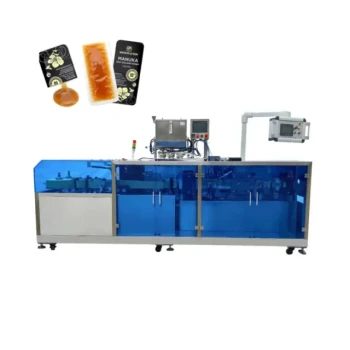
- Filling heads and nozzles
- Internal agitators and other product-contact parts
Seals and gaskets should also be selected for food-contact use and compatibility with the operating temperature, cleaning process, and honey-handling environment.
Moisture-control features
The system should include:
- Airtight or hermetically sealed tank closures
- Controlled or desiccated air vents where ventilation is necessary
- Sealed transfer connections
- Filling arrangements that minimize open exposure
- Protection against humid air entering during pumping or dispensing
These features help preserve honey’s low-water-activity condition and reduce fermentation risk.
Flow and mechanical capacity
Specify equipment according to actual product behavior, including:
- Moisture content and water activity
- Viscosity and specific gravity
- Crystallization tendency
- Required transfer distance and elevation
- Desired filling accuracy and production rate
- Pump torque and pressure requirements
- Need for controlled heating or jacketed vessels
Standard honey may have a specific gravity of approximately 1.423 at 17% moisture and can impose substantial loads on pumps, drives, tanks, and structural supports.
Understanding the Trade-offs
Corrosion resistance versus purchase cost
High-grade stainless steel and hygienic construction generally cost more than basic metal equipment. That initial premium must be weighed against reduced corrosion risk, lower contamination exposure, longer service life, and fewer interruptions for repair or replacement.
For commercial distribution, the least expensive purchase price is not necessarily the lowest total cost of ownership.
Sealing versus operational accessibility
More effective sealing protects honey from humidity, but it can make inspection, cleaning, and maintenance more demanding. The design should balance airtight operation with practical access to tanks, valves, filters, and filling heads.
A system that is well sealed but difficult to clean can create a different food-safety problem.
Heating versus quality preservation
Heating can reduce viscosity and improve filling consistency, particularly with crystallized honey. Excessive or poorly controlled heat, however, can compromise heat-sensitive enzymes and diminish the product characteristics that many buyers expect from natural honey.
Choose equipment with controlled thermal management rather than treating heat as a substitute for correct pump, nozzle, and line sizing.
Standardization versus product flexibility
A filling line optimized for fluid Fireweed honey may not handle rapidly granulating Manuka honey effectively. Conversely, a heavy-duty heated and piston-based system may be more capability than necessary for a processor handling only liquid varieties.
Wholesalers, resellers, and beekeepers should match the specification to the current product range while considering likely future varieties and formats.
Making the Right Choice for Your Goal
The best procurement decision begins with the honey profile, not simply the required tank volume or filling speed.
- If your primary focus is corrosion protection and food safety: Specify high-grade, food-grade, corrosion-resistant stainless steel across every product-contact surface, including valves, seals, pumps, and nozzles.
- If your primary focus is long-term bulk storage: Prioritize hermetic tank closures, controlled venting, and sealed transfer connections to limit moisture absorption.
- If your primary focus is accurate filling: Select high-torque transfer equipment with matched nozzles, pressure regulation, and temperature control for the honey’s actual viscosity.
- If your primary focus is handling multiple honey varieties: Choose modular or adaptable systems that can accommodate both liquid honey and rapidly crystallizing, paste-like products.
- If your primary focus is reliable wholesale fulfillment: Work with a supplier able to coordinate the full equipment package, technical documentation, responsive service, and efficient delivery rather than sourcing isolated components.
When acidity and osmotic behavior are treated as core design parameters, honey storage and filling hardware becomes safer, more durable, and more dependable in commercial operation.
Summary Table:
| Property | Influence on Equipment | Key Specification |
|---|---|---|
| Acidity (pH 3.2–4.5) | Corrosion and metal leaching risk | Food-grade, corrosion-resistant stainless steel for all wetted parts |
| Hygroscopicity | Moisture absorption and fermentation risk | Airtight seals, controlled venting, moisture-barrier systems |
| High viscosity | Flow resistance and filling challenges | High-torque pumps, precision nozzles, temperature control |
Ensure your commercial honey storage and filling equipment meets the demands of acidity and osmotic behavior. HONESTBEE offers a comprehensive range of hygienic, corrosion-resistant tanks, pumps, and filling machines tailored for beekeepers, distributors, and wholesalers. Benefit from our one-stop sourcing, OEM/ODM support, and rapid delivery. Contact us today to discuss your requirements and secure reliable, efficient equipment for your business.
Related Products
- Commercial Rotary Honey Filling Machine for Production
- Small Honey Filling Machine Sachet Packing Equipment Single Nozzle
- Double Nozzle Small Honey Filling Machine Honey Sachet Packing Packaging Equipment
- Automatic Honey Filling and Filtering Machine for Beekeeping Bottle Filling
- Precision Durable Efficient HONESTBEE Rotary Honey Filling Machine
People Also Ask
- What role do commercial honey filling machines play in honey distribution? Scaling Efficiency and Quality Control
- What technical support do commercial-grade filling machines provide? Convert Honey NTFPs into Marketable Commodities
- What is the significance of specialized honey filling equipment? Scaling from Beekeeping to Commercial Success
- Why is professional honey filling machinery critical for honey production? Scale Your Apiary's Profit & Efficiency
- Why is high-capacity honey filling machinery necessary for Giant Honey Bees? Solve the Apis dorsata Volume Crisis