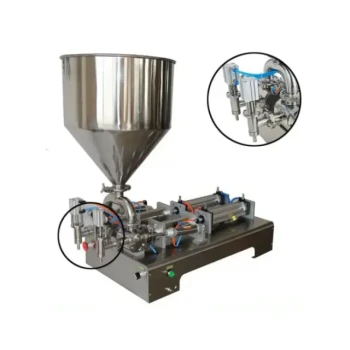
Commercial honey filling machines serve as the critical infrastructure connecting raw apiary production to the consumer market. They function primarily to automate high-efficiency, high-precision quantitative filling, ensuring that distributors can meet large-scale capacity demands while minimizing product overflow and waste.
By enforcing strict volume controls and standardized operations, these machines transform honey from a raw agricultural ingredient into a consistent, "retail-ready" commodity capable of entering professional supply chains.
Driving Operational Efficiency
The primary role of filling machinery is to bridge the gap between apiary output and market demand through rigorous process control.
Precise Quantitative Control
Manual filling is prone to variance. Commercial machines utilize high-precision metering to ensure exact filling volumes.
This accuracy is essential for minimizing product overflow and waste, directly preserving the profit margin on every unit produced.
Meeting Large-Scale Supply Demands
To transition from small-scale sales to mass distribution, throughput is key.
High levels of automation allow distributors to process bulk honey rapidly, ensuring a smooth flow of products to the consumer market without bottlenecks.
Improving Economic Viability
Automating the filling process significantly increases labor productivity and total output.
By reducing the unit production cost per kilogram, these machines help producers overcome the tight profit margins often associated with manual or small-scale operations.
Ensuring Quality and Compliance
Beyond speed, these machines play a vital role in maintaining the integrity of the honey as a food product.
Minimizing Contamination Risks
Commercial fillers provide a sterile environment that is difficult to replicate manually.
By reducing human contact, they mitigate the risk of secondary contamination from handling, meeting strict food safety regulations required by modern retail markets.
Preserving Sensory Characteristics
Honey is hygroscopic (absorbs moisture) and sensitive to processing.
Advanced filling machines utilize hermetic sealing technologies to prevent moisture absorption and preserve the honey’s natural color, crystallinity, and sensory profile.
Regulatory Compliance
Automated filling ensures that final products meet the traceability and hygiene standards required by food, pharmaceutical, and cosmetic industries.
This compliance is critical for maintaining the classification of honey as a minimally processed natural good while still ensuring safety.
Strategic Market Positioning
The machinery used in the distribution chain directly impacts how the product is perceived and sold.
Standardization for Branding
Consistency builds trust. Automated machines ensure that every jar in a batch has identical weight and appearance.
This uniformity allows apiaries to convert bulk honey into branded commodities, supporting a professional image necessary for retail shelves.
Versatility in Packaging
Market demands change rapidly. Many modern machines can adapt to various container specifications by changing filling molds.
This flexibility allows producers to quickly pivot between different packaging volumes or materials to suit specific retail trends.
Understanding the Trade-offs
While automation offers significant advantages, it introduces specific operational challenges that must be managed.
Maintenance and Calibration Demands
High-precision equipment requires rigorous maintenance. If the metering systems are not regularly calibrated, the "precision" advantage is lost, leading to regulatory fines for under-filling or financial loss from over-filling.
Complexity of Changeovers
While machines offer versatility, switching between different packaging formats (e.g., glass jars vs. squeeze bottles) requires downtime for mold changes and cleaning.
Inefficient changeover processes can eat into the efficiency gains the machine provides, making production planning critical.
Making the Right Choice for Your Goal
To maximize the value of a commercial honey filling machine, align the equipment capabilities with your specific business objective.
- If your primary focus is Profit Margins: Prioritize machines with advanced anti-overflow systems and high-speed metering to minimize unit costs and waste.
- If your primary focus is Premium Brand Positioning: Select equipment that emphasizes hermetic sealing and gentle processing to preserve the honey's natural sensory traits and extend shelf life.
- If your primary focus is Market Expansion: Choose versatile machinery with interchangeable molds to satisfy diverse packaging requirements for export and domestic retail channels.
The right filling technology does not just package your product; it secures the consistency and safety required to scale your business.
Summary Table:
| Key Role | Primary Benefit | Strategic Impact |
|---|---|---|
| Quantitative Control | Minimizes product overflow and waste | Protects profit margins per unit |
| High-Efficiency Scaling | Meets large-scale market demands | Eliminates bottlenecks in the supply chain |
| Quality Assurance | Reduces secondary contamination risk | Ensures food safety and regulatory compliance |
| Brand Standardization | Consistent weight and appearance | Enhances professional branding and consumer trust |
| Packaging Versatility | Quick adaptation to various containers | Allows rapid pivoting to market trends |
Scale Your Apiary Operations with HONESTBEE
Transitioning from raw production to professional retail requires more than just high-quality honey—it requires precision infrastructure. HONESTBEE specializes in empowering commercial apiaries and distributors with the tools needed to dominate the market.
From high-precision honey-filling machines and specialized hive-making hardware to a full spectrum of beekeeping tools and consumables, we provide the comprehensive wholesale solutions your business needs to reduce unit costs and preserve product integrity.
Ready to optimize your production chain? Contact us today to discover how our tailored machinery and equipment can drive your operational efficiency and global market reach.
References
- Usif Abulfat Humbatov. ABOUT REGULATION OF BEE-KEEPING FARM PRICES BY THE STATE. DOI: 10.15863/tas.2015.07.27.18
This article is also based on technical information from HonestBee Knowledge Base .
Related Products
- Commercial Rotary Honey Filling Machine for Production
- Precision Durable Efficient HONESTBEE Rotary Honey Filling Machine
- Fully Automatic Honey Filling Packaging Machine for Processing Line
- Economy Small Honey Filling Machine Honey Bottle Filler Packaging Machine
- Automatic Honey Filling and Filtering Machine for Beekeeping Bottle Filling
People Also Ask
- What technical support do commercial-grade filling machines provide? Convert Honey NTFPs into Marketable Commodities
- What is the significance of specialized honey filling equipment? Scaling from Beekeeping to Commercial Success
- Why is professional honey filling machinery critical for honey production? Scale Your Apiary's Profit & Efficiency
- Why is high-capacity honey filling machinery necessary for Giant Honey Bees? Solve the Apis dorsata Volume Crisis
- How does honey-filling machinery enhance the market value of stingless bee honey? Scale Your Premium Honey Brand