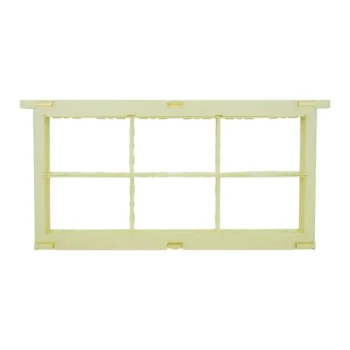
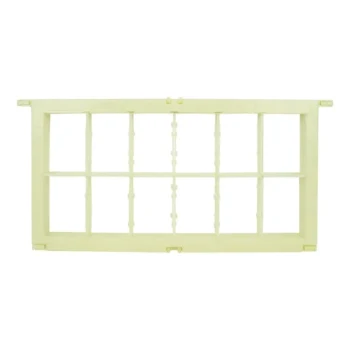
A graduated grid frame enhances scientific accuracy by superimposing a standardized coordinate system over the naturally irregular structure of a honeycomb. Instead of relying on subjective visual estimation, this tool divides the frame into precise, measurable units—such as square inches or centimeters. This allows researchers to apply specific conversion factors, such as approximately 26 cells per square inch, to derive an exact quantitative count of the capped brood population.
By transforming organic, irregular brood patterns into standardized area data, the graduated grid frame eliminates human estimation error. It provides an objective, mathematical baseline essential for rigorously assessing colony strength and queen performance.
The Mechanics of Quantitative Measurement
Standardizing Irregular Shapes
Natural brood patterns are rarely uniform; they are often patchy or dispersed across the frame. A graduated grid divides these complex biological shapes into manageable, standard units. This allows the observer to tally the total area occupied by brood with high precision, regardless of the pattern's complexity.
Applying Precise Conversion Factors
Measuring the area is only the first step; the scientific value lies in knowing the specific population count. By applying a consistent conversion factor to the measured area, researchers can calculate the total number of capped broods. For example, using the standard metric of approximately 26 brood cells per square inch converts raw area data into a definitive population census.
Creating an Objective Baseline
Without a grid, assessments of colony status are often based on "gut feel" or visual approximations, which vary wildly between observers. The grid forces a quantitative approach, ensuring that data regarding queen oviposition (egg-laying) and overall colony strength is reproducible and verifiable.
Enhancing Research Capabilities
A Platform for Hygienic Studies
Capped brood frames serve as the primary observation platform for studying social immunity and hygienic behavior. Researchers introduce damaged larvae to specific sections of the comb to see how effectively worker bees detect and remove them.
Validating Experimental Observations
The integrity of these studies relies entirely on knowing exactly how much brood was present before and after the cleaning task. The graduated grid ensures that the biological samples (the brood) are quantified accurately. This precision allows researchers to correlate specific management protocols with actual changes in the colony's ability to maintain hive hygiene.
Understanding the Constraints
Reliance on Average Cell Density
While superior to estimation, this method relies on the accuracy of the conversion factor (e.g., 26 cells/sq in). It assumes a uniform cell density across the comb. Significant deviations in natural comb construction could introduce slight variances in the final calculated count.
The Trade-off of Time vs. Precision
Using a graduated grid requires more time and effort than a quick visual inspection. It transforms a rapid check-up into a data collection task. This level of detail is necessary for scientific accuracy but may be overkill for casual beekeeping where general trends suffice.
Making the Right Choice for Your Goal
To determine if a graduated grid frame is the right tool for your current project, consider your data requirements:
- If your primary focus is Scientific Research: You must use a graduated grid to ensure your data on hygienic behavior and colony strength is reproducible and statistically valid.
- If your primary focus is General Hive Management: You can likely rely on visual estimation, as you may not need the granular precision required to track exact oviposition rates.
The graduated grid frame ultimately bridges the gap between biological observation and hard data, turning a beehive into a measurable scientific instrument.
Summary Table:
| Feature | Visual Estimation | Graduated Grid Frame |
|---|---|---|
| Data Type | Subjective / Qualitative | Objective / Quantitative |
| Accuracy | Low (High human error) | High (Standardized units) |
| Measurement Basis | "Gut feel" approximation | Math-based (e.g., 26 cells/sq in) |
| Primary Use Case | Casual hive management | Scientific research & hygienic studies |
| Reproducibility | Poor (Varies by observer) | Excellent (Verifiable baseline) |
Precision Tools for Professional Apiaries
Maximize your research accuracy and colony productivity with professional-grade equipment from HONESTBEE. As a premier wholesale partner for commercial apiaries and distributors, we provide the specialized tools necessary for rigorous data collection and hive management.
Our value to you:
- Comprehensive Wholesale Catalog: From graduated measurement tools to advanced hive-making and honey-filling machinery.
- Industry-Leading Quality: Durable hardware and essential consumables designed for the rigors of commercial beekeeping.
- Custom Solutions: We cater to your specific operational scale, ensuring your business has the competitive edge.
Ready to elevate your beekeeping operations? Contact us today to explore our full spectrum of tools and machinery!
References
- Mohamed Abdel-Rahman, H. Abou El-Enain. FIELD EVALUATION OF SOME NATURAL MATERIALS AGAINST CHALKBROOD DISEASE INFECTING HONEYBEE COLONIES. DOI: 10.21608/jppp.2009.217224
This article is also based on technical information from HonestBee Knowledge Base .
Related Products
- Heavy Duty Castellated Iron Frame Spacer for Honey Supers
- HONESTBEE Wired and Assembled Wooden Bee Frames Foundation for a Thriving Hive
- HONESTBEE Durable Frame Wiring Board with Integrated Tensioner
- Assembled Wooden Bee Frames with Beeswax Foundation Ready to Use by HONESTBEE
- Assembled Wooden Bee Frames with Plastic Foundation for Durability and Convenience by HONESTBEE
People Also Ask
- What are honey super frames and what foundation options are available? Choose the Best Support for Your Bees
- What are the reasons and drawbacks of using nine frames in a ten-frame honey super? Boost Extraction Speed Today
- What are honey super frames and how many are needed per box? A Beekeeper's Essential Guide
- What are honey super frames and their foundation options? Choose the Best Support for Your Hive's Honey Production
- Why might a beekeeper use fewer than the standard number of frames in a honey super? Boost Extraction Efficiency