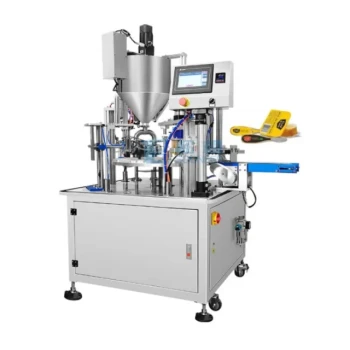
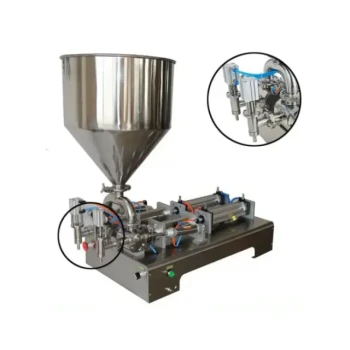
A honey filling machine operates primarily through structured volumetric displacement. It utilizes a combination of gravity, air pressure, and mechanical actuation to draw honey from a central hopper and force a precise amount through a nozzle, specifically adjusting for the fluid's natural resistance and viscosity.
The core operational goal is to overcome honey's high viscosity while maintaining dosage accuracy. By balancing hydraulic pressure and mechanical force, the system draws product into a chamber and dispenses it in a synchronized cycle, often utilizing heat to improve fluidity and prevent air bubbles.
Core Mechanical Principles
Piston-Driven Volumetric Filling
This mechanism acts as the industry standard for precision with viscous fluids. The machine draws a pre-determined volume of honey into a cylinder using a retraction stroke.
Once the cylinder is full, the piston reverses, forcing the honey out through the nozzle. This method is highly effective for thick honey because it relies on positive displacement rather than passive flow.
Gravity and Pressure Assistance
Simpler systems rely on the Gravity Filling Principle, using the weight of the honey to facilitate flow from a hopper into the container.
To assist this passive flow, many machines introduce air pressure. This pressure helps force the thick liquid through the system, ensuring the hopper empties consistent regardless of the remaining volume.
Pump-Based Regulation
High-speed operations often utilize a rotary or gear pump system. Instead of a discrete piston stroke, a pump provides a continuous regulated flow.
Sensors and valves control the duration of the pump's activation to determine the fill volume. This allows for rapid, consistent filling but requires precise calibration to prevent overfilling.
Essential System Components
The Hopper and Transfer System
The process begins at the hopper, a reservoir that holds the bulk honey supply. From here, the honey moves into a barrel or hollow tube that conveys the product toward the dispensing point.
The Actuating Mechanism
This serves as the machine's control center. It dictates the timing and volume of each filling cycle, ensuring that the piston or pump engages for the exact duration required to fill the specific container size.
The Nozzle and Cut-off
The nozzle is the final pathway for the honey entering the jar. Advanced nozzles utilize a "gate and hold" or specialized cut-off mechanism to prevent dripping, which is a common issue with sticky substances.
Optimizing Fluidity
Thermal Regulation
Because honey thickens significantly when cool, many machines incorporate an optional heating mechanism.
By gently warming the honey within the hopper or transfer tubes, the machine reduces the fluid's viscosity. This facilitates a smoother flow, reduces strain on the pump or piston, and helps eliminate trapped air bubbles for a cleaner look.
Understanding Operational Trade-offs
Precision vs. Speed
Piston fillers offer the highest level of volumetric accuracy, ensuring every jar has the exact same weight. However, the mechanical action of drawing and plunging makes them slower than continuous pump systems.
Viscosity vs. Complexity
Gravity fillers are cost-effective and mechanically simple, making them easy to maintain. However, they struggle with raw, thick honey and often require the product to be heated significantly to flow, which can degrade the quality of raw honey.
Automation vs. Flexibility
Pump-based systems are ideal for fully automated lines where speed is the priority. The downside is a higher initial cost and a more complex cleaning process compared to the simpler disassembly of a piston filler.
Selecting the Right Mechanism for Your Goal
The choice of operating principle should be dictated by your production volume and the viscosity of your specific honey blend.
- If your primary focus is boutique quality and accuracy: Prioritize a piston-driven system, as it handles thick, raw honey with high precision without requiring excessive heating.
- If your primary focus is high-volume industrial output: Prioritize a pump-based automated system, which sacrifices a marginal amount of precision for significantly faster throughput and consistency.
- If your primary focus is budget and simplicity: Prioritize a gravity-based system, but be prepared to heat your honey to ensure it flows through the nozzle effectively.
Success in honey packaging comes from matching the machine's mechanical force to the natural resistance of your product.
Summary Table:
| Mechanism Type | Operating Principle | Best For | Key Advantage |
|---|---|---|---|
| Piston-Driven | Positive Displacement | Thick/Raw Honey | High Volumetric Accuracy |
| Pump-Based | Continuous Regulated Flow | High-Volume Lines | Maximum Throughput Speed |
| Gravity-Fed | Passive Weight Flow | Budget Operations | Mechanical Simplicity |
| Thermal-Assisted | Heat-Reduced Viscosity | Cold/High-Density Honey | Improved Flow & Less Bubbles |
Maximize Your Apiary's Efficiency with HONESTBEE
Transition from manual labor to professional precision. HONESTBEE provides commercial apiaries and distributors with industrial-grade honey-filling machines and specialized beekeeping hardware designed to handle the toughest viscosities. Whether you need a single precision piston filler or a fully automated production line, we offer the machinery, tools, and consumables to scale your operations.
Ready to upgrade your production? Contact our specialists today to find the perfect equipment for your business goals.
Related Products
- Precision Durable Efficient HONESTBEE Rotary Honey Filling Machine
- Semi Automatic Small Honey Bottle Filling Machine Honey Filler
- Economy Small Honey Filling Machine Honey Bottle Filler Packaging Machine
- Fully Automatic Honey Filling Packaging Machine for Processing Line
- Commercial Rotary Honey Filling Machine for Production
People Also Ask
- What is a key feature of the new generation of the honey filling machine? The Advanced Electronic Control Unit
- How do honey filling and processing machines aid native bee product conservation? Boost Value with HONESTBEE Technology
- What are the common types of bottling machines used for honey? Choosing the Right Solution for Your Apiary
- How do high-precision honey filling machines ensure quality? Optimize Your Commercial Production with HONESTBEE
- How do honey filling machines work? Achieve Precision & Speed for Your Apiary