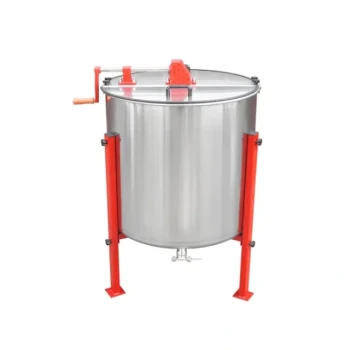
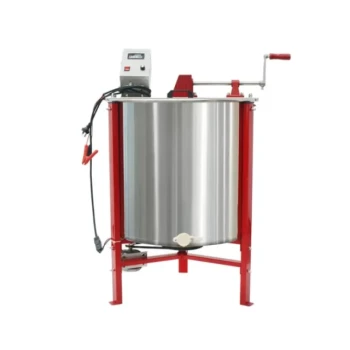
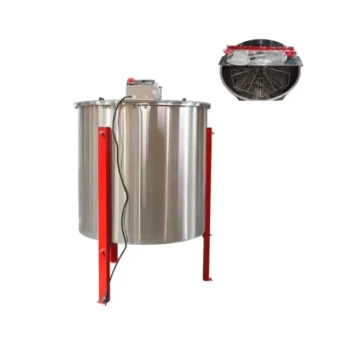
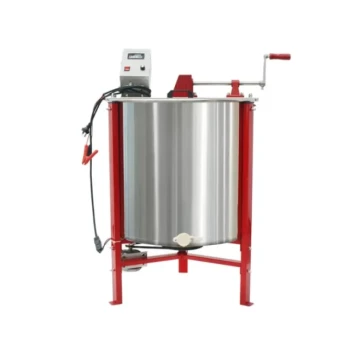
A radial honey extractor works in harmony with the honeycomb’s inherent architecture. Rather than relying solely on brute force, it aligns the mechanical action of the machine with the specific angle at which bees construct their cells. By orienting frames like spokes on a wheel with the top bar facing outward, the extractor utilizes centrifugal force to slide the honey along its natural structural path.
Core Takeaway Honeycomb cells are not perfectly horizontal; bees build them with a specific 10 to 14-degree upward slope to prevent nectar from dripping. Radial extractors leverage this by positioning frames so that centrifugal force pushes honey "up" this slope and out of the cell, allowing for the simultaneous emptying of both sides of the comb without the need to flip the frames.
The Geometry of the Honeycomb
The Natural Slope
To understand the extractor, you must first understand the comb. Bees do not build cells at a 90-degree angle to the vertical center rib.
Retaining the Nectar
Instead, bees construct cells with a distinct upward slope of 10 to 14 degrees. This natural tilt ensures that uncapped nectar stays inside the cell and does not drip out due to gravity before it is cured into honey.
How Radial Physics Aligns with Nature
Orientation is Critical
In a radial extractor, frames are positioned vertically, arranged like the spokes of a wheel. Crucially, the top bar of the frame faces the outer wall (the rim), while the bottom bar faces the center (the hub).
Working With the Angle
Because the cells slope "up" toward the top bar, positioning the top bar outwardly aligns the cell openings with the direction of the centrifugal force.
The Path of Least Resistance
As the drum spins, the centrifugal force pushes the honey outward. Because of the frame alignment, this force acts parallel to the 10-14 degree slope, effectively sliding the honey "uphill" and out of the unsealed cell mouth.
The Efficiency Advantage
Simultaneous Extraction
Because the force pulls honey out of the cells toward the drum wall, and both sides of the frame slope upward toward the top bar, honey is extracted from both sides of the comb at the same time.
Eliminating Manual Labor
Unlike tangential models, which require the operator to stop the machine and flip the frames halfway through, radial extractors complete the job in a single uninterrupted cycle.
Understanding the Trade-offs
The Risk of Collapse
While efficient, the forces involved are significant. If the rotation speed is too high initially, the pressure of the honey pushing against the wax can deform or collapse the cell walls.
Importance of Speed Control
To mitigate damage, the process usually begins with a slow rotation to remove the bulk of the heavy honey. The speed is then gradually increased to sling out the remaining honey without destroying the comb structure.
Making the Right Choice for Your Goal
Whether you are a hobbyist or a commercial operator, understanding the interaction between the machine and the comb helps you optimize your harvest.
- If your primary focus is Efficiency and Speed: Choose a radial extractor, as the simultaneous extraction of both sides eliminates the downtime required to flip frames.
- If your primary focus is Comb Preservation: Utilize a radial extractor with variable speed control, starting slowly to preserve the delicate wax structure for reuse by the colony.
By aligning mechanical force with biological design, radial extraction maximizes output while respecting the integrity of the bees' work.
Summary Table:
| Feature | Radial Extractor Impact on Honeycomb |
|---|---|
| Frame Orientation | Top bar faces outward like wheel spokes |
| Biological Alignment | Matches the 10-14° upward cell slope |
| Extraction Method | Both sides emptied simultaneously |
| Manual Labor | No need to flip frames during the cycle |
| Comb Safety | Preserved via gradual speed acceleration |
Maximize Your Honey Harvest with HONESTBEE
At HONESTBEE, we understand that for commercial apiaries and distributors, efficiency and equipment reliability are paramount. Our comprehensive wholesale offering includes high-performance radial honey extractors, specialized hive-making machines, and honey-filling systems designed to respect the integrity of your bees' work while maximizing output.
Whether you are scaling up your honey production or looking for the latest in beekeeping technology and machinery, our team provides the full spectrum of tools and industry consumables to help your business thrive. Let us support your growth with our premium hardware and honey-themed merchandise.
Contact HONESTBEE Today to Explore Our Wholesale Catalog
Related Products
- 24 Frame Honey Extractor Commercial Radial Honey Frame Extraction Machine
- Stainless Steel Manual 8 Frame Radial Honey Extractor Machine for Beehives
- 6 Frame Manual Stainless Steel Honey Extractor Beekeeping Equipment
- HONESTBEE 8 Frame Electric and Manual Three Use Honey Extractor
- Electric 4 Frame Tangential Honey Extractor
People Also Ask
- How do modern honey extraction machines improve harvest efficiency? Boost Your Yield with Radial Technology
- Why must the head of the honey comb be placed near the center axis? Protect Your Comb During Radial Extraction
- Why is the width of iron rings varied for radial honey extractor tilt? Optimize Your Harvest with Precise Engineering
- What are the operational differences between radial and tangential honey extractors? Maximize Your Harvest Efficiency
- What are the characteristics of radial honey extractors? Boost Efficiency in Commercial Honey Production