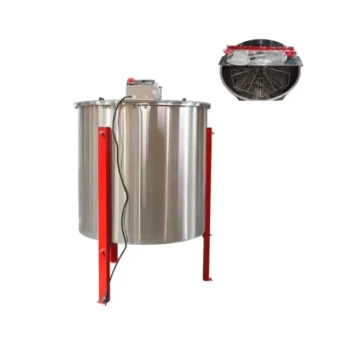
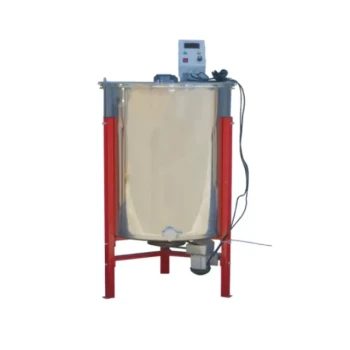
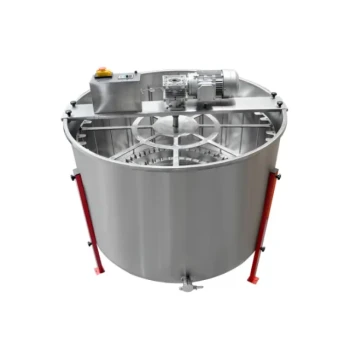
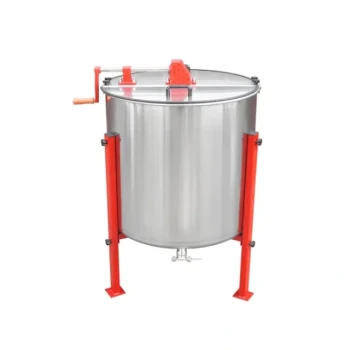
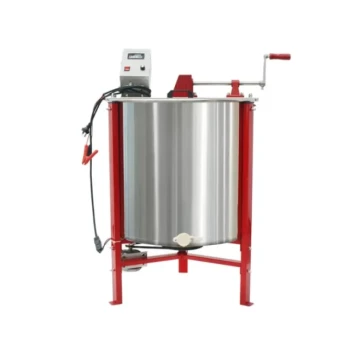
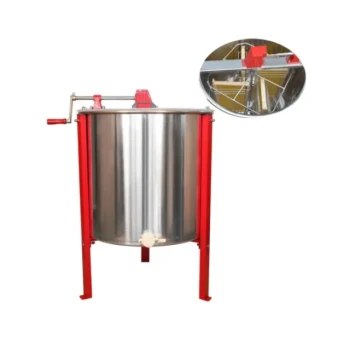
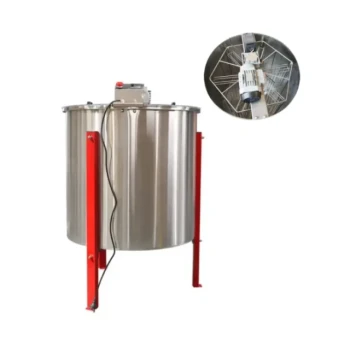
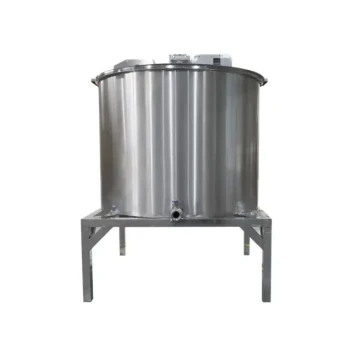
Centrifugal force is the fundamental principle behind a spin honey extractor's operation.
A spin extractor functions by holding honeycomb frames in a central basket within a drum; as the basket rotates at high speed, the physical force overcomes the honey's viscosity and surface tension, flinging the liquid out of the wax cells and onto the inner walls of the container.
Core Takeaway Unlike pressing methods that destroy the honeycomb to retrieve the harvest, a spin extractor separates liquid honey while keeping the wax frames intact. This allows the empty frames to be returned to the hive, saving bees the significant energy cost of rebuilding the comb.
The Operational Workflow
The spin extraction process is a precise mechanical sequence designed to maximize yield while minimizing damage to the equipment and the hive resources.
Phase 1: Preparation and Uncapping
Before a frame can be spun, the honey must be exposed. Bees seal filled cells with a thin layer of wax known as "cappings."
A spin extractor cannot remove honey from sealed cells. Therefore, the operator must first slice these caps off using a heated uncapping knife. This creates an open pathway for the honey to exit during the spin cycle.
Phase 2: Loading and Balancing
The uncapped frames are placed into the extractor's central basket. This step requires careful attention to weight distribution.
The load must be balanced. Similar to a washing machine, an unbalanced load in a honey extractor can cause severe wobbling. This vibration can damage the extractor's motor, the drum, or even the frames themselves.
Phase 3: The Spin Cycle
Once loaded, the basket is rotated—either manually via a hand crank or by an electric motor.
As rotational speed increases, centrifugal force pushes the honey out of the cells. The honey strikes the inner wall of the drum, runs down the sides, and pools at the bottom. From there, it is drained through a tap or removed via a pump.
Radial vs. Tangential Extraction
There are two primary orientations for the frames inside the drum:
- Radial Extractors: Frames are arranged like the spokes of a wheel (top bars facing the wall). This allows honey to be extracted from both sides simultaneously without stopping to flip the frames. It is generally faster and more efficient.
- Tangential Extractors: One side of the frame faces the wall. The operator must spin to empty one side, stop, flip the frame, and then spin the other side.
Understanding the Trade-offs
While spin extractors are the standard for efficiency, they are not universally applicable to all beekeeping setups.
Benefit: Comb Preservation
The most significant advantage is reusability. Because the comb structure remains intact, bees can immediately begin refilling it with nectar. This results in faster subsequent honey production compared to methods where bees must rebuild wax from scratch.
Limitation: Structural Requirements
Spin extractors exert significant physical stress on the wax. This method is generally unsuitable for natural comb that lacks reinforcement.
Frames without wire or plastic foundation support often break apart under the intensity of the centrifugal force. For these delicate natural combs, the crushing and straining method is often the only viable option.
Variable: Temperature Sensitivity
Honey viscosity changes with temperature. While press extraction can work effectively at cooler temperatures (around 15°C), spin extraction typically requires warmer ambient temperatures to ensure the honey flows freely out of the cells during the spin.
Making the Right Choice for Your Goal
Selecting the right extraction method depends on your equipment and your long-term goals for the apiary.
- If your primary focus is maximum honey production: Use a motorized radial extractor. This preserves the drawn comb, allowing bees to focus entirely on honey production rather than wax secretion.
- If your primary focus is low-cost or natural beekeeping: Use the crush-and-strain method. This is ideal for foundationless frames that cannot withstand the force of a spinner, though it requires bees to rebuild comb next season.
Ultimately, the spin extractor is an investment in efficiency, trading the initial cost of machinery for the long-term benefit of a reusable comb.
Summary Table:
| Feature | Radial Extractor | Tangential Extractor | Crush & Strain Method |
|---|---|---|---|
| Mechanism | Centrifugal (Spoke layout) | Centrifugal (Flat layout) | Mechanical Pressing |
| Comb Preservation | Excellent (Both sides at once) | Good (Requires flipping) | None (Comb destroyed) |
| Efficiency | High (Best for commercial) | Moderate (Labor intensive) | Low (Slow process) |
| Ideal For | Large scale apiaries | Hobbyist beekeepers | Foundationless/Natural comb |
| Honey Flow | Temperature dependent | Temperature dependent | Works at cooler temps |
Maximize Your Honey Yield with HONESTBEE
Efficiency is the heartbeat of a successful commercial apiary. At HONESTBEE, we specialize in empowering commercial beekeepers and distributors with the high-performance machinery needed to scale operations. From precision-engineered radial extractors and honey-filling machines to durable hive-making equipment, our comprehensive wholesale portfolio ensures your business stays productive and profitable.
Don't let manual processes slow your growth. Whether you need a full spectrum of beekeeping tools or essential industry consumables, our experts are ready to provide the hardware and support you need to succeed.
Contact HONESTBEE today to upgrade your extraction workflow!
Related Products
- Stainless Steel 3 Frame Manual Honey Extractor Spinner for Bee Honey Extraction
- Commercial Electric 12 Frame Honey Extractor Spinner Motorized Honey Extractor
- 8-Frame Electric Self-Reversing Honey Extractor Spinner for Commercial Honey Extraction Equipment
- 2 Frame Stainless Steel Manual Honey Spinner Extractor for Beekeeping
- Electric 8 Frame Honey Spinner Extractor Equipment for Beekeeping
People Also Ask
- Which type of honey extractor is generally more durable? Focus on Material & Build Quality for Longevity
- What are the disadvantages of a manual honey extractor? Overcome Efficiency Bottlenecks in Your Apiary
- What is a manual honey extractor? The Essential Guide to Cost-Effective Beekeeping for Beginners
- Why are manual extractors popular among beginner beekeepers? A Guide to Starting Simple & Saving Money
- What are the primary advantages of utilizing a manual honey extractor? Cost-Effective & Gentle Harvesting