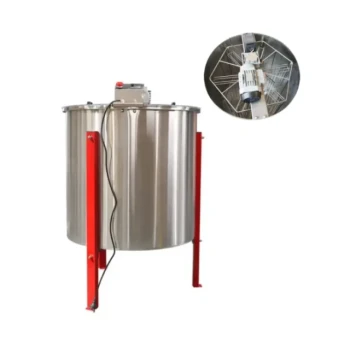
The moment of inertia acts as a precise, real-time fuel gauge for the extraction process. By continuously calculating the resistance to rotation, the equipment’s control system can mathematically determine how much honey has left the combs and how much remains, allowing it to adapt the cycle automatically rather than relying on fixed, estimated timers.
By treating the moment of inertia as a dynamic variable, extraction equipment can "feel" the weight of the honey leaving the comb. This transforms the machine from a simple spinning device into an intelligent system that self-regulates to save energy and ensure maximum yield.
The Dynamics of Changing Mass
Tracking Real-Time Mass Reduction
In honey extraction, the moment of inertia is not a static figure. As honey is spun out of the frames, the total rotating mass decreases, altering the physics of the spin.
The control system monitors this parameter to measure extraction progress. It recognizes that a decrease in inertia correlates directly to the volume of honey removed.
Establishing the Baseline
At the start of the cycle, the equipment calculates the initial moment of inertia. This provides an accurate estimation of the total honey volume loaded into the machine.
This baseline allows the system to tailor the intensity and duration of the cycle to the specific load, rather than running a generic program.
Automating Process Decisions
Identifying Efficient Reversal Points
For extractors that utilize reversing cycles, timing is critical. The system uses inertia data to determine the exact moment when the first side is sufficiently extracted.
It then triggers the reversal point automatically. This ensures the frames are flipped or the motor reverses at the optimal time for complete extraction.
Preventing Over-Running
A common inefficiency in traditional extraction is running the machine longer than necessary. Once the moment of inertia stabilizes, the system knows the combs are empty.
It triggers an automatic shutdown immediately. This prevents the energy waste associated with spinning empty dry combs.
Handling Variable Viscosity
Adapting to Honey Consistency
Honey viscosity changes based on temperature and floral source. Thicker honey exits the comb more slowly, keeping the moment of inertia higher for longer.
Because the system reacts to the physical weight (inertia) rather than a clock, it automatically extends the cycle for thick honey and shortens it for thin honey. This ensures consistent results without manual reprogramming.
Understanding the Trade-offs
Increased Technical Complexity
Implementing inertia calculation requires sophisticated sensors and a more complex control unit than standard extractors. This creates more potential points of failure than a simple mechanical timer.
Sensitivity to Loading
The accuracy of inertia calculation relies on the physics of rotation. If frames are loaded unevenly, severe imbalances could potentially generate noise in the data, requiring the operator to be diligent about load distribution.
Making the Right Choice for Your Goal
The value of inertia-based extraction depends on the scale and variety of your operation.
- If your primary focus is energy efficiency: This technology offers the highest return by ensuring the motor never runs a second longer than required to empty the combs.
- If your primary focus is consistent quality across different harvests: Inertia tracking provides the best solution, as it automatically adjusts to the varying viscosities of different honey types without manual guesswork.
By allowing the physics of the extraction to drive the controls, you ensure that every cycle is mathematically optimized for the specific honey in the barrel.
Summary Table:
| Feature | Traditional Extraction | Inertia-Based Extraction |
|---|---|---|
| Cycle Timing | Fixed/Manual Timers | Dynamic (Self-Regulating) |
| Mass Tracking | None (Estimated) | Real-time Mass Monitoring |
| Viscosity Handling | Manual Adjustment | Automatic Adaptation |
| Energy Efficiency | Low (Potential Over-running) | High (Auto-shutdown) |
| System Intelligence | Static Mechanical | Sophisticated Sensor-Driven |
Maximize Your Honey Yield with Intelligent Extraction Solutions
Efficiency in a commercial apiary starts with the right technology. HONESTBEE specializes in providing advanced honey-filling machines, hive-making equipment, and a full spectrum of professional beekeeping tools designed for distributors and large-scale operations. Our inertia-driven extraction technologies ensure that your equipment never wastes a second of power, automatically adjusting to honey viscosity for a perfect harvest every time.
Ready to upgrade your apiary’s performance? Contact us today to explore our comprehensive wholesale offerings and discover how our specialized machinery can streamline your production from hive to honey jar.
References
- О.М. Логунов. Aдаптивна система управління електроприводом самооборотної медогонки. DOI: 10.33216/1998-7927-2022-272-2-42-45
This article is also based on technical information from HonestBee Knowledge Base .
Related Products
- Electric 8 Frame Honey Spinner Extractor Equipment for Beekeeping
- HONESTBEE 2 Frame Manual Acrylic Honey Extractor Beekeeping Equipment
- 6 Frame Manual Stainless Steel Honey Extractor Beekeeping Equipment
- 32 Frame Commercial Electric Honey Extractor for Beekeeping and Honey Production
- HONESTBEE 72 Frame Industrial Electric Honey Extractor for Beekeeping
People Also Ask
- What are the advantages of an electric honey extractor? Boost Efficiency and Scale Your Honey Production
- What are the characteristics of electric honey extractors? Boost Your Apiary Efficiency with Automated Technology
- What are the disadvantages of using an electric honey extractor? Weighing Cost, Power, and Comb Safety
- What are the features of an electric honey extractor? Boost Your Apiary's Productivity with Motorized Efficiency
- What are the technical advantages of electric honey extractors? Maximize Yield and Protect Your Bee Colony