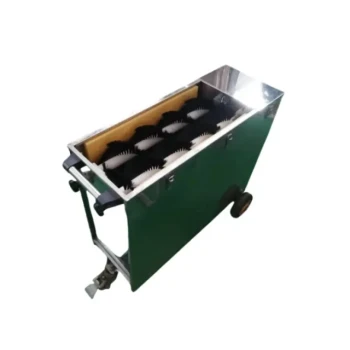
Industrial-grade mixing equipment facilitates the deep blending of bee venom dilution liquids with complex dry and viscous feed components. By mechanically forcing the integration of liquids into bases like corn flour, wheat bran, and honey, this process guarantees that the active ingredient concentration remains identical across every single gram of the final product.
The core value of industrial mixing is the elimination of variable dosage. By achieving a perfectly homogenous mixture, researchers ensure that every insect receives a precise, identical dose, which is the absolute baseline for reducing experimental error in bioassays.
The Mechanics of Uniformity
Integrating Diverse Textures
Creating an artificial insect diet requires combining ingredients with vastly different physical properties. The process involves blending low-viscosity bee venom dilution liquids with dry, absorbent powders like corn flour and wheat bran, as well as high-viscosity binders like honey.
Overcoming Physical Barriers
Simple stirring is often insufficient to penetrate the matrix of sticky or dry ingredients. Industrial-grade equipment provides the necessary mechanical force to ensure the liquid venom does not merely coat the surface of these particles but is thoroughly incorporated into the mixture.
The Impact on Experimental Accuracy
Consistent Concentration per Gram
The ultimate goal of this processing is ensuring "per-gram" consistency. Whether a sample is taken from the center, the edge, or the bottom of the mixing vessel, the concentration of active venom ingredients must be statistically identical.
Minimizing Biological Variation
In bioassays, the physiological response of the insect is the variable being measured. If the feed itself varies in potency, it introduces a confounding variable that makes the data useless.
Eliminating False Negatives and Positives
Uniform mixing ensures that survival or mortality rates are due to the venom's specific toxicity, not because one insect ate a "hot spot" of concentrated venom while another ate a portion with no venom at all.
Understanding the Risks of Improper Mixing
The Danger of Stratification
Without the consistent agitation provided by industrial equipment, liquids tend to separate from solids over time. This leads to stratification, where the top layers of feed may be diluted while the bottom layers become dangerously potent.
Data Reproducibility Issues
If a mixing process cannot be standardized, the experiment cannot be reproduced. Industrial equipment offers defined settings (speed, duration, torque) that allow other researchers to replicate the exact conditions of the diet preparation.
Ensuring Experimental Integrity
To achieve reliable data in insect toxicology or physiology studies, the preparation of the diet is just as critical as the selection of the venom itself.
- If your primary focus is precise bioassay data: Rely on industrial blending to ensure that mortality rates accurately reflect the toxicity of the specific venom concentration being tested.
- If your primary focus is large-scale feed production: Use industrial equipment to maintain quality control and ensure that the first batch produced is identical to the last.
True scientific rigor begins with the certainty that every subject is reacting to the exact same stimulus.
Summary Table:
| Feature | Manual/Simple Stirring | Industrial-Grade Mixing |
|---|---|---|
| Consistency | High risk of stratification & 'hot spots' | Uniform concentration per gram |
| Texture Integration | Poor blending of viscous & dry ingredients | Deep mechanical forcing & integration |
| Data Integrity | High experimental error; non-reproducible | Minimized biological variation; high reproducibility |
| Process Control | Variable speed and duration | Standardized settings (speed, torque, time) |
| Application | Small-scale, non-critical testing | Professional bioassays & large-scale production |
Elevate Your Beekeeping Operations with HONESTBEE
At HONESTBEE, we specialize in empowering commercial apiaries and industry distributors with the high-performance tools required for scientific precision and operational efficiency. Whether you are conducting rigorous bioassays or scaling up commercial feed production, our comprehensive wholesale portfolio has you covered.
From specialized hive-making and honey-filling machinery to industrial-grade processing equipment and essential consumables, we provide the infrastructure your business needs to thrive. Partner with us to ensure every batch of your product meets the highest standards of uniformity and quality.
Ready to scale your apiary or distribution network? Contact HONESTBEE Today to Discuss Your Wholesale Needs
References
- Karem Ghoneim, D. Emam. Toxicity and Disruptive Impacts of the Honeybee Apitoxin on Growth and Development of The Greater Wax Moth, Galleria mellonella (Lepidoptera: Pyralidae).. DOI: 10.21608/eajbsf.2019.45537
This article is also based on technical information from HonestBee Knowledge Base .
Related Products
- Full Set Beekeeping Electronic Bee Venom Collector Machine Device for Bee Venom Collecting
- Professional Hive Top Bee Feeder for Beekeeping
- Adjustable Formic and Acetic Acid Dispenser for Bee Mite Treatment
- Queen Bee Artificial Insemination Instrument Equipment for Instrumental Insemination
- Professional In-Hive Bee Feeder HONESTBEE Frame for Beekeeping
People Also Ask
- How does the glass plate integrated into a bee venom collector contribute to maintaining quality and purity?
- What is the function of specialized collection equipment in the production process of bee venom? Expert Guide
- What is the significance of using specialized bee venom collection devices in commercial beekeeping operations?
- Why are bee venom collection devices typically mounted on specialized wooden carrier boards? Maximize Yield & Purity.
- How does a dedicated bee venom collection device operate? Extract Pure Venom Safely Without Harming Your Bees