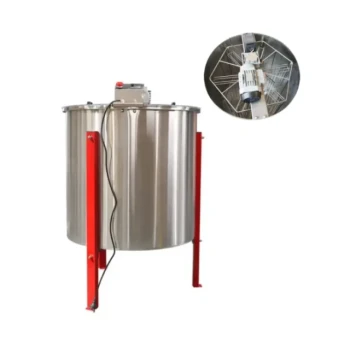
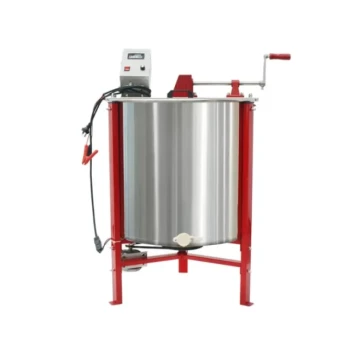
Honey extractors protect honeycombs by leveraging centrifugal force to separate liquid honey from solid wax without physical destruction. Instead of crushing or scraping the comb—which destroys the hive's infrastructure—the extractor spins the frames at high speeds, using physics to gently "flick" the honey out of the cells while leaving the delicate wax walls intact.
The Core Insight By removing honey without destroying the wax structure, an extractor allows the honeycomb to be immediately returned to the hive. This saves the bee colony the significant time and biological energy required to secrete new wax, shifting their focus directly back to honey production.
The Mechanics of Structural Preservation
The Role of Centrifugal Force
The primary mechanism of protection is the substitution of mechanical force for physical abrasion.
Rather than scraping the surface, the extractor spins the frames, generating centrifugal force that pulls the liquid honey out of the cells. This non-contact method ensures the honey is released without tearing the fragile wax walls.
Structural Support Systems
To prevent the comb from collapsing under the intense pressure of the spin, extractors utilize specialized internal structures.
Rectangular wire frames provide essential lateral support during the high-speed rotation. These frames hold the comb in a stable posture, preventing the cell walls from deforming or blowing out as the honey is expelled.
Gentle Loosening vs. Destructive Harvesting
Traditional methods often involve crushing the comb to squeeze out the honey.
In contrast, the motor-driven or manual rotation of an extractor creates a consistent force that loosens the honey from the comb. This yields high-quality honey with significantly less wax debris and impurities.
The Biological Impact on the Colony
Conserving Colony Energy
The most critical advantage of protecting the comb is energy conservation for the bees.
Producing wax is a metabolically expensive process for a bee colony. By preserving the existing comb structure, you save the bees the labor and energy required to secrete new wax and rebuild the hive's interior.
Accelerating Production Cycles
Because the structure remains intact, the frames can be reused immediately.
Bees can begin refilling the empty cells with nectar the moment the frames are returned to the hive. This creates a more efficient cycle for both the beekeeper and the colony.
Understanding the Trade-offs
The Risk of Improper Speed
While extractors are designed to protect combs, incorrect usage can still cause damage.
Starting an electric extractor at full speed immediately can generate enough force to rupture the comb before the honey has begun to flow. It is critical to gradually increase rotation speed to prevent structural failure.
Manual vs. Electric Control
Manual extractors often offer superior tactile feedback regarding comb safety.
A manual hand crank allows the operator to feel the resistance and adjust the speed intimately, ensuring a gentle start. Electric motors offer efficiency but require variable speed settings to match this level of protection.
Making the Right Choice for Your Goal
To maximize honeycomb protection while using an extractor, consider your specific operational needs:
- If your primary focus is maximum comb safety: Prioritize a manual extractor or an electric model with a sensitive variable speed dial to ensure a slow, gentle start that prevents "blowouts."
- If your primary focus is high-volume efficiency: Utilize an electric radial extractor with reinforced wire frames, ensuring the combs have adequate lateral support to withstand higher continuous speeds.
By treating the honeycomb as a renewable resource rather than a disposable by-product, you align your processing method with the natural efficiency of the hive.
Summary Table:
| Feature | Traditional Crushing | Centrifugal Extraction |
|---|---|---|
| Wax Integrity | Destroyed/Melted | Preserved/Intact |
| Comb Reusability | Impossible | Immediate |
| Energy Cost | High (Bees must rebuild) | Low (Bees focus on nectar) |
| Honey Purity | High wax debris | Low debris/High quality |
| Mechanism | Physical Compression | Centrifugal Force |
Scale Your Honey Production with HONESTBEE
Preserving your honeycombs is just the first step in optimizing a professional apiary. At HONESTBEE, we specialize in empowering commercial beekeepers and distributors with the high-performance machinery needed to maximize yields without compromising hive health.
Our extensive portfolio includes:
- Advanced Honey Extractors: Manual and variable-speed electric models designed for maximum structural preservation.
- Precision Machinery: Hive-making equipment and automated honey-filling machines to streamline your workflow.
- Professional Supplies: A full spectrum of beekeeping tools and essential industry consumables.
Whether you are scaling a commercial operation or supplying the industry, our wholesale solutions are tailored to your success. Contact us today to discover our full range of professional beekeeping equipment!
Related Products
- HONESTBEE 72 Frame Industrial Electric Honey Extractor for Beekeeping
- HONESTBEE 3-Frame Manual Acrylic Honey Extractor
- Commercial Electric 12 Frame Honey Extractor Spinner Motorized Honey Extractor
- electric honey extractor honey centrifuge 3 frame honey extractor stainless steel honey frame extractor
- HONESTBEE 6 Frame Self Reversing Electric Honey Extractor for Beekeeping
People Also Ask
- What is the importance of balancing honeycomb frames within a honey extractor? Ensure Stability and Protect Machinery
- How is honey separated from the frames after they are uncapped? Efficient Extraction Methods for High Yields
- What are the main benefits of using a honey extractor? Maximize Yields and Protect Your Honeycomb
- What are the recommended methods for removing honey from the honeycomb? Top Extraction Techniques for Maximum Efficiency
- How do manual honey extractors compare to electric honey extractors? Choosing the Right Tool for Your Apiary Growth