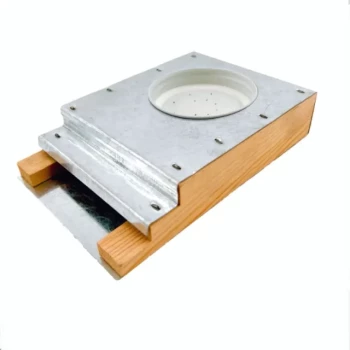
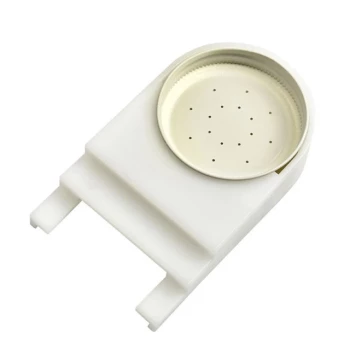
To accommodate a round top feeder in a narrow Top Bar hive, you must mechanically elevate the unit to bypass the hive's tapered geometry. Since a standard 10.5-inch diameter feeder is wider than the 10-inch bottom of the hive, it must be propped up on sticks or makeshift stilts to sit securely within the wider upper portion of the cavity.
Core Takeaway The round feeder cannot rest on the floor of a Top Bar hive due to the sloped sides; it requires a makeshift platform (stilts) to elevate it. It is placed in the empty void behind the colony, accessible only through a specially modified divider board.
The Physical Installation
Overcoming the Tapered Width
Top Bar hives typically feature sloped sides, resulting in a bottom width that is narrower than the top.
A standard round feeder is approximately 10.5 inches in diameter.
If your hive bottom is only 10 inches wide, the feeder will get stuck on the sides before reaching the bottom.
Implementing the Stilt Method
To solve this, you must install makeshift stilts or support sticks inside the hive.
These supports lift the feeder off the floor, raising it to a level where the hive cavity is wide enough to accommodate the feeder's full diameter.
Ensure these supports are stable, as the feeder will be heavy when full.
Managing Hive Access
Placement Relative to the Colony
Do not place the feeder directly above the brood nest as you would in a Langstroth hive.
Instead, locate the feeder in the empty portion of the hive, separated from the colony by the divider board (follower board).
Modifying the Divider Board
Because the feeder is isolated in the empty section, the bees need a specific path to reach it.
You must modify the divider board to allow bee passage.
This creates a controlled access point where bees can leave the main colony area, feed, and return.
Operational Versatility and Trade-offs
Feed Types
While typically used for syrup with a floating insert, this setup is versatile.
You can remove the top of the feeder to provide dry pollen or dry sugar.
This allows you to adapt the feed type based on the season without changing the installation method.
Stability Risks
Using "makeshift stilts" introduces a variable of instability not found in flat-bottomed hives.
If the sticks shift, the feeder may tip, leading to syrup spills inside the hive.
Ensure your elevating materials are flat and secure to prevent drowning bees or attracting pests with spilled syrup.
Making the Right Choice for Your Goal
Depending on your immediate objective, apply the following adjustments:
- If your primary focus is feeding liquid syrup: Ensure the stilts are perfectly level to prevent the floating insert from binding or the liquid from spilling.
- If your primary focus is feeding dry pollen: You can be slightly less precise with leveling, but ensure the top is removed to give bees direct access to the powder.
Elevating the feeder allows you to utilize standard equipment in non-standard hive geometries without compromising the colony's space.
Summary Table:
| Feature | Top Bar Hive Requirement | Round Feeder Adaptation |
|---|---|---|
| Placement | Empty section behind divider board | Must be propped on stilts/sticks |
| Width Support | Narrow bottom (often 10") | Elevated to upper, wider hive section |
| Bee Access | Through modified follower board | Central cone or open top (for dry feed) |
| Stability | Level floor required | Leveling is critical to prevent syrup spills |
| Versatility | Supports liquid and dry feed | Remove lid for pollen/dry sugar |
Maximize Your Colony's Growth with HONESTBEE
Transitioning from standard equipment to Top Bar hive management requires the right tools and expertise. At HONESTBEE, we specialize in supporting commercial apiaries and distributors with a comprehensive range of high-quality beekeeping machinery and supplies. From hive-making and honey-filling machines to essential hardware and consumables, our portfolio is designed to enhance your operational efficiency.
Whether you are scaling your own apiary or stocking a distribution network, we provide the wholesale solutions you need to succeed. Contact us today to discuss your equipment needs and let HONESTBEE empower your beekeeping business!
Related Products
- HONESTBEE Round Hive Top Bee Feeder for Syrup
- Rapid Bee Feeder White Plastic 2L Round Top Feeder for 8 or 10-Frame Bee Hives
- HONESTBEE Square Top Hive Bee Feeder Top Bee Feeder
- Professional Hive Top Bee Feeder for Beekeeping
- HONESTBEE Professional Hive Top Bee Feeder Feeding Solution
People Also Ask
- What can the round hive top feeder be used for? A Guide to Efficient, Safe Bee Feeding
- What types of hive boxes is the round hive top feeder compatible with? Universal Fit for 8 & 10-Frame Langstroth Hives
- What is the capacity of the round hive top feeder for syrup and pollen? A Guide to Targeted Apiary Support
- What types of feed can be used with the round hive top feeder? Versatile Feeding for Optimal Apiary Health
- What are the different types of top feeders for bees? Choosing the Best Feeder for Your Apiary