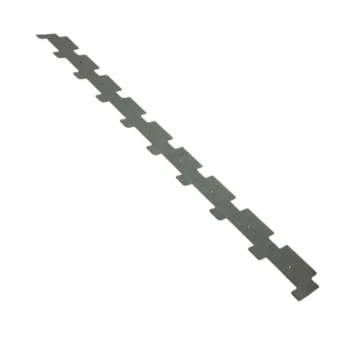
Ideally, you should arrange your honey super by including a few frames of previously drawn-out honeycomb if they are available. If you do not have drawn comb, or are starting with fresh foundation, you must fill the super with the standard 10 frames to ensure the bees build correctly.
Core Takeaway The arrangement of frames dictates how bees build wax. While standard spacing is required for new foundation to prevent messiness, reducing frame counts (spacing) on drawn comb encourages "fatter" honey stores that are significantly easier to harvest.
The Baseline Strategy: Drawn vs. Undrawn Comb
Prioritize Drawn Comb
The most beneficial starting point is to utilize frames where bees have already built out the wax (drawn comb).
This gives the bees a head start on storage. It signals immediate availability for nectar deposition, rather than forcing them to expend energy building wax first.
The Rule for New Foundation
If you do not have drawn comb, you must place 10 frames in a standard 10-frame box.
When foundation is undrawn, bees need the tight spacing of 10 frames to guide their construction.
This proximity forces them to build straight, individual combs within the frame borders.
Optimizing for Extraction: The Spacing Technique
Once your frames have drawn comb, you can arrange them with wider spacing to improve harvest efficiency. This is often done by placing fewer frames in the box.
The 9-Frame Configuration
Spacing 9 frames evenly in a 10-frame super is a standard practice for established hives.
With slightly more room, bees will extend the honeycomb cells outward, making the comb "wider."
These wider combs are generally easier to uncap with a knife, as the wax protrudes past the wood of the frame. It also tends to run smoother in automated extracting systems.
The 8-Frame Configuration
Reducing the count to 8 frames creates even larger gaps, resulting in "fatter," bulging combs.
This maximizes the amount of wax cappings, which can be useful if you harvest wax.
It also reduces the total number of frames you must handle in the extraction room by roughly 10%, potentially speeding up your workflow.
Common Pitfalls to Avoid
The Risk of Cross-Comb
You must never use reduced spacing (8 or 9 frames) with undrawn foundation.
If you give bees too much space before the comb is established, they will build "cross comb" or "burr comb."
Instead of following the frame, they may build bridges between frames, creating a structural mess that is difficult to inspect and harvest.
Plastic Frame Limitations
Material matters when arranging your frames. Bees often interact with plastic frames differently than wax foundation.
Even with drawn comb, bees may not draw out plastic frames effectively if they are spaced too widely.
When using plastic, it is often safer to stick to 9 or 10 frames per box to prevent irregular building patterns.
Making the Right Choice for Your Goal
Depending on the maturity of your equipment and your harvesting goals, choose the arrangement that minimizes labor and maximizes quality.
- If you are using new, undrawn foundation: Use 10 frames to force the bees to build straight, manageable comb.
- If you want easier manual uncapping: Use 9 evenly spaced frames of drawn comb to encourage bees to build the honey cells slightly beyond the wood frame.
- If you want to minimize lifting and handling: Use 8 evenly spaced frames of drawn comb to handle fewer units while maintaining honey volume.
Always prioritize the structural integrity of the comb over spacing tricks until the wax is fully drawn.
Summary Table:
| Configuration | Best For | Requirement | Key Benefit |
|---|---|---|---|
| 10 Frames | New Foundation | Undrawn Foundation | Ensures straight, uniform comb construction |
| 9 Frames | Manual Uncapping | Drawn Comb | Protruding comb for faster, cleaner uncapping |
| 8 Frames | Bulk Harvesting | Drawn Comb | Maximizes honey volume per frame; reduces labor |
Scale Your Honey Production with HONESTBEE
Maximize your apiary's efficiency with professional-grade equipment. HONESTBEE specializes in serving commercial apiaries and distributors with high-quality wholesale solutions. We supply the full spectrum of industry essentials, including:
- Specialized Machinery: Honey-filling and hive-making machines.
- Durable Hardware: Beekeeping tools and equipment designed for longevity.
- Consumables: A wide array of essential industry supplies and honey-themed merchandise.
Whether you are expanding your operation or looking for more efficient extraction tools, our portfolio is built to support your growth.
Contact us today to explore our wholesale catalog and discover how we can streamline your commercial beekeeping operations.
Related Products
- Heavy Duty Castellated Iron Frame Spacer for Honey Supers
- Durable 16 Way Circular Bee Escape for Efficient Honey Harvesting
- Digital Honey Refractometer for Precision Measurement of Optimal Honey Quality
- Precision Honey Refractometer Instrument for Quality Assessment
- Professional Plastic Honey Dipper for Easy Honey Drizzling
People Also Ask
- What are honey super frames and what foundation options are available? Choose the Best Support for Your Bees
- What are the reasons and drawbacks of using nine frames in a ten-frame honey super? Boost Extraction Speed Today
- What are honey super frames and how many are needed per box? A Beekeeper's Essential Guide
- What are honey super frames and their foundation options? Choose the Best Support for Your Hive's Honey Production
- Why might a beekeeper use fewer than the standard number of frames in a honey super? Boost Extraction Efficiency