
At its core, a resource hive is a single hive body that is internally divided to house two separate, side-by-side nucleus colonies. Also known as a "double nuc," this setup allows two small colonies to operate independently while sharing a common wall, bottom board, and potentially a honey super on top.
The fundamental purpose of a resource hive is to efficiently manage and support multiple small colonies in one piece of equipment, leveraging their combined heat for better overwintering and resource generation.
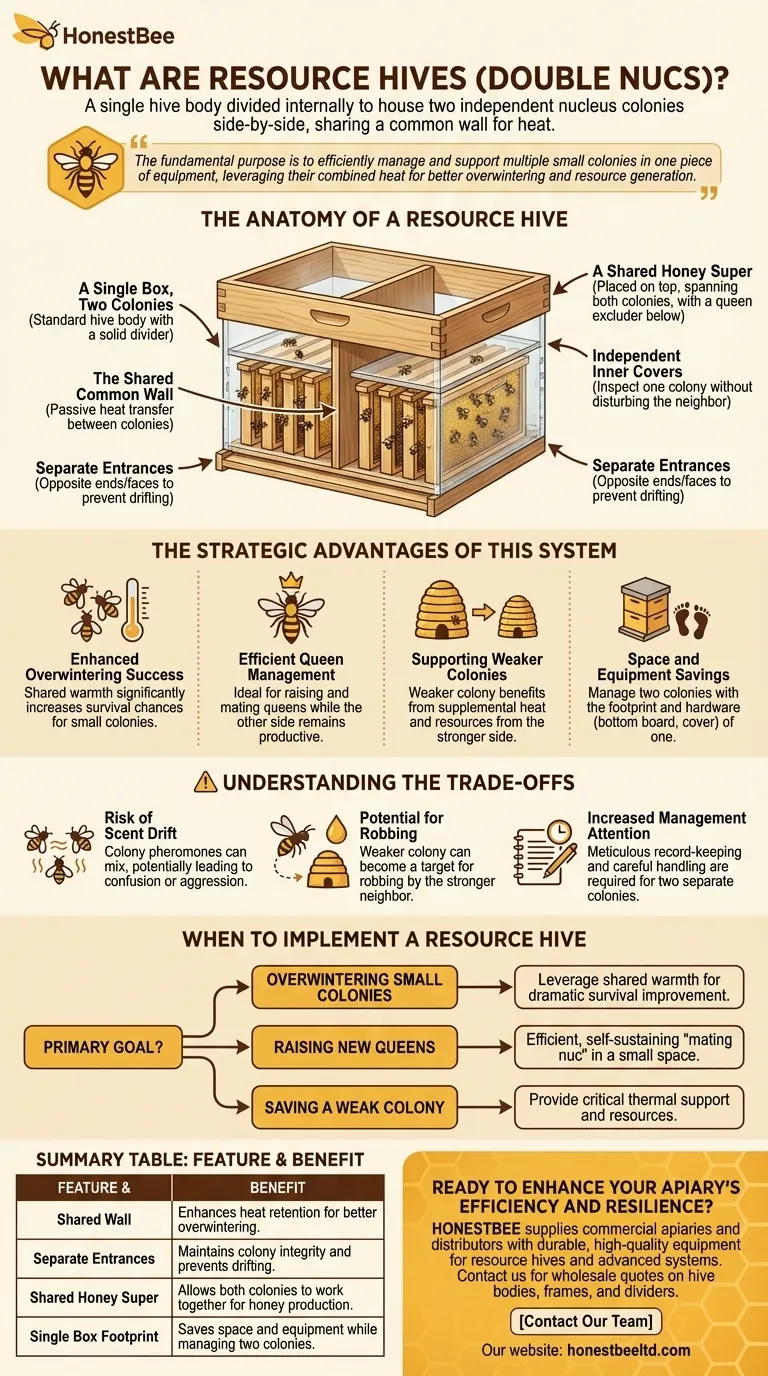
The Anatomy of a Resource Hive
A resource hive might look like a standard hive from the outside, but its internal configuration is what makes it unique and useful.
A Single Box, Two Colonies
The system uses a standard hive body (like a 10-frame deep) but features a solid divider down the middle. This partition effectively creates two smaller, 5-frame nucleus boxes within a single structure.
The Shared Common Wall
The central divider is the key to the system's primary benefit. This shared wall allows for the passive transfer of heat between the two colonies.
Separate Entrances
To maintain colony integrity and prevent bees from drifting, each side has its own distinct entrance. These are typically located on opposite ends or faces of the hive box.
Independent Inner Covers
Each nucleus colony has its own inner cover. This allows a beekeeper to inspect or manipulate one colony without exposing and disturbing its neighbor.
A Shared Honey Super
A single honey super can be placed on top, spanning both colonies. With a queen excluder below it, the worker bees from both colonies can work together to fill a single set of frames with honey.
The Strategic Advantages of This System
Beekeepers use resource hives to solve several common management challenges, particularly related to the health and viability of smaller colonies.
Enhanced Overwintering Success
This is the most critical benefit. Two small colonies clustering against a shared wall generate and retain heat far more effectively than a single nuc would on its own. This significantly increases their chances of surviving a cold winter.
Efficient Queen Management
Resource hives are ideal for raising and mating queens. A beekeeper can use one side to raise a new queen while the other side remains a productive, queenright colony that provides warmth and stability.
Supporting Weaker Colonies
You can place a weaker colony next to a stronger one. The weaker colony benefits from the supplemental heat, and the beekeeper can easily transfer frames of brood or food from the strong side to bolster the weak one.
Space and Equipment Savings
This setup allows you to manage two colonies with the footprint and some of the hardware of one. You only need one bottom board, one outer cover, and one stand for two distinct colonies.
Understanding the Trade-offs
While highly effective, this system is not without its considerations. An awareness of the potential downsides is key to successful management.
Risk of Scent Drift
Even with separate entrances, the close proximity means the colonies' pheromones can mix. This can sometimes lead to confusion or aggression if not managed carefully.
Potential for Robbing
If one colony becomes significantly weaker than its neighbor, it can become a target for robbing by the stronger colony in the same box.
Increased Management Attention
You are managing two separate colonies in one box. This requires meticulous record-keeping and careful handling to ensure you are addressing the unique needs of each side.
When to Implement a Resource Hive
This setup is a strategic tool, not a universal solution. Its use is best tied to specific beekeeping goals.
- If your primary focus is overwintering small colonies: Use a resource hive to leverage shared warmth and dramatically improve their chances of survival.
- If your primary focus is raising new queens: This setup provides an efficient "mating nuc" that is self-sustaining and easy to manage in a small space.
- If your primary focus is saving a weak colony: Place it next to a stronger colony in a resource hive to provide critical thermal support and a ready source of resources.
Ultimately, the resource hive is a strategic tool for the thinking beekeeper, turning two small colonies into a single, more resilient unit.
Summary Table:
| Feature | Benefit |
|---|---|
| Shared Wall | Enhances heat retention for better overwintering. |
| Separate Entrances | Maintains colony integrity and prevents drifting. |
| Shared Honey Super | Allows both colonies to work together for honey production. |
| Single Box Footprint | Saves space and equipment while managing two colonies. |
Ready to enhance your apiary's efficiency and resilience?
HONESTBEE supplies commercial apiaries and beekeeping equipment distributors with the durable, high-quality equipment needed to successfully implement resource hives and other advanced beekeeping systems. Our wholesale-focused operations ensure you get the best value on hive bodies, frames, and dividers to build a stronger, more productive operation.
Contact our team today to discuss your specific needs and request a wholesale quote!
Visual Guide
Related Products
- Durable Plastic Hive Number Set for Beekeeping
- Professional Large-Format Hive Number Set for Beekeeping
- Modern Flat-Mount Hive Number Set for Beekeeping
- Wholesales Dadant Size Wooden Bee Hives for Beekeeping
- Precision Stainless Steel Frame Cleaner for Hive Grooves and Corners
People Also Ask
- How do plastic hives offer protection against wax moths? Secure Your Apiary with Durable Pest Resistance
- Why might bees reject a plastic hive? Key Factors in Colony Acceptance and Material Management
- What are the advantages of numbered plastic tags? Achieve Precise Individual Honeybee Identification
- What is the role of record-keeping tools like manuals and hive markers in professional queen bee breeding? Master Data.
- What potential problems can the smooth interior surface of plastic hives cause? Combat Moisture and Disease












