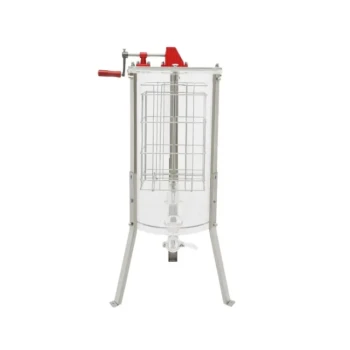
Standardized honey processing equipment represents a fundamental shift from variable artisanal production to precise industrial engineering. These systems offer distinct advantages over manual operations by utilizing automated extraction and multi-stage filtration to drastically reduce product loss while significantly increasing processing capacity.
Core Takeaway While manual processing is inherently inconsistent and labor-intensive, standardized equipment provides the rigorous hygiene and quantitative precision required for modern commerce. It transforms honey production from a high-waste activity into a scalable operation that protects the product's pharmacological stability and ensures compliance with international export standards.
Optimizing Yield and Efficiency
Minimizing Product Loss
Manual extraction often results in significant waste due to inefficient handling and residue. Standardized equipment utilizes optimized extraction mechanisms designed to capture the maximum amount of product.
This ensures that the raw material harvested from the apiary is converted into the final product with minimal physical loss during the processing phase.
Enhancing Production Scalability
Manual operations are limited by human speed and endurance. Industrial-grade equipment breaks this bottleneck, allowing for large-scale processing capacity that remains consistent over long operational hours.
This capability is essential for producers aiming to move beyond local sales to meet the volume demands of broader distribution networks.
Reducing Labor Constraints
By automating the metering and sealing processes, producers can significantly reduce their reliance on manual labor. This not only lowers long-term operational costs but also removes the variability and fatigue associated with human workers.
Elevating Hygiene and Purity
Multi-Stage Filtration
Achieving a contaminant-free product manually is difficult and prone to error. Standardized equipment employs multi-stage filtration systems that systematically remove impurities such as wax and physical debris.
This ensures a level of product clarity and purity that is difficult to replicate consistently with hand-strained methods.
Protecting Bioactive Integrity
Honey contains oxygen-sensitive substances, including inhibines, phenolic antioxidants, and vitamins. Manual packaging often exposes honey to open air for extended periods, degrading these compounds.
Industrial filling machines often utilize closed-system designs, which significantly reduce exposure to air and external contaminants. This preserves the pharmacological stability of the honey, ensuring the end consumer receives a biologically active product.
Preventing Secondary Contamination
Manual bottling introduces the risk of human contact and airborne pathogens. Automated sealing and filling create a hygienic barrier, minimizing secondary contamination risks during the critical packaging phase.
Ensuring Commercial Consistency
Precise Quantitative Filling
A critical challenge in manual operations is filling containers to an exact weight. Automated filling machines utilize high-precision quantitative systems to ensure every unit meets the specified net weight.
This consistency eliminates material giveaway (overfilling) and customer complaints (underfilling), both of which are common in manual operations.
Meeting Export Standards
For producers aiming for international markets, consistency is not optional; it is a regulatory requirement. Standardized machinery provides the documentation, hygiene controls, and uniform packaging necessary to meet strict international export standards.
Understanding the Trade-offs
The "Artisanal" vs. "Standardized" Balance
While standardized equipment offers superior efficiency and hygiene, it requires a shift in operational philosophy. The process moves from a tactile, hands-on approach to a monitoring and maintenance role.
Implementation Requirements
Adopting this technology removes the flexibility of ad-hoc processing. It demands a structured workflow where the raw honey must fit the specifications of the machine (e.g., viscosity and temperature controls) to function correctly. The gain in speed and hygiene comes at the cost of rigid process adherence.
Making the Right Choice for Your Goal
To determine if standardized equipment is the right step for your operation, consider your end goals:
- If your primary focus is entering the export market: You must invest in automated filling and sealing machinery to ensure the hygiene and weight consistency required by international regulators.
- If your primary focus is maximizing product value: Prioritize equipment with closed-system designs to minimize oxidation and preserve the honey's delicate bioactive compounds.
- If your primary focus is reducing overhead: Shift to automated metering tools to eliminate the labor costs and material waste associated with manual bottling.
Standardized equipment is not just about speed; it is the infrastructure required to guarantee product safety and market viability.
Summary Table:
| Feature | Manual Operations | Standardized Equipment |
|---|---|---|
| Production Scalability | Limited by human labor | High-volume industrial capacity |
| Product Consistency | Variable (artisanal) | Precise quantitative filling |
| Hygiene Control | High contamination risk | Multi-stage filtration & closed systems |
| Bioactive Integrity | Prone to oxidation | Optimized to protect vitamins & antioxidants |
| Loss Prevention | High residue/waste | Minimal loss through automated extraction |
| Market Readiness | Local/Small-scale only | International export compliant |
Elevate Your Honey Production with HONESTBEE
Transitioning from manual labor to industrial efficiency is the key to global market success. HONESTBEE empowers commercial apiaries and distributors with high-performance beekeeping tools, honey-filling machines, and comprehensive hive-making equipment.
Whether you need to preserve the pharmacological stability of your honey or scale up for international export, our wholesale solutions provide the precision and reliability you need. Contact us today to discover how our specialized machinery and industry consumables can transform your apiary into a high-yield, professional operation.
References
- J. A. Ugbe, H. D. Japheth. SWOT Analysis of Honey Producers and Marketers in Cross River State, Nigeria. DOI: 10.5281/zenodo.18070574
This article is also based on technical information from HonestBee Knowledge Base .
Related Products
- Electric Double Wall Honey Filtering Machine Purifier Equipment for Honey Processing Plant
- 0.5T Capacity Honey Dehumidifier Dryer with Vacuum Heating and Thickening Filtering Machine
- Heavy Duty Stainless Steel Honey Processing Machine Decrystallizing Tank
- Double Wall Honey Heating Stirring Homogenizer Mixing Machine with Various Capacity
- Economy Honey Homogenizer Mixer and Melting Machine for Beekeeping
People Also Ask
- What is the process of filtering honey? A Guide to Clean, Pure, and Market-Ready Honey
- What types of equipment are used in honey filtering? Build an Efficient System for Pure, Marketable Honey
- What is the overall importance of using the right equipment in honey filtering? Boost Quality & Marketability
- Why is filtering important in honey processing, and what equipment is used? A Guide to Quality & Efficiency
- What are the benefits of drying honey filtering equipment after use? Protect Your Honey Quality & Equipment Investment