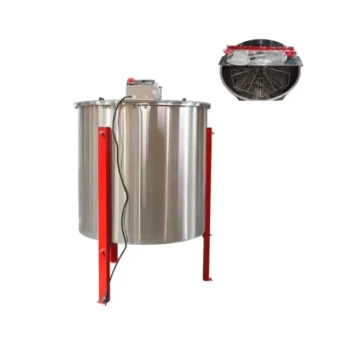
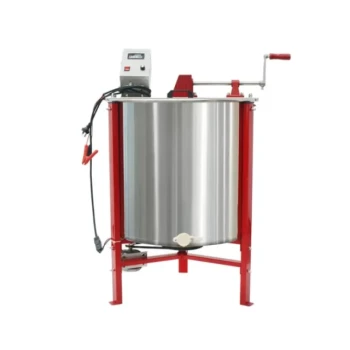
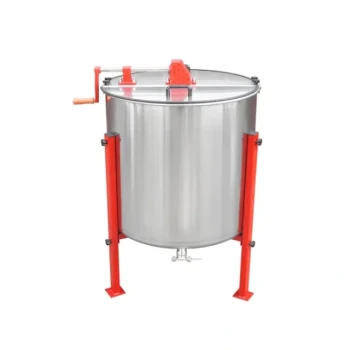
A motor conversion kit effectively transforms a standard manual honey extractor into a semi-automated processing unit. This upgrade directly addresses the primary bottleneck of manual extraction by eliminating the physical labor of hand-cranking, resulting in a significantly more consistent and efficient harvest, particularly for beekeepers managing multiple frames or commercial workloads.
The primary value of a motor conversion kit is the ability to scale your operation without buying a completely new machine. It replaces physical exertion with mechanical consistency, allowing you to process larger volumes of honey faster and with less fatigue.
Elevating Efficiency and Output
Elimination of Physical Fatigue
The most immediate advantage of a motor conversion kit is the reduction of physical labor. Manual extraction requires continuous, repetitive hand-cranking, which becomes physically exhausting as the volume of frames increases.
By automating the centrifugal spinning process, the motor takes over the heavy lifting. This allows the operator to conserve energy, making the extraction process sustainable over longer sessions.
Increased Processing Speed
Automating the spin cycle significantly accelerates the overall workflow. A motor maintains a steady, high-speed rotation that a human operator cannot sustain manually over time.
This speed increase is critical for commercial operations or hobbyists expanding their apiaries. It allows for the rapid turnover of multiple frames, reducing the total time spent in the honey house.
Consistency of Extraction
Human cranking is naturally variable; operators slow down as they tire, leading to inconsistent centrifugal force. A motor ensures a constant RPM (revolutions per minute) throughout the cycle.
This mechanical consistency ensures that honey is extracted evenly from the comb. It prevents the issue of "wet frames" caused by insufficient spinning speed near the end of a long extraction day.
Understanding the Trade-offs
While motor kits offer efficiency, it is important to understand what is sacrificed when moving away from a purely manual system.
Loss of Tactile Feedback
Manual extractors offer a high degree of control and a "tactile" connection to the process. Beekeepers can feel the weight of the honey and adjust speed instantly to prevent damaging delicate combs.
Motorized systems detach the operator from this physical feedback loop. Without careful speed regulation, there is a slightly higher risk of comb blowout, especially with new or soft wax.
Dependency on Power Sources
A manual extractor is fully portable and field-ready, requiring no electricity. Adding a motor tethers the machine to a power source, limiting where extraction can take place.
This removes the "off-grid" advantage of the manual unit. If your operation is in a remote location without reliable electricity or generator access, a motor kit becomes a liability rather than an asset.
Cost and Complexity
Manual units are prized for their affordability and mechanical simplicity. Adding a motor increases the complexity of the machine, introducing components that may eventually require maintenance or repair.
Making the Right Choice for Your Goal
Deciding to install a conversion kit depends entirely on the scale of your operation and your available resources.
- If your primary focus is volume and efficiency: The motor kit is a necessary upgrade that reduces labor time and physical strain, essential for managing a growing number of hives.
- If your primary focus is budget or portability: Stick with the manual crank to maintain off-grid capability, lower costs, and total control over delicate combs.
Ultimately, a motor conversion kit is the bridge between hobbyist beekeeping and small-scale commercial production, offering professional efficiency for existing equipment.
Summary Table:
| Feature | Manual Extraction | Motorized Conversion Kit |
|---|---|---|
| Labor Intensity | High (Repetitive hand-cranking) | Low (Automated rotation) |
| Processing Speed | Variable & slower over time | High & consistent RPM |
| Extraction Yield | Inconsistent (User fatigue) | Even and thorough |
| Portability | Full (Off-grid capable) | Limited (Requires power source) |
| Control | Tactile feedback for delicate combs | Mechanical precision via settings |
Scale Your Apiary with HONESTBEE Precision Equipment
Ready to transition from hobbyist labor to professional efficiency? HONESTBEE specializes in empowering commercial apiaries and distributors with high-performance beekeeping machinery. Whether you need specialized honey-filling machines, advanced hive-making hardware, or heavy-duty extraction tools, we provide the full spectrum of industrial-grade equipment and consumables to streamline your harvest.
Maximize your honey production today—Contact our experts to discuss wholesale solutions and custom machinery!
Related Products
- Vertical Motor Kits for 2 3 4 Frame Electric Honey Extractors
- Spare Crank Gear Drivetrain Assembly for Manual 4 Frame Honey Extractor
- Commercial Electric 12 Frame Honey Extractor Spinner Motorized Honey Extractor
- 8-Frame Electric Self-Reversing Honey Extractor Spinner for Commercial Honey Extraction Equipment
- Stainless Steel 3 Frame Manual Honey Extractor Spinner for Bee Honey Extraction
People Also Ask
- What operational benefits do motorized honey extractors provide? Scale Your Harvest Efficiency
- What operational practices are required when using motorized honey extractors to ensure smooth operation and prevent equipment imbalance? Explore our comprehensive guide for essential tips on balanced loading, speed control, and maintenance strategies.
- What are the advantages of using a motorized honey extractor? Maximize Efficiency and Precision for Your Apiary
- What other tasks can a honey extractor motor be used for? Explore its limited secondary applications.
- What is the primary function of a honey extractor motor in beekeeping? Boost Efficiency & Protect Honeycomb