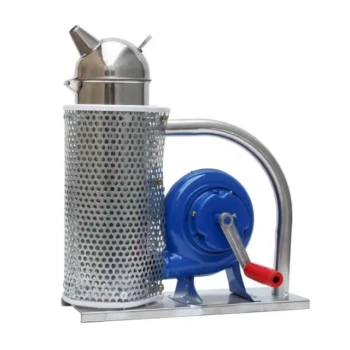
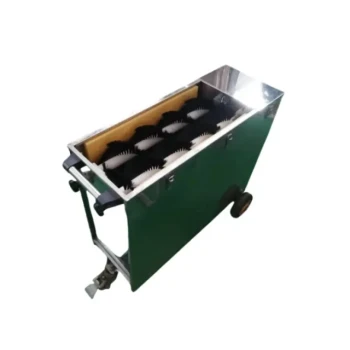
Automatic sprayers and atomizing equipment provide superior disease control by creating a uniform mist that coats hive surfaces more effectively than traditional methods. This technology maximizes the contact area between medicinal solutions and infected sites, such as hive walls and larval remains, ensuring thorough treatment diffusion.
By generating micron-sized droplets, atomizing equipment transforms liquid treatments into a pervasive mist. This ensures comprehensive coverage of both the honeycomb structure and the bees themselves, facilitating consistent ingestion of active ingredients through natural grooming and social behaviors.
Enhancing Physical Coverage and Penetration
To effectively treat deep-seated infections like American Foulbrood, the medicinal solution must physically reach the source of the pathogen.
Uniform Surface Misting
Traditional dripping methods often result in uneven distribution, leaving parts of the hive untreated. Automatic sprayers coat the entire surface area of the hive frames and walls with botanical extracts.
Increased Contact Area
Atomization breaks liquid into fine particles, drastically increasing the surface contact area. This allows the solution to cover more square inches of the hive using the same amount of liquid compared to a solid stream or drip.
Improved Diffusion Efficiency
The mist effectively penetrates difficult-to-reach areas, including larval remains and cellular debris. This high diffusion efficiency is critical for neutralizing the actual source of infection within the colony structure.
Leveraging Bee Behavior for Distribution
Beyond treating the physical hive, atomizing sprayers utilize the bees' natural biology to distribute the treatment internally.
Activation Through Grooming
Ultra-fine atomizers generate micron-sized droplets that coat the bodies of the bees. As bees engage in grooming behaviors to clean themselves and each other, they ingest the active ingredients.
Colony-Wide Systemic Distribution
Bees share food and fluids through a process called trophallaxis. Because the mist provides uniform coverage across the population, the medicinal components are rapidly shared, ensuring the entire colony ingests the treatment.
Microbiota Intervention
This delivery method ensures that antimicrobial components reach every member of the colony. This facilitates a uniform intervention in the colony's microbiota, rather than treating only a specific subset of bees.
Understanding the Trade-offs
While atomization offers superior coverage, it requires specific conditions to be effective.
Requirement for Industrial-Grade Equipment
To achieve the micron-sized droplets necessary for this level of coverage, standard hand sprayers are often insufficient. You generally require industrial-grade ultra-fine atomizing equipment, which implies a higher initial investment than simple drip tools.
Complexity vs. Simplicity
Dripping is mechanical and simple. Atomization relies on the physics of mist generation. If the equipment is not calibrated to produce ultra-fine mist, the droplets may be too large, reducing the "fogging" effect that facilitates grooming and deep penetration.
Making the Right Choice for Your Goal
The decision to use atomizing equipment should be based on the severity of the infection and the need for colony-wide saturation.
- If your primary focus is treating deep-seated infections (e.g., American Foulbrood): Use atomization to ensure the solution penetrates larval remains and thoroughly coats hive walls.
- If your primary focus is systemic colony treatment: Rely on ultra-fine misting to leverage bee grooming and trophallaxis for uniform ingestion of the active ingredients.
Switching to atomization changes the treatment mechanism from simple application to a comprehensive, biologically-assisted intervention.
Summary Table:
| Feature | Traditional Dripping | Automatic Atomization |
|---|---|---|
| Coverage | Uneven, localized application | Uniform 360° surface coating |
| Penetration | Limited to surface contact | Deep diffusion into debris & cells |
| Delivery Mode | Mechanical/Direct | Micron-sized mist/Fogging |
| Bee Interaction | Minimal ingestion | High ingestion via grooming/trophallaxis |
| Infection Target | Surface-level pathogens | Deep-seated sources (e.g., Foulbrood) |
Maximize Your Apiary Productivity with HONESTBEE
Efficient disease management is the backbone of a successful beekeeping operation. At HONESTBEE, we specialize in supporting commercial apiaries and distributors with high-performance wholesale solutions.
Our extensive portfolio includes:
- Advanced Machinery: Professional-grade honey-filling and hive-making machines.
- Precision Tools: Industrial atomizing equipment and a full spectrum of beekeeping hardware.
- Essential Consumables: A wide array of industry-standard supplies for hive maintenance.
Whether you are scaling your commercial production or supplying the local market, our expertise ensures you have the right tools for the job. Contact us today to discover how our comprehensive equipment range can streamline your operations and enhance colony health!
References
- Mesbah H.A., G.A. EL-Hamamy. Efficiency of Certain Natural Extracts and Antibiotics in Managing the American Foulbrood (AFB) of Honey Bees in Egypt. DOI: 10.21608/asejaiqjsae.2017.3616
This article is also based on technical information from HonestBee Knowledge Base .
Related Products
- Heavy Duty Manual Bee Smoker Blower for Beekeeping
- Automatic High-Speed Bee Hive Box Stapling Machine
- Automatic Honey Filling and Filtering Machine for Beekeeping Bottle Filling
- Stainless Steel Electric Beehive Smoker for Beekeeping and Bee Keeper Use
- Precision Stainless Steel Frame Cleaner for Hive Grooves and Corners
People Also Ask
- What are bee smokers made out of? Choose the Right Material for Your Apiary
- What are the advantages of a manual bee smoker? Enhance Hive Safety with Controlled Cool Smoke Technology
- What is the primary function of a manual bee smoker? Master Hive Control for Safe Inspections
- What is the proper technique for applying smoke to a beehive? Master Calm and Effective Hive Management
- What is the purpose of using a bee smoker for Small Hive Beetle inspections? Master Chemical Control & Hive Safety