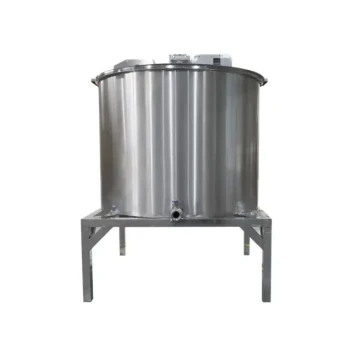
Industrial-grade constant-speed stirring offers a significant leap in both processing efficiency and final product quality. By replacing passive static methods with active mechanical intervention, this equipment accelerates the crystallization rate by 5 to 6 times while simultaneously engineering a finer, softer crystal structure.
The Core Takeaway Static crystallization is limited by high viscosity, often resulting in slow processing and coarse textures. Dynamic stirring overcomes these physical barriers through forced molecular migration, delivering a fully crystallized product with superior rheological properties in a fraction of the time.
Accelerating Production Velocity
Overcoming Nucleation Barriers
High viscosity is the primary adversary in honey crystallization. In static processes, this thickness inhibits the movement of molecules required to form crystals.
Constant-speed stirring provides the continuous mechanical power necessary to force molecular migration. This active intervention effectively overcomes the natural nucleation barriers that slow down static methods.
Drastically Reduced Processing Time
The impact on production schedules is substantial. By forcing interaction at the molecular level, industrial stirring equipment reduces the total time required for crystallization by 5 to 6 times.
This allows facilities to cycle batches significantly faster, increasing overall throughput without expanding the facility footprint.
Controlling Crystal Architecture
The Function of Mechanical Shear
In a static environment, crystals are free to grow unchecked, often leading to a gritty or coarse texture.
Dynamic equipment introduces mechanical shear forces. These forces physically disrupt the growth process, preventing individual crystals from becoming excessively large.
Generating Micro-Nuclei
The goal of controlled crystallization is uniformity. The mechanical action promotes the generation of a vast number of micron-sized micro-nuclei.
Rather than forming a few large crystals, the honey forms millions of microscopic ones. This serves as the foundation for a smooth, cohesive final product.
Optimizing Product Rheology
Lower Hardness and Viscosity
The physical properties of the honey are fundamentally altered by dynamic stirring. The resulting product exhibits lower hardness and lower viscosity compared to statically processed honey.
This difference is critical for consumer usability, distinguishing a hard, solidified mass from a spoonable, spreadable product.
Superior Rheological Characteristics
Rheology refers to how a material flows and deforms. Because of the uniform micro-nuclei distribution, dynamically crystallized honey possesses superior rheological characteristics.
It maintains a stable, fully crystallized state while remaining workable and textured, meeting high-quality industrial standards.
Operational Considerations
Investment vs. Output
While static processes require little more than storage space, dynamic crystallization requires specialized industrial machinery.
You must weigh the capital investment of constant-speed equipment against the operational gains of a 5-6x faster production cycle.
Process Consistency
To achieve the specific rheological benefits mentioned—such as lower hardness—the stirring speed must be constant.
Fluctuations in mechanical power can lead to inconsistent crystal sizes, negating the quality advantages of the dynamic process.
Making the Right Choice for Your Goal
- If your primary focus is Production Volume: Implement dynamic stirring to overcome viscosity barriers and cut your batch processing time by a factor of 5 to 6.
- If your primary focus is Product Texture: Use continuous mechanical shear to generate micron-sized nuclei, ensuring a product with lower hardness and superior spreadability.
Dynamic stirring transforms crystallization from a passive waiting period into an active, controlled process that maximizes both efficiency and quality.
Summary Table:
| Feature | Static Crystallization | Dynamic Stirring (Industrial-Grade) |
|---|---|---|
| Processing Speed | Slow (limited by high viscosity) | 5 to 6 times faster |
| Crystal Structure | Coarse, large, and unchecked | Fine, uniform micro-nuclei |
| Final Texture | Gritty or hard solidified mass | Soft, smooth, and spreadable |
| Viscosity/Hardness | High; difficult to manipulate | Lower; superior rheological flow |
| Production Goal | Low-cost/Low-volume storage | High-throughput commercial output |
Elevate Your Honey Production with HONESTBEE
Maximize your apiary's throughput and product quality by upgrading to professional crystallization technology. HONESTBEE specializes in serving commercial apiaries and global distributors with a comprehensive range of beekeeping machinery, honey-filling equipment, and specialized hardware designed for industrial efficiency.
Whether you need precision honey-processing machines or a full spectrum of beekeeping tools, we provide the hardware and consumables to scale your business.
Ready to transform your production cycle? Contact us today to explore our wholesale solutions!
References
- Silvia Tappi, Pietro Rocculi. Physical and structural properties of honey crystallized by static and dynamic processes. DOI: 10.1016/j.jfoodeng.2020.110316
This article is also based on technical information from HonestBee Knowledge Base .
Related Products
- Professional Thermostatic Conical Honey Melter
- Heavy Duty Stainless Steel Honey Processing Machine Decrystallizing Tank
- Double Wall Honey Heating Stirring Homogenizer Mixing Machine with Various Capacity
- Modern Stainless Steel Honey Dipper Stirrer
- Professional Plastic Honey Dipper for Easy Honey Drizzling
People Also Ask
- What is melter honey used for? A Low-Cost Ingredient for Bakers and Brewers
- How does a honey melter address the issue of crystallized honey in storage? Restore Flow and Quality Efficiently
- How do you melt a bucket of honey? Safely Reliquefy Crystallized Honey Without Damage
- When is a honey melter necessary? Optimize Your Facility's Workflow for Crystallized Honey
- What factors should be considered when selecting a heater for honey containers? Optimize Your Warming Efficiency