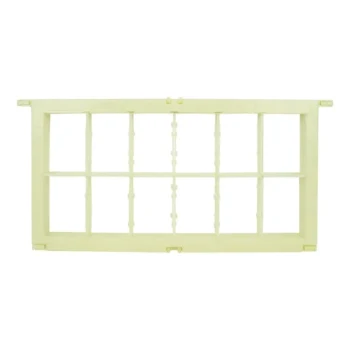
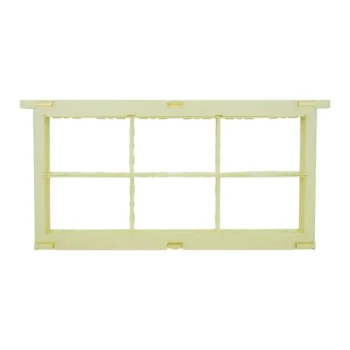
Standardization is the prerequisite for industrial scalability in apiary management. Adopting standard-sized frames, such as the 435x300 mm specification, directly enables mass production by ensuring mechanical consistency across all hive operations. This precise dimensioning transforms the hive from a variable biological environment into a controlled production unit.
Core Insight: The primary value of standard frames lies in their ability to maintain precise "bee space," which prevents operational friction caused by burr comb. This mechanical uniformity is the key factor that permits the integration of automated grafting and harvesting technologies, drastically increasing labor productivity.
Operational Efficiency and Hive Hygiene
Precision Control of Bee Space
The most immediate benefit of the 435x300 mm frame is the rigorous maintenance of bee space. When frames deviate from standard dimensions, colonies fill gaps with burr comb (excess wax).
Eliminating Mechanical Friction
Standard frames prevent the colony from cementing components together with wax or propolis. This allows for the smooth insertion and removal of rearing frames without jarring the hive, which is critical when handling delicate larvae.
Streamlining Manual Interventions
In large-scale operations, speed is essential. Standardized dimensions ensure that any frame fits any hive box instantly, reducing the time beekeepers spend adjusting or forcing equipment during routine inspections.
Enabling Industrial Automation
Compatibility with Automated Systems
To scale royal jelly production, manual processes must eventually be replaced or augmented by machines. Industrial grafting systems and automated harvesters require rigid, predictable input dimensions to function without jamming or damaging the product.
High-Density Larval Rearing
Standard frames provide a uniform chassis that can support specialized modular inserts, such as wooden cell bars. This allows producers to arrange hundreds of queen cell cups in a high-density, standardized layout that maximizes output per square inch of frame space.
Laboratory-to-Hive Workflow
The modular nature of these frames supports a split workflow. Technicians can perform precise grafting in a controlled laboratory environment on removable bars, which are then slotted into the standard frames and returned to the hive, protecting larvae from exposure.
Biological and Environmental Consistency
Uniform Micro-Climate
Standard frames ensure that every artificial queen cell is positioned in the exact same area of the hive. This maintains uniform temperature and humidity across all cells, which is vital for high larval survival rates.
Statistical Accuracy in Production
By standardizing the position and number of cups, producers can reliably predict acceptance rates. This consistency allows for better forecasting of royal jelly yields and more accurate biological output data per colony.
Understanding the Trade-offs
High Initial Investment
Transitioning to a fully standardized system, particularly one compatible with 435x300 mm automation, often requires a significant upfront capital investment to replace legacy or non-standard equipment.
Risk of Pathogen Spread
While standardization improves efficiency, the ease of moving frames between hives can also accelerate the spread of pests and diseases if strict sterilization protocols are not followed.
Rigid Framework Limitations
Standardization prioritizes efficiency over flexibility. If local environmental conditions or specific bee subspecies require non-standard hive geometries for optimal health, a rigid adherence to the 435x300 mm standard may be biologically suboptimal.
Making the Right Choice for Your Production Goals
To determine if strict adherence to the 435x300 mm standard is right for your operation, consider your end goals:
- If your primary focus is Industrial Scalability: Adopt the 435x300 mm standard immediately to ensure compatibility with future automated harvesting and grafting investments.
- If your primary focus is Labor Efficiency: Use standard frames to minimize the time spent cleaning burr comb and to allow for rapid, interchangeable frame manipulation between colonies.
- If your primary focus is Biological Research: Leverage the standard frame to eliminate spatial variables, ensuring that temperature and positioning are constant across all test subjects.
Standardization is not just about fitting a frame into a box; it is about removing mechanical variability so you can focus entirely on biological optimization.
Summary Table:
| Key Benefit | Impact on Production | Why It Matters |
|---|---|---|
| Precise Bee Space | Eliminates burr comb & propolis buildup | Allows smooth, fast frame removal without hive disturbance. |
| Automation Ready | Compatible with grafting & harvesting machines | Essential for scaling manual labor to industrial output levels. |
| Climate Consistency | Uniform temperature & humidity across cells | Ensures high larval survival rates and predictable jelly yields. |
| Workflow Efficiency | Seamless laboratory-to-hive integration | Minimizes larval exposure and reduces technician labor time. |
| Interchangeability | Any frame fits any hive box | Streamlines inspections and reduces equipment adjustment time. |
Scale Your Royal Jelly Production with HONESTBEE
Transitioning to standardized equipment is the first step toward industrial-grade apiary management. At HONESTBEE, we specialize in supporting commercial apiaries and distributors with high-precision beekeeping tools, specialized hive-making machinery, and automated honey-filling systems.
Whether you need standard 435x300 mm frames, advanced grafting hardware, or bulk consumables, our comprehensive wholesale offering is designed to drive your efficiency and profitability.
Ready to modernize your operation? Contact our experts today to discuss your wholesale needs
References
- O. Mischenko, D. Kryvoruchko. The influence of honey harvest conditions on the production of the royal jelly by queen bees. DOI: 10.31073/agrovisnyk202104-06
This article is also based on technical information from HonestBee Knowledge Base .
Related Products
- Wooden Bee Hive Frames for Beekeeping and Wholesale
- Plastic Honey Comb Frames Cassette Box for Honey
- Plastic Bee Frame Beekeeping Hive Frames for Wholesale
- Assembled Wooden Bee Frames with Plastic Foundation for Durability and Convenience by HONESTBEE
- Professional Sectional Comb Honey Frame with 250g Cassette System for Beekeeping
People Also Ask
- How does balancing the number of frames impact hive productivity? Optimize Your Apiary's Biological Output
- How do wooden and plastic hive frames compare in terms of durability? Wood vs. Plastic Longevity & Repairability
- What are the main considerations when choosing between wooden and plastic bee hive frames? Optimize Your Apiary's Efficiency
- How should beehive frames be maintained to prolong their lifespan? 5 Pro Tips for Durable Beekeeping Equipment
- Can I reuse old beehive frames? Save Money and Boost Hive Productivity