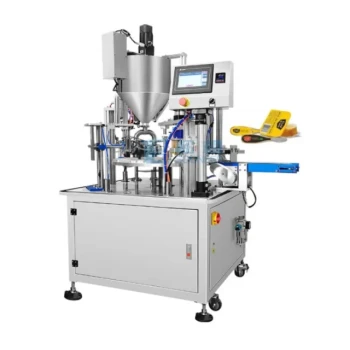
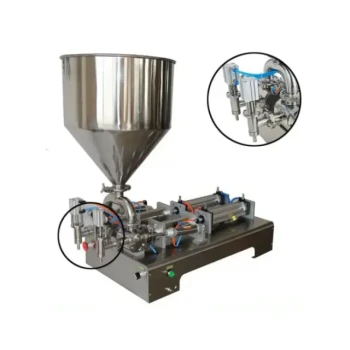
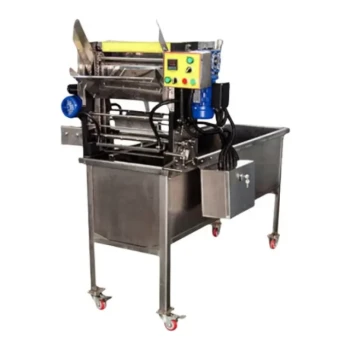
Semi-automated honey filling machines operate on a hybrid production model that bridges the gap between manual labor and full automation. These systems utilize automatic mechanisms to dispense the product, but they rely on human operators for specific tasks, typically loading empty containers or managing the filling initiation.
Core Insight: Semi-automated fillers are the "middle ground" solution designed to maximize flexibility for small-to-medium producers. They significantly boost production efficiency compared to hand-filling without requiring the massive capital investment or rigid setup of a fully automated industrial line.
The Operational Workflow
The Role of Human Intervention
Unlike fully automated systems, semi-automated machines do not handle the entire packaging lifecycle autonomously. The defining characteristic is manual intervention. An operator is usually required to place the container—whether it be a jar, bottle, or sachet—under the nozzle and initiate the fill cycle.
Handling High Viscosity
Honey is a uniquely difficult product due to its thickness and stickiness. Semi-automated machines are specifically engineered to handle these high-density properties. They typically employ volumetric or piston filling systems to physically push the viscous liquid, ensuring consistent flow where gravity alone might fail.
Versatility in Packaging
One of the strongest assets of a semi-automated system is adaptability. These machines can be easily reconfigured to handle a wide variety of container shapes and sizes. This makes them ideal for producers who package different product lines, such as varying jar sizes or even different product types like pastes and spreads, on the same machine.
Technical Mechanisms
Piston Fillers for Precision
For thick products like honey, piston fillers are the standard. A cylinder draws in a specific volume of honey and forces it out into the container. This mechanical action ensures a precise amount of honey is dispensed every time, minimizing product waste.
Gravity and Vacuum Options
While less common for extremely thick honey, other mechanisms exist depending on your specific viscosity and speed requirements. Gravity fillers utilize the weight of the honey from an overhead source, while vacuum fillers use suction to draw the liquid into the bottle. The choice often comes down to prioritizing fill speed versus absolute volumetric accuracy.
Understanding the Trade-offs
Production Capacity Limitations
While faster than manual filling, semi-automated machines cannot match the throughput of fully automated lines. Fully automatic machines utilize PLC control systems to eliminate labor dependence almost entirely, making them superior for mass production. Semi-automated units are generally slower and best suited for smaller quantities.
Precision Variance
Semi-automated machines offer a "high degree of precision" compared to manual pouring. However, when compared to fully automated counterparts, they may exhibit slightly less consistency in fill volume. Human error in container placement or timing can introduce minor variables that fully robotic lines eliminate.
Labor Dependence
These machines reduce labor costs significantly compared to manual scooping or pouring. However, they do not eliminate labor costs entirely. You still need a dedicated operator to run the machine, whereas fully automated lines allow one operator to oversee multiple stages of production simultaneously.
Making the Right Choice for Your Goal
To determine if a semi-automated honey filler is the correct investment for your facility, consider your current production stage.
- If your primary focus is Flexibility and Cost: Choose a semi-automated machine. It offers a lower initial investment and allows you to switch between different jar sizes and product types quickly.
- If your primary focus is Mass Volume: Choose a fully automated machine. The higher cost is justified by maximum speed, PLC-controlled precision, and minimized labor reliance.
Select the machine that solves your current bottleneck while leaving room for the scale you intend to reach in the next 24 months.
Summary Table:
| Feature | Semi-Automated Filling Machine | Benefit for Producers |
|---|---|---|
| Mechanism | Piston or Volumetric Filling | Ensures precise volumes for thick, viscous honey |
| Operation | Hybrid (Manual loading + Auto-fill) | Balance of human control and mechanical speed |
| Versatility | High Adaptability | Quickly switch between different jar sizes and shapes |
| Investment | Low to Moderate Capital | Affordable scaling for small-to-medium operations |
| Control | Foot pedal or button initiation | Minimizes product waste and improves hygiene |
Scale Your Honey Production with HONESTBEE
Are you a commercial apiary or distributor looking to bridge the gap between manual labor and industrial efficiency? HONESTBEE specializes in providing the full spectrum of beekeeping machinery, including high-precision honey-filling machines and specialized hive-making equipment. We offer flexible, cost-effective solutions tailored to your specific production needs, ensuring your operations remain competitive and scalable.
Ready to optimize your workflow? Contact our experts today to find the perfect machinery for your business!
Related Products
- Semi Automatic Small Honey Bottle Filling Machine Honey Filler
- Precision Durable Efficient HONESTBEE Rotary Honey Filling Machine
- Automatic Honey Filling and Filtering Machine for Beekeeping Bottle Filling
- Precision Automated Packaging Turntable Honey Spoon Filling Sealing Packing Machine
- Automatic Single-Dose Snap & Squeeze Honey Sachets Packing Machine
People Also Ask
- What is a semi-automatic honey filler? Scale Your Honey Production with Precision and Efficiency
- How does high-precision honey filling machinery help improve product competitiveness in modern apiary upgrades?
- What challenges can arise from packaging honey without a suitable filling machine? Optimize Your Production Today
- How does a honey filling machine benefit small-scale honey processing businesses? Boost Efficiency & Brand Quality
- What technical advantages do honey filling and packaging machines provide? Optimize Your Large-Scale Production