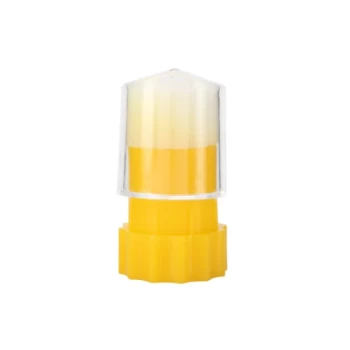
Marking a queen bee involves three primary methods of immobilization, which vary based on the beekeeper's experience and dexterity. You can apply the mark while the queen remains directly on the frame, manually hold her between your thumb and forefinger, or utilize a specialized stabilization tool like a plunger cage or push-in cage.
The goal of any marking method is to safely immobilize the queen just long enough to apply a small dot of paint to her thorax, ensuring the mark dries completely without inhibiting her movement or senses.
Methods of Immobilization
Tool-Assisted Stabilization
For those gaining experience or prioritizing safety, using a specific tool is often the best approach. Devices like plastic "piston" cages equipped with foam plungers allow you to trap the queen and gently push her against a mesh grid.
Alternatively, a push-in cage (often called a "crown of thorns") can be pressed directly into the comb over the queen. This holds her stationary against the frame itself, allowing you to mark her through the mesh without handling her directly.
The Manual Hand-Held Method
Experienced beekeepers often prefer to hold the queen by hand. This process usually begins by grasping the queen by her wings to lift her from the frame.
Once lifted, you carefully transition her to your other hand, trapping at least two of her legs between your thumb and forefinger (nail side down). This position secures her thorax for marking while leaving her abdomen free from pressure.
Direct On-Frame Application
The third method involves marking the queen directly on the comb as she walks, without any confinement.
This requires a very steady hand and a calm queen. While it is the least intrusive method regarding handling, it carries a higher risk of a smudged mark or misplaced paint if the queen moves unexpectedly.
The Mechanics of Marking
Proper Paint Application
Regardless of the holding method, you must use a non-toxic, water-based paint pen or enamel. Before approaching the queen, shake the pen and test it on a hard surface to ensure the paint flows smoothly but not excessively.
Apply a small, solid dot—approximately 2-3 millimeters wide—to the center of the top of her thorax.
Critical "No-Paint" Zones
Precision is vital. You must strictly avoid getting paint on her head, antennae, wings, or abdomen. Paint on the sensory organs can cripple her ability to lead the hive, and paint on the abdomen can interfere with her breathing spiracles.
Drying Time
After applying the dot, you must hold the queen (or keep her in the tool) for 30 seconds to one minute.
Releasing her too quickly can result in attendant bees cleaning the wet paint off immediately, rendering your work useless.
Understanding the Trade-offs
Risk vs. Speed
The manual hand-held method is efficient and requires no extra gear, but it carries the highest risk of physical injury to the queen. Squeezing the abdomen can sterilize or kill her.
Conversely, tool-assisted methods are slower and require carrying extra equipment, but they significantly reduce the chance of crushing the queen or damaging her legs.
Paint Volume Pitfalls
A common error is applying too much paint. Excess fluid can run down the thorax and glue the queen’s wings to her body or clog her joints.
It is highly advisable to practice on drones first. Drones are expendable and non-stinging, providing a low-stakes environment to master the pressure of the paint pen and the mechanics of handling.
Making the Right Choice for Your Goal
- If your primary focus is maximum safety and low risk: Use a plunger cage or push-in cage to immobilize the queen without direct hand contact.
- If your primary focus is efficiency and you have dexterity: Use the manual method, ensuring you practice grasping drones by the wings first to build muscle memory.
- If your primary focus is minimal disturbance: Attempt the on-frame method, but only if you have a steadied hand and a verified low-flow paint pen.
Mastering the immobilization technique is far more important than the marking itself; a marked queen is valuable, but an injured queen is a liability.
Summary Table:
| Method | Tools Required | Skill Level | Safety Level | Key Advantage |
|---|---|---|---|---|
| Tool-Assisted | Plunger or Push-in Cage | Beginner | High | Minimizes physical contact & injury risk |
| Manual Holding | None | Experienced | Moderate | High efficiency and speed for large apiaries |
| Direct On-Frame | Paint Pen only | Expert | Low | Zero handling; minimal hive disturbance |
| Practice (Drones) | Any of the above | All | N/A | Risk-free way to master dexterity |
Scale Your Beekeeping Success with HONESTBEE
Efficient queen management is the backbone of a productive apiary. At HONESTBEE, we empower commercial apiaries and distributors with the professional-grade tools needed to succeed. Whether you require precision marking tools, specialized hive-making machinery, or honey-filling equipment, our comprehensive wholesale portfolio has you covered.
From essential industry consumables to honey-themed cultural merchandise, we provide the full spectrum of equipment to grow your business. Partner with a supplier who understands the demands of large-scale beekeeping.
Contact HONESTBEE Today to Discuss Your Wholesale Needs
Related Products
- One Hand Yellow Queen Marking Catcher Tube Cage Beekeeper Tool Accessory for Queen Bee
- Plastic Long Marker Device for Catching and Marking Bees Queen Bee Marking Tube and Cage
- Queen Bee Marking Pen UNI Medium Point for Queen and Bee Marking
- Queen Bee Marking Pen POSCA Queen Marking Pens for Beekeeping Bee Markers
- Queen Bee Marking Tube Cage Bottle Catcher Holder with Clear Plastic Plunger Marker
People Also Ask
- What tools are available to assist in safely marking a queen bee? Essential Gear for Professional Beekeepers
- What equipment is needed to mark a queen bee? A Simple 3-Tool Guide for Every Beekeeper
- Why are high-quality queen bee marking tools essential for pedigree tracking? Master Honey Bee Genetic Integrity
- What are the specific advantages of using international standard marking tools in queen bee production and management?
- What tools are recommended for marking a Queen bee? Ensure a Safe and Successful Mark