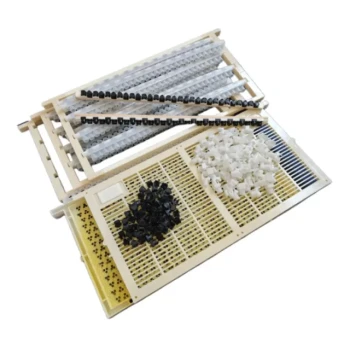
Queen rearing methods span a broad spectrum of difficulty, ranging from relying entirely on natural colony instincts to utilizing highly technical laboratory procedures. The hierarchy moves from the "walk-away split," which is the simplest intervention, through graft-free systems like Jenter and Nicot, to the manual precision of grafting, and finally to the most advanced technique of instrumental insemination.
While advanced methods offer greater control over genetics and timing, the most effective technique is simply the one that matches your scale of production and your manual dexterity.
The Foundation: Leveraging Natural Instincts
The entry-level methods rely on the bees' inherent biology rather than the beekeeper's technical skill.
The Walk-Away Split
This is explicitly recognized as the simplest method available.
The beekeeper divides a colony and allows the queenless half to rear a new queen naturally from existing eggs.
This method requires minimal equipment and zero handling of larvae, making it the default choice for beginners.
The Middle Ground: Graft-Free Systems
For beekeepers who need more queens than a split can provide but lack the dexterity for manual grafting, "graft-free" systems offer a practical solution.
Jenter and Nicot Systems
These are specific hardware setups designed to isolate the queen on a specialized grid.
The queen lays eggs directly into removable cups, which eliminates the need to manually touch or move the larvae later.
Advantages for Small-Scale Production
These systems allow for the creation of numerous, moveable queen cells without the risks associated with handling fragile larvae.
They bridge the gap between hobbyist and commercial methods, providing scalability without demanding advanced motor skills.
The Technical Standard: Manual Grafting
While the references highlight alternatives to this method, manual grafting remains a distinct step up in complexity.
Manual Transfer
This technique involves physically transferring young larvae from a comb into artificial queen cups.
The Barrier to Entry
As noted in the supplementary material, this method is often found to be impractical for many due to the physical requirements.
Successful grafting demands a steady hand and excellent vision, creating a steep learning curve that graft-free systems aim to bypass.
The Apex: Advanced Control
At the far end of the complexity spectrum lies the manipulation of biology itself.
Instrumental Insemination
This is identified as the most intricate and advanced method of queen rearing.
It moves beyond simply raising the queen to controlling her mating process artificially in a laboratory setting.
This allows for precise genetic control that is impossible with open mating, but it requires expensive equipment and specialized training.
Understanding the Trade-offs
Choosing a method involves balancing convenience against control.
Simplicity vs. Quantity
The walk-away split is easy, but it yields very few queens and interrupts the honey production of the parent colony.
Equipment vs. Skill
Graft-free systems (Jenter/Nicot) remove the need for manual skill but require purchasing and cleaning specialized plastic components.
Manual grafting is cheap regarding equipment but expensive regarding the time and practice required to master the physical technique.
Making the Right Choice for Your Goal
To select the correct method, evaluate your resources and your end-game requirements.
- If your primary focus is simplicity and low cost: Utilize the walk-away split to generate a new queen with minimal intervention and no specialized gear.
- If your primary focus is volume without manual dexterity: Invest in a Jenter or Nicot system to produce multiple moveable cells without needing a steady hand for grafting.
- If your primary focus is maximum genetic control: Pursue instrumental insemination (or purchase queens from a breeder who uses it) to ensure precise lineage.
Master the method that fits your hands and your apiary goals, rather than chasing complexity for its own sake.
Summary Table:
| Method | Complexity Level | Key Equipment Needed | Primary Benefit |
|---|---|---|---|
| Walk-Away Split | Low (Beginner) | None (Existing Hive) | Simplest, no manual intervention |
| Graft-Free (Jenter/Nicot) | Medium | Specialized Cup Systems | High volume without manual dexterity |
| Manual Grafting | High | Grafting Tool, Queen Cups | Cost-effective for commercial scaling |
| Instrumental Insemination | Expert | Lab Equipment, Microscopes | Total genetic and mating control |
Scale Your Apiary with HONESTBEE Professional Solutions
Whether you are a commercial apiary looking to automate your honey processing or a distributor seeking high-quality beekeeping supplies, HONESTBEE is your dedicated partner. We provide a full spectrum of industry-essential tools—from specialized hive-making and honey-filling machines to premium hardware and cultural merchandise.
Ready to enhance your production efficiency and honey quality? Contact us today to discover how our wholesale offerings can empower your beekeeping business!
Related Products
- Nicot Queen Rearing Kit for Beekeeping and Grafting in Nicot System
- Retractable Chinese Queen Rearing Grafting Tools Equipment
- Stainless Steel Beekeeping Queen Grafting Tool for Honey Bee Rearing
- Plastic Chinese Queen Grafting Tool for Bee Queen Rearing
- Plastic Beekeeping Honey Bee Larvae Grafting Tools for Queen Rearing and Chinese Grafting
People Also Ask
- What is the primary function of a queen rearing kit? Eliminate Manual Grafting for Superior Bee Breeding
- What are some alternative methods to grafting for queen cell production? Discover Graft-Free Queen Rearing Systems
- How do specialized queen rearing kits and queen management tools improve the success rate of bee colony expansion?
- What specialized tools and supplies are required for commercial queen bee rearing and grafting operations? Discover essential equipment for successful queen production.
- How do modern queen bee rearing and breeding kits improve apiary management? Transition to Proactive Precision Breeding