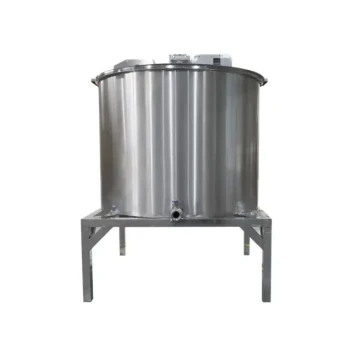
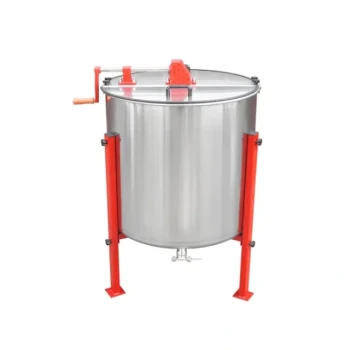
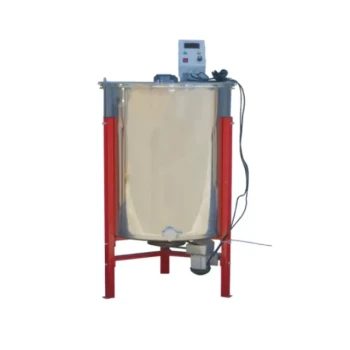
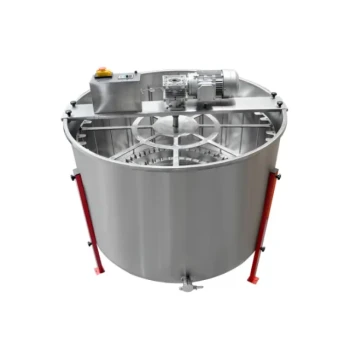
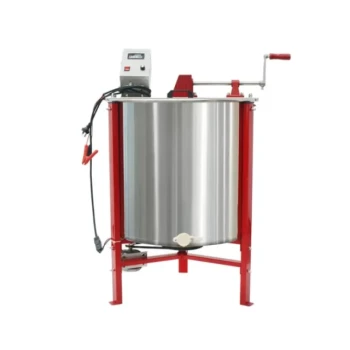
Automatic honey extractors primarily introduce financial and logistical complexities that manual models do not present. While they reduce physical labor, their disadvantages center on significantly higher upfront costs, a rigid dependency on electricity, and the need for specialized maintenance to address potential mechanical or electronic failures.
Core Takeaway While automatic extractors excel at efficiency and volume, they require a reliable infrastructure that many hobbyists lack. You are essentially trading the physical effort of cranking for higher operational costs, decreased portability, and a greater risk of equipment downtime due to technical complexity.
The Financial Implications
Higher Upfront Investment
The most immediate barrier to entry is the cost. Automatic models are significantly more expensive than their manual counterparts due to the inclusion of motors, speed controllers, and more complex gearing systems.
ongoing Repair and Maintenance Costs
Unlike manual extractors, which have few breakable parts, automatic units contain technological components that require regular maintenance.
If a motor burns out or a circuit board fails, you may face substantial repair bills. This adds a layer of financial risk that does not exist with simple hand-cranked machinery.
Infrastructure and Dependency
Reliance on Electricity
An automatic extractor is useless without power. This makes them impractical in remote locations, field setups, or areas with unreliable power grids.
Placement Limitations
Because you must tether the machine to a power outlet, your workflow is restricted to specific areas within your honey house or garage.
You lose the flexibility to extract outdoors or in off-grid structures unless you also invest in generators or long extension cords, which adds further clutter and cost.
Operational Risks and Complexity
Risk of Honeycomb Damage
One of the subtle disadvantages is the loss of tactile feedback. With a manual extractor, you can feel the weight of the frames and adjust your speed instinctively.
Electric motors can easily spin too fast, exerting excessive centrifugal force. If not monitored carefully, this can cause delicate wax combs—especially those that are wire-free or unripe—to "blow out" or break apart inside the basket.
Cleaning Challenges
Electric extractors are generally heavier and more cumbersome due to the motor assembly.
This makes them more challenging to clean and sanitize after harvest. You must be extremely careful not to get water into the electrical components, which complicates the washing process compared to a fully submersible manual unit.
Understanding the Control Trade-offs
The "Touch" Factor
While many automatic extractors offer speed controls, they lack the immediate physical response of a hand crank.
If a load becomes unbalanced in a manual extractor, you feel it immediately and stop. An automatic motor may continue to spin an unbalanced load until the machine "walks" across the floor or damages the internal basket, requiring you to supervise the process closely despite the automation.
Making the Right Choice for Your Apiary
To decide if the disadvantages outweigh the benefits, evaluate your specific beekeeping goals:
- If your primary focus is budget and simplicity: Stick to a manual extractor to avoid maintenance costs and reliance on electricity.
- If your primary focus is preserving delicate wax: Use a manual extractor or a high-end automatic model with very precise low-speed settings to prevent comb blowout.
- If your primary focus is volume and efficiency: The automatic extractor is likely the better choice, provided you have a dedicated space with reliable power.
Select the tool that matches your infrastructure, not just your desire to save time.
Summary Table:
| Disadvantage Category | Key Issues & Risks |
|---|---|
| Financial Impact | High initial purchase price and potential repair costs for motors/electronics. |
| Infrastructure | Absolute dependency on electricity; limited portability for remote or field use. |
| Operational Risk | Risk of 'comb blowout' due to high centrifugal force; lack of tactile feedback. |
| Maintenance | Complex cleaning requirements to protect electrical parts; motor/gear upkeep. |
| Safety & Stability | Potential for machine 'walking' if loads become unbalanced during automated cycles. |
Maximize Your Harvest Efficiency with HONESTBEE
Transitioning to automated beekeeping requires the right partner to mitigate technical risks. HONESTBEE specializes in supporting commercial apiaries and distributors with robust, professional-grade honey-filling machines, hive-making equipment, and a full spectrum of beekeeping tools designed for durability.
Whether you are scaling your operation or stocking essential consumables, our comprehensive wholesale offering ensures you have the reliable machinery and hardware needed to overcome operational complexities.
Ready to upgrade your apiary’s infrastructure? Contact us today to discover how our tailored equipment solutions can enhance your productivity and bottom line.
Related Products
- HONESTBEE 72 Frame Industrial Electric Honey Extractor for Beekeeping
- 32 Frame Commercial Electric Honey Extractor for Beekeeping and Honey Production
- Commercial Electric 12 Frame Honey Extractor Spinner Motorized Honey Extractor
- HONESTBEE 4 Frame Manual Self Reversing Honey Extractor for Beekeeping
- Stainless Steel 3 Frame Manual Honey Extractor Spinner for Bee Honey Extraction
People Also Ask
- What is the importance of balancing honeycomb frames within a honey extractor? Ensure Stability and Protect Machinery
- How is honey separated from the frames after they are uncapped? Efficient Extraction Methods for High Yields
- What are the main benefits of using a honey extractor? Maximize Yields and Protect Your Honeycomb
- What are the recommended methods for removing honey from the honeycomb? Top Extraction Techniques for Maximum Efficiency
- How do manual honey extractors compare to electric honey extractors? Choosing the Right Tool for Your Apiary Growth