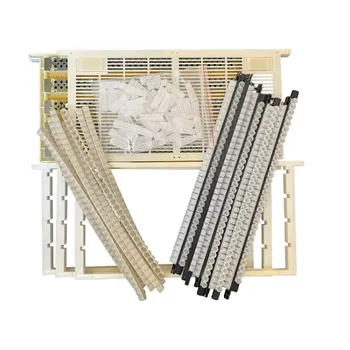
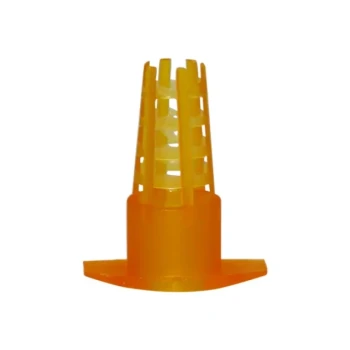
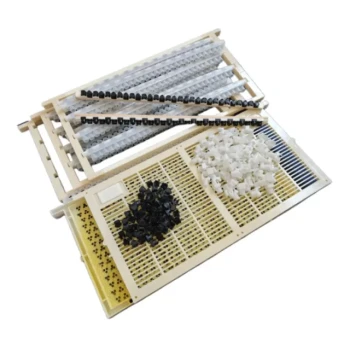
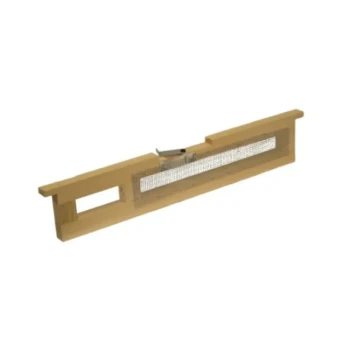
Plastic queen-rearing kits and specialized cell frame systems make commercial queen production more standardized, safer, and easier to scale. Plastic cell bases allow queens to lay directly into removable cups, while cell-bar frames hold those cups securely in a cell-builder hive. Together, they reduce delicate larval handling, improve workflow consistency, and support continuous production across commercial apiaries.
The main advantage is controlled modularity: standardized cups provide consistent cell geometry, while specialized frames enable secure, repeatable movement through laying, acceptance, development, inspection, and transfer.
How the Systems Improve Queen-Rearing Workflow
Direct egg laying reduces grafting risk
A plastic queen-rearing kit can encourage the queen to lay eggs directly into removable plastic cell bases. This avoids transferring very young larvae with a grafting needle.
The result is less risk of crushing, drying, or otherwise damaging fragile larvae during handling. It also reduces dependence on highly experienced grafting operators.
Grafting remains an available production method
Not every commercial operation uses direct egg laying. Plastic queen cups can also be loaded through the Doolittle grafting method, in which young larvae are transferred into cups mounted on cell bars.
This makes the system flexible. A breeder can use direct laying for reduced handling or grafting when precise selection of larval age, colony, or genetic line is required.
Modular components simplify movement
Plastic cell bases, cups, and bar mounts can be assembled, removed, inspected, and transferred as separate modules. This is more efficient than manipulating individual fragile cells throughout the production cycle.
For commercial operations, modularity also supports repeatable procedures across multiple cell-builder colonies and production batches.
Why Standardization Matters at Commercial Scale
Uniform cell dimensions improve compatibility
Plastic cups provide consistent geometry and spacing. They are designed to fit standardized cell bars, grafting frames, and related queen-rearing equipment.
This physical compatibility reduces adjustment time and makes it easier to source replacement components or expand production capacity.
Consistent spacing supports easier inspection
Evenly positioned cells are easier to inspect, count, label, and manage. Operators can quickly identify accepted cells, developmental differences, and cells ready for transfer.
That visibility is valuable when production decisions must be made across dozens or hundreds of queen cells.
Standardization supports repeatable outcomes
Uniform cups provide a consistent physical environment for larvae and nurse bees. However, the equipment does not independently control temperature, humidity, nutrition, or colony strength.
Those biological conditions remain dependent on cell-builder management, feeding, timing, and apiary practices. The system’s contribution is to reduce equipment-related variation and make good management easier to reproduce.
How Specialized Cell Frames Increase Production Capacity
Multiple cells can be managed simultaneously
Cell-bar frames hold numerous queen cups in one structured unit. A single frame can therefore support the simultaneous development of many queen cells.
This increases output compared with relying only on naturally produced queen cells, which are less predictable and harder to schedule.
Vertical placement protects developing cells
When cell-bar frames hang vertically inside a cell-builder hive, the cups remain securely positioned while nurse bees work around them. The frame structure helps prevent accidental contact, compression, or damage during handling.
This protection is especially important when cells contain delicate larvae and royal jelly.
Continuous production becomes more practical
Reusable frames and removable cups allow operators to organize production in batches. One group of cups can be prepared, placed in a builder colony, inspected, and transferred while another group is being cleaned or loaded.
For commercial breeders, this creates a more predictable production rhythm and improves use of labor, colonies, and facilities.
Operational Advantages for Commercial Buyers
Lower labor intensity
Direct-lay systems reduce or eliminate manual grafting for the relevant production method. Even when grafting is used, standardized cups and frames make preparation and transfer more systematic.
Lower handling requirements can improve throughput and reduce the effect of operator fatigue or inconsistent technique.
Reduced training dependence
Grafting remains a specialized skill, particularly when handling very young larvae. A direct-laying plastic system can lower the skill barrier for some stages of production.
It does not eliminate the need for experienced queen-rearing management. Breeders still need to control colony condition, larval timing, mating quality, disease prevention, and selection.
Easier cleaning and disinfection
Durable plastic components can be cleaned and disinfected between production cycles. This supports more disciplined hygiene than systems that depend entirely on disposable or irregular wax components.
Cleaning procedures must still follow the material manufacturer’s guidance and local biosecurity requirements. Reuse is an advantage only when components are properly maintained.
Faster fulfillment and replacement
Standardized systems simplify inventory management for distributors, wholesalers, and commercial apiaries. Cups, cell bases, frames, grafting tools, and replacement mounts can be specified as compatible product groups rather than as unrelated items.
For buyers, dependable availability matters because a missing frame or cup can interrupt an entire production schedule. A supplier with a full-spectrum portfolio, rapid response, and efficient order fulfillment can reduce that operational risk.
Understanding the Trade-offs
Plastic is consistent but not automatically superior to wax
Plastic cups offer durability, dimensional consistency, and repeatability. Fresh beeswax cells may sometimes receive stronger initial acceptance from bees.
Therefore, plastic systems should be evaluated as production tools, not as a guarantee of higher acceptance in every colony or season. Proper preparation, coating when appropriate, cup placement, and cell-builder condition remain important.
Standardization does not guarantee queen quality
A uniform cup can support consistent development, but queen quality depends on more than cell shape. Larval age, nutrition, nurse-bee population, temperature, mating success, genetics, and disease control all influence the final queen.
The equipment improves process control; it does not replace biological management or breeding decisions.
Upfront compatibility must be checked
A kit is valuable only when its cups, bases, cell bars, and frames fit the rest of the operation. Buyers should confirm dimensions, mounting style, frame format, and intended use before ordering.
For resellers, offering compatible components together is more useful than supplying isolated parts without a clear system relationship.
Reusable parts require disciplined hygiene
Plastic’s reusability can reduce recurring consumable needs, but poorly cleaned components may carry contamination between batches. A documented cleaning, inspection, and replacement process is necessary for professional operations.
Damaged or warped cups and mounts should be removed rather than returned to production.
Making the Right Choice for Your Goal
Select the system according to the production method, scale, and level of process control your operation requires.
- If your primary focus is reducing larval handling: Choose a direct-lay plastic queen-rearing kit with removable cell bases to minimize manual transfer of fragile larvae.
- If your primary focus is high-volume production: Use standardized cell-bar frames and modular cups that allow many cells to be managed simultaneously.
- If your primary focus is precise genetic selection: Use compatible plastic cups with grafting tools so operators can transfer larvae from specifically selected colonies.
- If your primary focus is consistent workflow: Prioritize uniform cup dimensions, secure frame mounting, easy inspection, and compatibility across the complete equipment set.
- If your primary focus is hygiene and repeat use: Select durable, cleanable plastic components and establish documented disinfection and inspection procedures.
- If your primary focus is dependable procurement: Work with a supplier able to provide compatible cups, bases, frames, grafting tools, replacement parts, responsive service, and fast order fulfillment.
Used with sound colony management, plastic kits and specialized cell frames give commercial queen breeders a safer, more repeatable, and more scalable production platform.
Summary Table:
| Advantage | Impact |
|---|---|
| Direct egg laying | Reduces grafting risk and larval handling |
| Modular components | Simplify movement and workflow |
| Standardized cups | Ensure uniform cell geometry and compatibility |
| Consistent spacing | Makes inspection and management easier |
| Multiple cells per frame | Increases production capacity |
| Vertical placement | Protects developing cells |
| Reusable and cleanable | Supports hygiene and repeat use |
| Reduced labor and training | Lowers skill barriers for some stages |
Looking to streamline your queen-rearing operation with reliable, high-quality equipment? Contact HONESTBEE today and explore our comprehensive range of beekeeping tools, machinery, and consumables. As a trusted wholesale supplier for commercial apiaries and distributors, we offer one-stop sourcing, fast delivery, and expert support to keep your production running smoothly.
Related Products
- JZBZ Type Wide Base Plastic Queen Cell Cups for Base Mounting and Queen Rearing
- JZBZ Langstroth Queen Rearing Frame for Beekeeping
- HONESTBEE Improved No Grafting Queen Rearing Kit For Queen Rearing and Royal Jelly Production
- Premium Nicot Style Cell Bar Holder and Queen Cell Cup Holder System
- Nicot Queen Rearing Kit for Beekeeping and Grafting in Nicot System
People Also Ask
- What is the primary function of commercial plastic queen cell cups? Driving Efficiency in Mass Queen Rearing
- What are the primary advantages of using plastic queen cell cups? The Industrial Choice for High-Efficiency Apiaries
- What technical advantages do commercial plastic queen cell cups offer? Scale Your Queen Rearing for Maximum Efficiency
- What is the function of standardized plastic Queen Cell Cups? Boost Efficiency in Commercial Larval Grafting
- Why are standardized plastic queen cell cups preferred? Boost Commercial Queen Rearing Efficiency