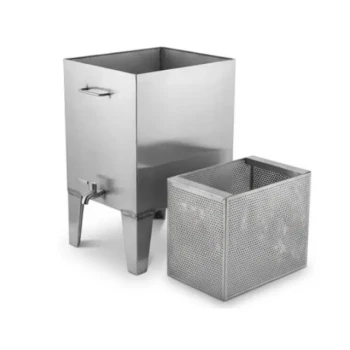
Submerged beeswax extraction offers a decisive operational advantage by utilizing the physical principles of buoyancy and gravity to automate the filtration process. Unlike the traditional sack jute method, which relies on physical force, submerged equipment allows a single operator to manage the workflow, eliminating the need for a multi-person team to manually squeeze molten wax.
By shifting from manual pressing to automated buoyancy separation, operations can recover nearly half the wax volume often lost in traditional methods while simultaneously reducing labor requirements to just one person.
Analyzing the Operational Shift
Automating the Filtration Process
The submerged extraction method leverages buoyancy and gravity to separate impurities from the wax.
Because wax is lighter than the water and impurities involved, it naturally rises to the top while heavier debris settles.
This physical separation occurs automatically within the equipment, removing the variable of human effort from the filtration equation.
Drastic Reduction in Labor Requirements
The traditional sack jute pressing method is inherently labor-intensive.
It requires multiple people to manually squeeze bags of molten wax to extract the product.
In contrast, the submerged equipment design streamlines this entire operation, allowing it to be completed effectively by a single operator.
Maximizing Material Yield
One of the most critical inefficiencies of the traditional sack method is material waste.
Manual pressing often fails to extract all available wax, potentially leading to losses as high as 47%.
Submerged extraction minimizes this waste, ensuring a significantly higher yield of usable product from the same amount of raw material.
Understanding the Trade-offs
Equipment vs. Low-Tech Simplicity
While the operational metrics favor submerged extraction, the traditional method requires very little infrastructure.
Sack jute pressing relies on basic materials like bags and manual force, representing a near-zero technology barrier.
Submerged equipment introduces a level of technical complexity that may require maintenance protocols not needed for manual methods.
Capital Investment Considerations
The efficiency of submerged extraction comes with an implied upfront cost for the machinery.
Traditional methods, while operationally expensive in terms of labor and waste, have negligible equipment costs.
Operators must weigh the long-term savings in wax recovery against the immediate capital expenditure of purchasing specialized equipment.
Making the Right Choice for Your Operation
Deciding between these methods depends on your production volume and resource availability.
- If your primary focus is maximizing yield: The submerged method is essential to stop losing up to 47% of your product to waste.
- If your primary focus is labor efficiency: Transitioning to submerged equipment allows you to reallocate staff, as the process requires only one operator.
- If your primary focus is minimum upfront cost: The traditional sack method avoids equipment expenditure but will cost more in lost product and labor hours over time.
Upgrading to submerged extraction is not just a change in machinery; it is a fundamental shift toward a high-yield, low-labor production model.
Summary Table:
| Feature | Submerged Extraction Method | Traditional Sack Jute Pressing |
|---|---|---|
| Primary Mechanism | Buoyancy & Gravity (Automatic) | Manual Physical Force |
| Labor Requirement | Single Operator | Multi-person Team |
| Wax Recovery Rate | High Efficiency (Minimal Waste) | High Loss (Up to 47% lost) |
| Technical Complexity | Moderate (Requires Machinery) | Low (Basic Tools Only) |
| Operational Focus | High-yield & Low-labor | Low Upfront Cost |
Elevate Your Beekeeping Operation with HONESTBEE
Are you losing nearly half of your wax yield to outdated manual pressing? HONESTBEE empowers commercial apiaries and distributors with cutting-edge beekeeping machinery designed for high-efficiency production. By upgrading to our professional submerged extraction equipment, you can transition to a high-yield, one-person operation while eliminating the waste associated with traditional methods.
From advanced hive-making machines to specialized beeswax processing equipment, our comprehensive wholesale portfolio provides everything you need to scale your business. Contact us today to discuss how our tools can optimize your production and increase your profitability!
References
- Lalisa Biyena. Pre-Extension Demonstration of Crude Beeswax Extraction Technology in Ilu Gelan District, West Shewa Zone, Oromia Regional State, Ethiopia. DOI: 10.11648/j.wjfst.20240804.12
This article is also based on technical information from HonestBee Knowledge Base .
Related Products
- Steam Beeswax Melter Wax Warmer for Wax Processing
- Fully Automatic Beeswax Embossing Machine Foundation Mill
- Electric Beeswax Flat Sheet Machine with Operating Tray for Wax Processing
- Solar Beeswax Melter Easy Solar Wax Melter for Beeswax
- Electric Beeswax Foundation Machine With Operating Tray and Wax Foundation Roller
People Also Ask
- How does a steam wax melter work? A Fast, Efficient Method for High-Quality Wax
- How does a professional steam wax melter optimize the recovery of beeswax? Maximize Yield & Hygiene for Your Apiary
- What are the steps to use a steam wax melter? Master Safe & Efficient Wax Rendering
- How do steam wax melters function in the disinfection of apiary equipment? Achieve Chemical-Free Organic Sterilization
- How do you operate a steam wax melter? Master Efficient Wax Extraction and Frame Sterilization