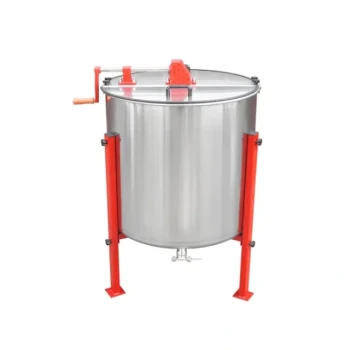
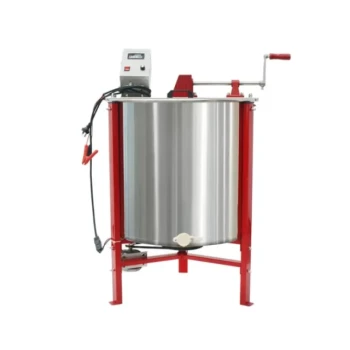
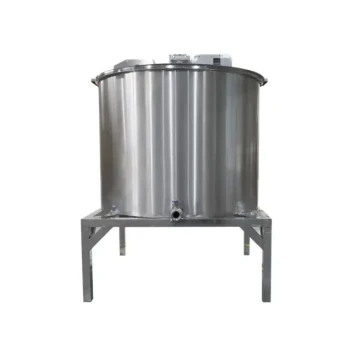
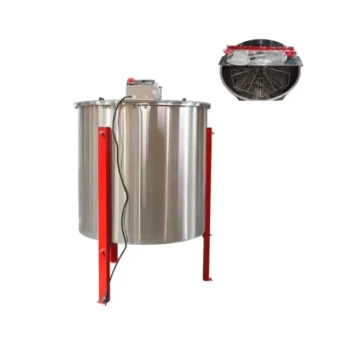
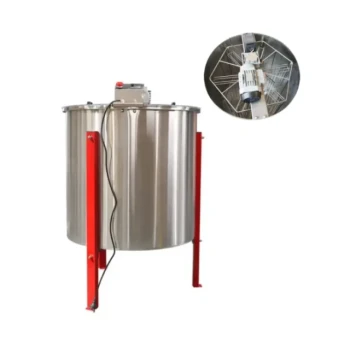
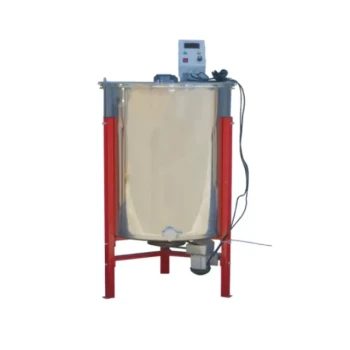
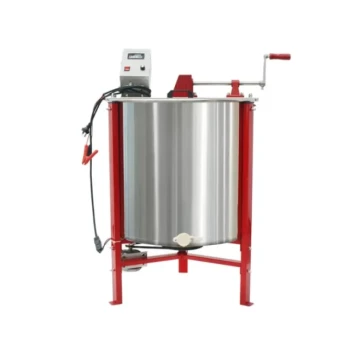
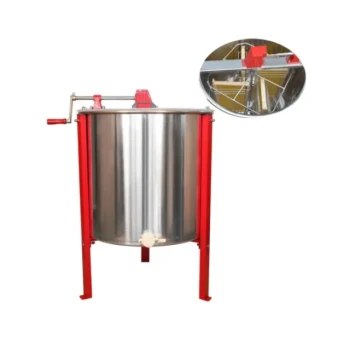
The fundamental operational difference lies in the frame orientation and the resulting workflow. Tangential extractors spin one side of the frame at a time, requiring the operator to stop and manually flip the frames to extract the remaining honey. In contrast, radial extractors position frames like spokes on a wheel, allowing centrifugal force to extract honey from both sides simultaneously in a single uninterrupted cycle.
The choice between these two systems comes down to a balance of budget versus labor; tangential models are affordable but labor-intensive, while radial models require a higher investment but significantly reduce the time and physical effort required per hive.
Operational Mechanics of Tangential Extractors
Parallel Frame Alignment
In a tangential extractor, the baskets are designed to hold the frames with the honeycomb facing outwards.
This positions the face of the comb parallel to the extractor's outer wall.
The Two-Step Process
Because the comb faces the wall, honey is only extracted from the outward-facing side during the spin.
Once the first side is empty, the operator must stop the machine and manually flip every frame.
The process is then repeated to extract honey from the reverse side, effectively doubling the spin cycles required.
Operational Mechanics of Radial Extractors
Perpendicular Frame Alignment
Radial extractors are designed so that the beehive frames are positioned with their top bar facing outwards.
This places the frames perpendicular to the extractor's outer wall, resembling the spokes of a bicycle wheel.
Simultaneous Extraction
This specific arrangement utilizes centrifugal force to pull honey out from both sides of the frames at once.
Because the force acts on both sides equally, there is no need to stop the machine or touch the frames until they are fully drained.
Understanding the Trade-offs
The Cost of Efficiency
Radial extractors are generally more expensive due to their larger capacity and design efficiency.
While they represent a higher upfront cost, they are the standard for managing multiple hives or commercial operations where time is money.
The Labor Factor
Tangential extractors are the most common choice for small-scale hobbyists because they are more affordable.
However, the lower price point comes at the cost of significantly increased physical labor and time spent managing the extraction process.
Making the Right Choice for Your Apiary
Ideally, your choice should align with your current hive count and your future expansion plans.
- If your primary focus is budget and small-scale hobby beekeeping: Choose a tangential extractor, as it offers a cost-effective entry point for managing a few hives where speed is not a priority.
- If your primary focus is efficiency and minimizing physical labor: Invest in a radial extractor to streamline your workflow and process frames from multiple hives in a single, continuous run.
Selecting the right extractor transforms harvest time from a tedious chore into a streamlined, rewarding finish to your season.
Summary Table:
| Feature | Tangential Extractor | Radial Extractor |
|---|---|---|
| Frame Orientation | Parallel to the wall (honeycomb faces out) | Perpendicular (top bar faces out) |
| Extraction Method | One side at a time | Both sides simultaneously |
| Manual Labor | High (frames must be flipped manually) | Low (single uninterrupted cycle) |
| Ideal Scale | Hobbyists / Small-scale (1-5 hives) | Commercial / Professional Apiaries |
| Primary Benefit | Lower initial purchase cost | Maximum time and labor efficiency |
Scale Your Honey Production with HONESTBEE
Efficiency is the backbone of a profitable apiary. At HONESTBEE, we specialize in empowering commercial beekeeping operations and distributors with high-performance machinery. From high-capacity radial honey extractors and honey-filling machines to specialized hive-making hardware, our comprehensive wholesale catalog is designed to minimize labor and maximize output.
Ready to upgrade your workflow? Contact us today to explore our full spectrum of beekeeping tools, machinery, and essential industry consumables. Let’s streamline your harvest together.
Related Products
- 24 Frame Honey Extractor Commercial Radial Honey Frame Extraction Machine
- Stainless Steel Manual 8 Frame Radial Honey Extractor Machine for Beehives
- 6 Frame Manual Stainless Steel Honey Extractor Beekeeping Equipment
- HONESTBEE 8 Frame Electric and Manual Three Use Honey Extractor
- Electric 4 Frame Tangential Honey Extractor
People Also Ask
- How does a radial honey extractor leverage the natural structure of a honeycomb? Optimize Your Apiary's Efficiency
- How do modern honey extraction machines improve harvest efficiency? Boost Your Yield with Radial Technology
- Why must the head of the honey comb be placed near the center axis? Protect Your Comb During Radial Extraction
- Why is the width of iron rings varied for radial honey extractor tilt? Optimize Your Harvest with Precise Engineering
- What are the characteristics of radial honey extractors? Boost Efficiency in Commercial Honey Production