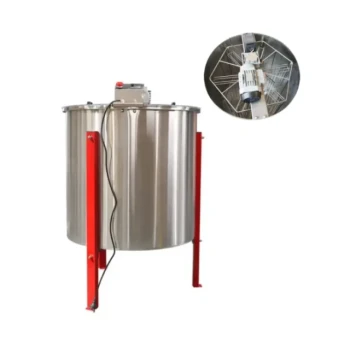
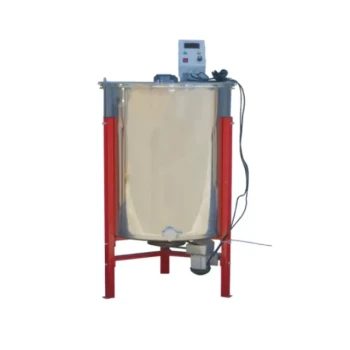
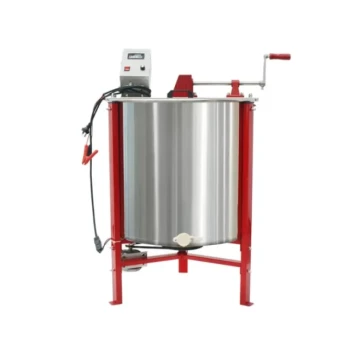
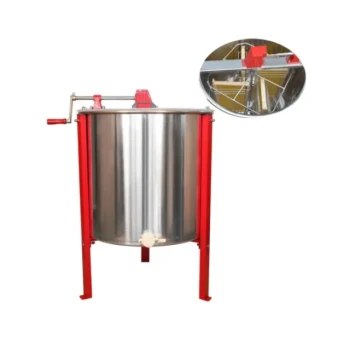
Varying the width of the iron rings is a deliberate engineering modification used to physically tilt the honeycomb frames outward within the extractor. By utilizing a wider ring at the top (typically 18 mm) and a narrower ring at the bottom (typically 15 mm), the design forces the frames to sit at a specific angle rather than remaining vertical. This adjustment is essential for aligning the mechanical force of the extractor with the biological geometry of the honeycomb.
By mimicking the natural slope of the comb, this modification minimizes resistance during the spin cycle, ensuring that honey flows smoothly out of the cells rather than being trapped against the cell walls.
The Physics of the Modification
Leveraging Natural Geometry
Honeybees construct their combs with a specific structural inclination. The cells are not perfectly horizontal; they possess a natural 14-degree upward inclination to prevent nectar from dripping out before it is capped.
In a standard vertical extraction setup, this slight upward slope creates a "lip" that can trap honey, requiring higher speeds or longer durations to empty the comb.
Creating the Optimal Tilt
To counteract the cell's natural slope, the extractor modification uses differential ring widths. By installing a 15 mm wide bottom ring and an 18 mm wide top ring, the frame basket is altered to create a specific outward tilt.
This geometry essentially "flattens" the effective angle of the cells relative to the centrifugal force, turning the upward slope into a straight path for the honey to exit.
Maximizing Extraction Efficiency
When the extractor spins, the tilted frames allow honey to slide directly out of the cells. The centrifugal force acts in parallel with the cell walls rather than fighting against them.
This results in a much smoother flow of honey, leading to higher extraction efficiency. It also significantly reduces the processing time required to empty a batch of frames.
Critical Considerations
Precision is Mandatory
The success of this modification relies entirely on the accuracy of the ring widths. The goal is to match the tilt specifically to the biological 14-degree inclination of the comb.
If the width difference between the top and bottom rings is too small or too large, the angle will not align with the cell structure. This could fail to improve flow or potentially cause uneven stress on the comb during high-speed rotation.
Making the Right Choice for Your Goal
This modification is fundamentally about trading simple fabrication for optimized performance.
- If your primary focus is Extraction Speed: The outward tilt reduces the resistance honey faces leaving the cell, allowing for shorter spin cycles.
- If your primary focus is Maximum Yield: Aligning the frame with the cell's natural slope ensures a more complete evacuation of the comb, minimizing waste.
By harmonizing mechanical design with biological structure, you achieve a more efficient and effective harvest.
Summary Table:
| Component | Ring Width | Function | Geometric Benefit |
|---|---|---|---|
| Top Iron Ring | 18 mm | Forces frame outward | Aligns with 14-degree cell slope |
| Bottom Iron Ring | 15 mm | Stabilizes frame base | Creates the necessary tilt angle |
| Resulting Action | N/A | Centrifugal Force | Minimizes cell wall resistance |
Maximize Your Apiary Efficiency with HONESTBEE
At HONESTBEE, we understand that precision engineering—like the perfect ring-width ratio—is what separates a hobbyist setup from a high-performance commercial operation. As a premier provider for commercial apiaries and distributors, we offer a comprehensive wholesale range of beekeeping machinery, including high-efficiency honey extractors and honey-filling machines designed for maximum yield.
Whether you need specialized hardware or essential industry consumables, our team is ready to support your growth with professional-grade equipment and honey-themed cultural merchandise. Contact us today to discover how our tailor-made solutions can streamline your extraction process and boost your bottom line!
References
- A. Zohairy. Simple and Inexpensive Method to Modify Bee Honey Extractor with Moving Baskets to Radial Extractor is Easy to Jaw and Installion, or with Out Baskets. DOI: 10.21608/jppp.2019.43183
This article is also based on technical information from HonestBee Knowledge Base .
Related Products
- 24 Frame Honey Extractor Commercial Radial Honey Frame Extraction Machine
- Stainless Steel Manual 8 Frame Radial Honey Extractor Machine for Beehives
- 6 Frame Manual Stainless Steel Honey Extractor Beekeeping Equipment
- HONESTBEE 8 Frame Electric and Manual Three Use Honey Extractor
- Electric 4 Frame Tangential Honey Extractor
People Also Ask
- How does a radial honey extractor leverage the natural structure of a honeycomb? Optimize Your Apiary's Efficiency
- How do modern honey extraction machines improve harvest efficiency? Boost Your Yield with Radial Technology
- Why must the head of the honey comb be placed near the center axis? Protect Your Comb During Radial Extraction
- What are the operational differences between radial and tangential honey extractors? Maximize Your Harvest Efficiency
- What are the characteristics of radial honey extractors? Boost Efficiency in Commercial Honey Production