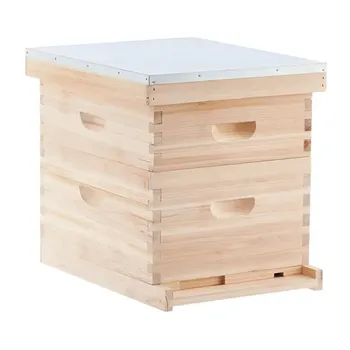
In practical terms, 8-frame and 10-frame Langstroth hives differ mainly in capacity, weight, and handling—not in basic beekeeping method. A 10-frame box holds more brood or honey and is the traditional commercial standard, while an 8-frame box is narrower and substantially easier to lift, move, inspect, and harvest. Both use the same modular Langstroth system, but beekeepers should standardize their woodenware and accessories around one configuration.
The 10-frame system prioritizes maximum capacity per box; the 8-frame system prioritizes lower weight and easier handling. The right choice depends on whether the operation values storage efficiency and established commercial standardization or reduced physical strain and mobility.
Where the Two Configurations Differ Operationally
Box capacity and hive volume
The number refers to the frames accommodated by each box. An 8-frame box holds eight frames, while a 10-frame box holds ten frames of the same depth.
A 10-frame deep therefore provides more internal comb area for brood and honey than an 8-frame deep. For colonies of comparable strength, the 10-frame configuration can offer more space per box and may reduce the number of boxes needed for a given colony size.
Weight during inspections
The largest day-to-day difference is the weight of a full box.
A fully loaded 10-frame deep or honey super can be extremely heavy, with actual weight varying according to box depth, honey density, comb, and moisture. The narrower 8-frame box contains less material when full, making it easier to lift and maneuver.
This matters most when removing supers, separating brood boxes, or working multiple colonies in succession.
Handling and physical strain
An 8-frame configuration can reduce bending, lifting, and carrying demands during routine hive management. It is particularly useful for beekeepers who work alone, have physical limitations, or regularly move colonies between apiaries.
The lighter format can also benefit pollination operations and other projects where hives must be transported or repositioned frequently.
Honey storage and harvesting
A 10-frame hive offers greater honey storage capacity per box. That can be an operational advantage for high-production apiaries seeking efficient use of boxes, pallets, transport space, and storage areas.
An 8-frame hive may require more boxes or more frequent additions to provide equivalent total capacity. However, each individual box is easier to remove during harvesting, which can simplify manual handling and reduce lifting strain.
What Remains the Same
Modular stacking
Both configurations use the same basic Langstroth management principle: boxes can be stacked as the colony expands and honey production increases.
Beekeepers can use deep, medium, or shallow boxes according to their brood-chamber and honey-super strategy. The configuration choice concerns box width and frame count, not a fundamentally different hive-management method.
Frame depth options
An 8-frame or 10-frame box may be built for deep, medium, or shallow frames. Frames of different depths are not interchangeable across depths, so replacement orders must specify the correct size.
The number of frames and the frame depth are separate purchasing decisions.
Standardized frame length
The frame length is generally shared between 8-frame and 10-frame Langstroth boxes of the same depth. This means a correctly sized frame may fit the other configuration’s box, although an 8-frame box accepts fewer frames.
This should not be confused with full-system interchangeability. Covers, bottom boards, boxes, frame rests, and other woodenware are typically configuration-specific because the overall box width differs.
How the Choice Affects Apiary Operations
Inspection workflow
With 10-frame boxes, the greater weight becomes especially noticeable when lifting boxes to inspect lower brood chambers or checking for congestion.
An 8-frame box is easier to remove and replace, allowing more manageable inspections. The trade-off is that the beekeeper may handle a greater number of boxes to provide equivalent colony or honey-storage volume.
Transport and site mobility
The narrower 8-frame profile can make individual units easier to carry and position. This is valuable for remote sites, pollination contracts, or operations where equipment is frequently loaded and unloaded.
The 10-frame format may use space efficiently at the box level because it provides more capacity per unit. Transport planning should therefore consider both box count and the lifting equipment available.
Equipment standardization
A beekeeper should generally select one configuration and maintain it consistently across the apiary. Mixing 8-frame and 10-frame equipment can create avoidable problems with lids, floors, hive stands, boxes, and inventory control.
For distributors and resellers, this distinction is important: customers need configuration-specific woodenware and replacement parts, even where certain frame dimensions overlap.
Inventory and fulfillment
A complete product range should clearly separate 8-frame and 10-frame items by configuration and frame depth. Product descriptions should identify whether a component is intended for 8-frame or 10-frame equipment.
For B2B buyers, reliable fulfillment depends on matching the complete system: hive bodies, supers, covers, bottom boards, frames, foundations, and replacement parts. Supplying a compatible frame alone does not guarantee that all surrounding woodenware will fit.
Understanding the Trade-offs
The 10-frame advantage: capacity and standardization
The 10-frame Langstroth is the traditional industry standard, particularly in North American beekeeping. Its larger internal volume supports higher storage capacity per box and aligns with a broad installed base of equipment.
For high-production apiaries, this can simplify established workflows and reduce the number of hive units required for a target colony or honey-storage volume.
The 10-frame limitation: full-box weight
The same capacity that makes a 10-frame box productive also makes it heavier when full. Removing a full super may require substantial strength, careful technique, or mechanical assistance.
This can slow inspections and harvesting when many boxes must be lifted manually.
The 8-frame advantage: maneuverability
The 8-frame configuration is substantially easier to handle because each box contains fewer frames and less total loaded weight.
That advantage compounds across repeated inspections, migrations, and harvests. It can make a meaningful difference to labor comfort and operational consistency.
The 8-frame limitation: lower capacity per box
An 8-frame box stores less brood or honey than a comparable 10-frame box. A beekeeper may need additional boxes, more frequent super management, or greater storage planning to achieve an equivalent total capacity.
The lighter individual unit does not necessarily mean the entire apiary will require less equipment.
The compatibility risk
Although same-depth frames may share the same length, the two configurations should not be treated as fully interchangeable systems. Width-specific components can become unusable if an operation changes configuration without planning.
Before switching, account for existing woodenware, covers, bottom boards, frames, transport equipment, and supplier availability.
Making the Right Choice for Your Goal
The best configuration is the one that matches both the colony-management objective and the physical realities of the operation.
- If your primary focus is maximum honey storage and commercial capacity: Choose 10-frame equipment for its greater internal volume per box and established industry standardization.
- If your primary focus is easier lifting and reduced physical strain: Choose 8-frame equipment because full boxes are lighter and more manageable during inspections and harvesting.
- If your primary focus is pollination or frequent hive movement: Favor 8-frame equipment for its narrower, more maneuverable format.
- If your primary focus is streamlined purchasing and replacement inventory: Standardize the apiary around one configuration and order boxes, covers, floors, and frames by both frame count and depth.
- If your primary focus is supplying diverse beekeeper customers: Maintain clearly separated 8-frame and 10-frame product lines, with configuration-specific fulfillment and compatibility guidance.
Choose 10-frame for capacity and established commercial standardization, or 8-frame for lighter handling and operational maneuverability.
Summary Table:
| Aspect | 8-Frame Hive | 10-Frame Hive |
|---|---|---|
| Frame Count | 8 frames per box | 10 frames per box |
| Box Width | Narrower | Standard width |
| Weight When Full | Lighter (less comb & honey) | Heavier (more comb & honey) |
| Capacity | Lower per box; may need more boxes | Higher per box; greater storage |
| Ease of Handling | Easier to lift, carry, and inspect | More physically demanding to lift |
| Inspection | Less strain during inspections | More strain; requires more strength |
| Honey Harvest | Easier to remove full supers | Heavier supers; may need help |
| Mobility | Better for frequent moving or pollination | Heavier and less maneuverable |
| Standardization | Less common; niche | Industry standard; widely available |
| Equipment Compatibility | Frames may fit, but boxes and accessories are specific | Frames may fit, but boxes and accessories are specific |
Note: Both use the same Langstroth system but with different widths. Choose based on your priorities for capacity vs. handling.
Ready to upgrade your apiary with the right hive configuration? At HONESTBEE, we supply both 8-frame and 10-frame Langstroth equipment, along with a full range of beekeeping tools and machinery. As a trusted B2B partner, we offer competitive wholesale pricing, OEM/ODM support, fast delivery, and dedicated customer service to streamline your operations. Whether you're scaling up honey production or optimizing for easier handling, our experts can help you standardize your equipment and boost your business. Contact us today to discuss your needs and get a tailored quotation!
Related Products
- High-Performance Langstroth Bee Hives for Global Professional Beekeeping
- Langstroth Honey Bee Box Hive Boxes for Different Depths
- Australian Langstroth Beehive Boxes for Beekeeping Wholesales
- Long Langstroth Style Horizontal Top Bar Hive for Wholesale
- Professional Observation Hive: The Ultimate Portable Solution for Beekeeping Education, Exhibitions, and Colony Displays
People Also Ask
- What structural differences should commercial apiary operators consider when selecting between Langstroth hives and Top Bar hives for standardized honey production? Langstroth for standardized honey production
- Why is the adoption of modern movable-frame hives, such as Langstroth hives, advantageous over traditional hive equipment for commercial apiaries? Key Benefits for Scalable Beekeeping
- What are the structural and yield differences between traditional primitive beehives and modern standard wooden hives (such as Langstroth hives) for commercial honey producers? Discover why modern hives boost yield and efficiency.
- How does transitioning to modern hives boost honey yield? Increase production and product quality for your commercial apiary
- What are the key operational differences and structural trade-offs between Langstroth beehives and top-bar beehives for apiary management? Discover which hive system fits your operational needs.