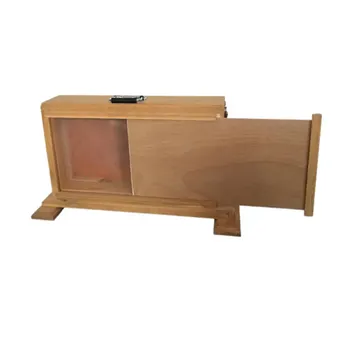
Traditional primitive hives and modern standard wooden hives differ fundamentally in both construction and commercial productivity. Primitive hives, including woven branch-and-mud hives and log hives such as karakovan, generally contain fixed or irregular combs and offer limited control over colony space. Modern systems such as Langstroth hives use standardized boxes and removable frames, enabling systematic inspections, mechanical extraction, comb reuse, and substantially higher yields.
The main commercial advantage of a Langstroth-style hive is not simply greater capacity—it is controllability. Standardized, movable components allow producers to manage colonies more intensively, harvest efficiently, reuse comb, and integrate equipment across a scalable apiary.
How the Hive Structures Differ
Fixed Comb in Traditional Primitive Hives
Primitive hives typically rely on a natural or semi-natural cavity formed from logs, woven branches, mud, or similar local materials.
Bees attach comb directly to the hive walls or internal supports. Because the comb is fixed, beekeepers cannot easily remove, rearrange, or replace individual comb sections without cutting or damaging them.
Modular Boxes in Modern Wooden Hives
Langstroth and similar standard hives are built from interchangeable components, including brood boxes, honey supers, bottom boards, covers, and framed combs.
The hive can be expanded vertically or adjusted according to colony strength and nectar flow. This modularity gives commercial operators direct control over available nesting and honey-storage space.
Movable Frames Enable Inspection
Modern frames allow beekeepers to remove individual combs for inspection without dismantling the entire colony.
Operators can evaluate brood development, food stores, queen performance, disease symptoms, and pest pressure. This level of access is difficult or impossible with fixed-comb hives.
Standard Dimensions Support Equipment Compatibility
Standard woodenware is designed around consistent frame and box dimensions.
That consistency allows Langstroth hives to work with honey extractors, uncapping equipment, transport pallets, storage systems, and other commercial apiary machinery.
Why Structure Affects Honey Yield
Traditional Hives Limit Space Management
In a primitive hive, the colony determines much of the comb layout, while the beekeeper has limited ability to guide its development.
When internal space becomes inadequate or poorly organized, the colony may swarm, reduce production, or abandon the hive. These constraints make output less predictable.
Modern Hives Support Controlled Expansion
A Langstroth hive can receive additional supers when the colony and nectar flow justify expansion.
This prevents honey-storage space from becoming a limiting factor during strong flowering periods. It also enables producers to separate brood areas from harvestable honey more systematically.
Reusable Comb Saves Colony Energy
After honey is extracted from a modern frame, the comb can often be returned to the hive for reuse.
Bees therefore spend less energy rebuilding wax structures and can allocate more resources to brood production, foraging, and honey storage. In fixed-comb systems, harvesting commonly destroys or removes the comb, increasing the colony’s rebuilding burden.
Multiple Harvests Become More Practical
Removable frames support repeated inspection and harvesting during the production season.
This is a major commercial distinction. Traditional systems may permit only limited or destructive harvests, while modern systems are better suited to planned, cyclical production.
Typical Yield Differences
Primitive Hives Generally Produce Less
Traditional primitive hives are commonly associated with low and variable yields.
The primary reference places typical production at approximately 3 to 5 kilograms per hive, while supplementary figures cite traditional outputs ranging from roughly 5 to 7 kilograms or, under broader conditions, 20 to 25 kilograms. These differences reflect variations in hive type, climate, forage availability, colony strength, and whether the figure represents one harvest or annual production.
Modern Hives Have Higher Yield Potential
Standardized modern hives are commonly reported at approximately 15 to 20 kilograms per harvest or 45 to 50 kilograms per hive per year under favorable management and forage conditions.
In exceptionally strong colonies and high-nectar environments, the primary reference identifies potential yields of up to 90 kilograms per hive. This should be treated as an upper-end performance figure rather than a universal commercial benchmark.
Yield Comparisons Must Use the Same Basis
A yield comparison is meaningful only when it specifies whether the number refers to one harvest, one season, or one full year.
For commercial planning, distributors and producers should compare equipment using consistent assumptions for local forage, colony population, harvest frequency, management skill, and climate. A modern hive improves production potential, but it does not guarantee maximum yield without strong colonies and competent management.
Operational Advantages for Commercial Apiaries
Faster and More Consistent Inspections
Removable frames allow workers to inspect colonies using a repeatable process.
This improves labor planning across large apiaries and makes it easier to identify weak colonies, disease, queen problems, or insufficient food stores before they reduce production.
More Efficient Honey Extraction
Langstroth frames can be placed directly into centrifugal honey extractors.
This removes honey while preserving the comb, allowing the frame to return to the hive. Traditional fixed comb generally requires cutting, pressing, or crushing, which is slower and less compatible with mechanized extraction.
Better Sanitation and Quality Control
Standardized removable components make it easier to replace damaged frames, clean equipment, and separate brood comb from honey-storage comb.
This supports better sanitation and more consistent honey handling than systems in which comb is permanently attached to the hive structure.
Easier Transport and Inventory Management
Standard hive bodies and frames can be stacked, palletized, transported, and stored using consistent dimensions.
For wholesalers and distributors, this simplifies product bundling, spare-parts management, container planning, and fulfillment across different customer orders.
More Predictable Product Specification
Modern hive components can be manufactured to defined dimensions and quality standards.
This is important for commercial buyers who need repeatable fit, reliable assembly, and compatibility among boxes, frames, covers, extractors, and replacement parts.
Understanding the Trade-offs
Primitive Hives Have Lower Entry Complexity
Primitive hives can often be made from locally available materials with limited tooling.
They may be appropriate for subsistence beekeeping, cultural preservation, low-input production, or regions where manufactured equipment is difficult to obtain.
Modern Hives Require More Investment
Standard hives require purchased components, maintenance, transport, protective equipment, and appropriate management knowledge.
The initial equipment cost is higher, and commercial returns depend on sufficient forage, healthy colonies, trained labor, and reliable seasonal conditions.
Standardization Does Not Eliminate Management Risk
A Langstroth hive provides better access and control, but it does not automatically prevent swarming, disease, pests, poor nutrition, or colony loss.
Its value is that it gives the beekeeper the access and tools needed to respond to these problems more effectively.
Yield Claims Should Not Be Treated as Guarantees
Figures such as 45 kilograms, 50 kilograms, or even 90 kilograms per hive describe potential performance under particular conditions.
Suppliers should present yield expectations with clear assumptions rather than using the highest possible figure as a universal promise. Buyers should request specifications and performance guidance suited to their target region.
Mechanization May Favor One System Over Another
Langstroth hives are well suited to centrifugal extraction and other standardized equipment.
Top-bar and other nonstandard systems can produce quality honey, but their free-hanging combs often require manual cutting or pressing and are generally less compatible with conventional commercial extraction lines.
Making the Right Choice for Your Goal
The appropriate hive system depends on whether the priority is local simplicity, premium artisanal production, or scalable commercial output.
- If your primary focus is maximum commercial yield: Choose standardized movable-frame hives, such as Langstroth systems, and pair them with disciplined colony management and sufficient super capacity.
- If your primary focus is mechanized harvesting: Prioritize standardized frames and hive dimensions that integrate with extractors, uncapping equipment, pallets, and transport systems.
- If your primary focus is low-cost or locally sourced beekeeping: Primitive hives may be suitable, but plan for lower, more variable yields and more labor-intensive harvesting.
- If your primary focus is equipment distribution: Offer a complete product portfolio covering hive bodies, frames, supers, bottom boards, covers, extractors, replacement parts, and compatible accessories.
- If your primary focus is long-term apiary scalability: Select standardized woodenware that supports interchangeable inventory, rapid replenishment, consistent quality, and efficient order fulfillment.
For commercial honey producers, modern standard hives provide the structural control and operational compatibility needed to turn beekeeping from a low-input activity into a scalable production system.
Summary Table:
| Feature | Traditional Primitive Hives | Modern Standard Wooden Hives (Langstroth) |
|---|---|---|
| Comb Structure | Fixed, irregular, attached to walls | Removable frames in standardized boxes |
| Inspection Access | Difficult, destructive | Easy, non-destructive via movable frames |
| Space Management | Limited, not adjustable | Expandable with supers, controlled |
| Honey Yield | 3-25 kg per hive (varies) | 15-50+ kg per hive per year (up to 90 kg) |
| Extraction Efficiency | Destructive (cutting/crushing) | Non-destructive with centrifugal extractors |
| Equipment Compatibility | Low | High (extractors, pallets, etc.) |
| Scalability for Commercial Use | Low | High |
Upgrade your apiary with HONESTBEE's premium beekeeping equipment. As a leading wholesale supplier for commercial apiaries and distributors, we offer a comprehensive range of hives, extractors, and accessories. Enjoy fast delivery, OEM/ODM support, and dedicated service. Maximize your yields and efficiency—contact us today to get a custom quote!
Related Products
- High-Performance Langstroth Bee Hives for Global Professional Beekeeping
- Langstroth Honey Bee Box Hive Boxes for Different Depths
- Australian Langstroth Beehive Boxes for Beekeeping Wholesales
- Long Langstroth Style Horizontal Top Bar Hive for Wholesale
- Professional Observation Hive: The Ultimate Portable Solution for Beekeeping Education, Exhibitions, and Colony Displays
People Also Ask
- Why is the adoption of modern movable-frame hives, such as Langstroth hives, advantageous over traditional hive equipment for commercial apiaries? Key Benefits for Scalable Beekeeping
- How does transitioning to modern hives boost honey yield? Increase production and product quality for your commercial apiary
- How do Langstroth and Dadant standard beehives compare regarding brood chamber management and component compatibility? Find the Perfect Fit for Your Apiary
- What are the key operational differences and structural trade-offs between Langstroth beehives and top-bar beehives for apiary management? Discover which hive system fits your operational needs.
- What hardware and equipment are typically provided by beekeeping extension services? Scale Your Commercial Apiary