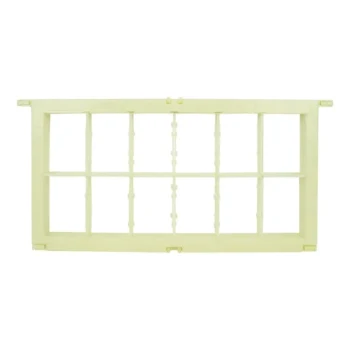
For standard modern Langstroth-style hives, use self-spacing Hoffman frames in brood boxes and Manley frames in honey supers. The most common specification is deep Hoffman frames for brood, paired with medium or shallow Manley frames for honey production. For simpler inventory and easier handling, many operations standardize on 8-frame medium boxes and matching medium frames throughout the hive.
Recommended baseline: Hoffman self-spacing frames for brood chambers, Manley self-spacing frames for honey supers, and wired wax foundation or beeswax-coated plastic foundation for stable, fast comb construction.
Recommended Frame Specifications
Brood-box frames
Brood chambers typically use Hoffman self-spacing frames because their shaped side bars maintain consistent bee space without separate frame spacers.
Common brood-frame options include:
- Deep frame: Approximately 9 1/8 inches high, used in a 9 5/8-inch deep hive body.
- Standard or medium frame: Approximately 6 1/4 inches high, used in a 6 5/8-inch medium hive body.
- Extra-deep frame: Approximately 12 inches high, used in specialized deep brood equipment.
Deep frames provide substantial comb area for brood production and colony expansion. Medium frames are increasingly popular because they are lighter and can be standardized across brood boxes and supers.
Honey-super frames
Honey supers generally use Manley frames, which have wider top bars and are designed to maintain spacing in honey-producing boxes.
Typical choices include:
- Medium Manley frame: Approximately 6 1/4 inches high, used in a 6 5/8-inch medium super.
- Shallow Manley frame: Approximately 5 3/8 inches high, used in a 5 11/16-inch shallow super.
- Deep super frame: Approximately 9 1/8 inches high, although deep honey supers are less convenient to lift when full.
Medium and shallow frames are preferred for supers because a fully filled honey box can become very heavy. Smaller boxes reduce lifting strain during inspections, transport, harvesting, and extraction.
Why Self-Spacing Frames Are Preferred
Hoffman frames simplify hive management
Hoffman brood frames incorporate self-spacing side bars that maintain the correct separation between adjacent frames. This removes the need for loose metal or plastic spacers.
Consistent spacing makes frame removal, inspection, and replacement faster. It also reduces the risk of disturbing bees or damaging comb while manipulating the hive.
Manley frames support honey production
Manley frames are commonly selected for honey supers because their wider top bars help maintain dependable frame spacing. They are particularly practical where supers are removed frequently for harvesting.
The exact design should be matched to the box and the supplier’s stated spacing dimensions. Frame and box systems from different manufacturers should not be assumed to be interchangeable without verification.
Foundation and Frame Construction
Wired wax foundation
Brood frames are best supplied with pre-wired wax foundation when comb strength and long-term durability are priorities. Wire reinforcement supports the comb during inspections, transportation, and mechanical extraction.
This is especially important for deep frames, which contain more comb and can flex or break under the weight of brood, nectar, and honey.
Beeswax-coated plastic foundation
Durable plastic frames or plastic foundation coated with a light film of beeswax are another practical option. The wax coating encourages bees to accept the foundation and begin drawing comb more promptly.
For commercial supply, confirm that the product is genuinely beeswax-coated, rather than untreated plastic. Uncoated plastic may require additional preparation before bees readily use it.
Choosing Between Deep and Medium Systems
Traditional deep brood and medium supers
A conventional modern configuration uses:
- Two deep brood boxes
- Deep Hoffman frames in the brood chambers
- Medium Manley frames in honey supers
This arrangement provides generous brood capacity while keeping honey supers more manageable than deep boxes.
A single brood box may also be used, depending on climate, bee strain, management style, and seasonal colony growth.
Uniform medium equipment
An apiary can instead standardize around 8-frame medium boxes for both brood and honey production. This allows medium frames to move between hive levels and reduces the number of box and frame sizes that must be stocked.
Uniform equipment can simplify purchasing, transport, inspections, extraction, and replacement-part management. It is also attractive for distributors and commercial beekeepers seeking a more streamlined product portfolio.
Box and Frame Compatibility
Match frame depth to box depth
The frame must correspond to the internal depth of the hive body or super:
| Hive component | Approximate box depth | Matching frame height |
|---|---|---|
| Deep hive body or super | 9 5/8 inches | 9 1/8 inches |
| Medium hive body or super | 6 5/8 inches | 6 1/4 inches |
| Shallow super | 5 11/16 inches | 5 3/8 inches |
The small difference between box depth and frame height provides clearance for the frame rests, bottom space, and correct bee-space management.
Eight-frame and ten-frame boxes
A standard hive body commonly holds 10 frames, while 8-frame boxes are also widely used. Eight-frame equipment is lighter and easier to handle, particularly when boxes are filled with honey.
Ten-frame systems remain common because they offer greater capacity per box and broad compatibility with established beekeeping equipment.
Understanding the Trade-offs
Deep frames offer capacity but increase weight
Deep brood frames provide substantial comb area and are suitable for colonies requiring significant brood capacity. However, deep boxes and frames become heavy when filled, making them less attractive for honey supers.
A full deep super can weigh approximately 45 kilograms, or 100 pounds, depending on honey density and equipment design. This is why medium and shallow supers are generally preferred for harvesting.
Uniform medium equipment simplifies operations
Using medium boxes throughout the hive reduces inventory complexity and permits frame interchangeability. The trade-off is that colonies may require more boxes to provide the same brood capacity as a deep-box system.
The best choice depends on whether the priority is maximum brood volume per box or easier handling and standardized equipment.
Frame spacing must remain consistent
Mixing Hoffman, Manley, and non-self-spacing frames without a spacing plan can create uneven bee space. Bees may respond by building burr comb or irregular comb, making inspections and harvesting more difficult.
For reliable operation, use one spacing system per hive component and verify the manufacturer’s frame dimensions before placing a purchase order.
“Standard” dimensions are not completely universal
Manufacturers may use different nominal descriptions for deep, medium, and shallow equipment. Small dimensional differences can affect frame fit, bee space, and compatibility.
Distributors should specify both the nominal frame type and the actual frame height, top-bar length, side-bar width, and box compatibility in product documentation.
Making the Right Choice for Your Goal
The recommended specification depends on the operating model and handling requirements.
- If your primary focus is conventional brood production: Use deep Hoffman frames, approximately 9 1/8 inches high, in 9 5/8-inch brood boxes, preferably with wired wax foundation.
- If your primary focus is manageable honey harvesting: Use medium or shallow Manley frames matched to 6 5/8-inch or 5 11/16-inch supers.
- If your primary focus is inventory simplicity: Standardize on 8-frame medium boxes and matching medium self-spacing frames across brood and honey chambers.
- If your primary focus is commercial durability: Offer wired wax foundation or beeswax-coated plastic foundation and clearly verify frame-to-box compatibility.
- If your primary focus is wholesale or distribution efficiency: Stock the core deep Hoffman, medium Manley, and shallow Manley configurations while documenting exact dimensions and interchangeable components.
The most dependable modern specification is a self-spacing Hoffman brood frame paired with a self-spacing Manley honey-super frame, matched precisely to the selected box depth.
Summary Table:
| Frame Type | Use | Typical Height | Box Depth |
|---|---|---|---|
| Hoffman (Deep) | Brood box | 9 1/8 in | 9 5/8 in |
| Hoffman (Medium) | Brood box or super | 6 1/4 in | 6 5/8 in |
| Manley (Medium) | Honey super | 6 1/4 in | 6 5/8 in |
| Manley (Shallow) | Honey super | 5 3/8 in | 5 11/16 in |
Ensure your beekeeping operation uses the right frames for maximum efficiency. Contact HONESTBEE today for wholesale supply of Hoffman and Manley frames, foundation, and all your beekeeping needs. Our one-stop sourcing, fast delivery, and expert support help distributors and beekeepers succeed. Get in touch now!
Related Products
- Assembled Wooden Bee Frames with Plastic Foundation for Durability and Convenience by HONESTBEE
- Langstroth Honey Bee Box Hive Boxes for Different Depths
- Australian Langstroth Beehive Boxes for Beekeeping Wholesales
- Professional Sectional Comb Honey Frame with 250g Cassette System for Beekeeping
- 5 Frame Wooden Nuc Box for Beekeeping
People Also Ask
- What are the technical advantages of using bee frames with plastic foundation? Boost Hive Efficiency and Durability
- When should frames with new foundation be given to colonies? Master Timing for a Thriving Hive
- Do you have to wire bee frames? Essential Guide to Frame Strength & Honey Harvesting
- How do you re-wax bee frames? A Simple Guide to Faster Comb Building
- What types of bee frames can be cleaned and returned to service? A Guide to Safe Apiary Refurbishment