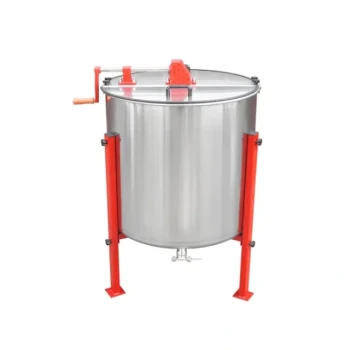
Specialized honey extraction equipment fundamentally outperforms traditional squeezing methods by utilizing negative pressure or centrifugal force to isolate honey without destroying the colony's nest structure. While traditional squeezing crushes honey pots, brood, and pollen together, specialized devices extract pure honey while leaving the hive architecture intact, resulting in a cleaner product and a healthier colony.
Core Takeaway The transition from squeezing to specialized extraction represents a shift from "harvesting by destruction" to "harvesting by preservation." By keeping the stingless bees' cerumen pots intact, you significantly increase production frequency and eliminate the impurities that lead to spoilage.
Preserving Hive Architecture and Colony Health
Protection of Cerumen Pots
Stingless bees store honey in specialized cerumen pots rather than the uniform hexagonal combs found in European honeybee hives. Traditional squeezing crushes these delicate structures completely.
Specialized suction devices allow you to extract honey while keeping these pots physically intact. This is the single most critical technical advantage for long-term sustainability.
Reducing the "Rebuild Interval"
When pots are destroyed by squeezing, the colony must divert energy and resources to rebuild their storage structures before they can produce honey again.
By using extraction equipment that preserves the pots, you eliminate this reconstruction phase. This significantly shortens the interval between harvest cycles, leading to higher overall productivity.
Minimizing Biological Stress
Manual squeezing often inadvertently damages the brood nest (where larvae are raised) and kills adult bees.
Specialized equipment allows for precise localization. You can target honey pots specifically without disturbing the brood or killing the workforce, ensuring the colony remains stable and strong for agricultural pollination services.
Elevating Product Purity and Quality
Eliminating Contamination Sources
Squeezing inevitably mixes honey with impurities such as pollen (bee bread), larval debris, royal jelly, and propolis.
Specialized extractors use a closed-loop or precise suction system to pull only the liquid honey. This prevents the "cloudy" appearance and distinct off-flavors associated with high impurity levels found in squeezed honey.
Controlling Fermentation Risks
Stingless bee honey naturally has a higher moisture content than standard honey, making it highly susceptible to fermentation.
Impurities introduced during squeezing—specifically pollen and larval fluids—accelerate this fermentation process. By using sterile, non-destructive extraction, you lower the microbial load and potential yeast sources, helping the product meet commercial physical and chemical standards.
Prevention of Secondary Contamination
Traditional manual handling exposes the honey to open air and human contact.
Modern extraction devices often utilize sterile tubing and collection bottles. This creates a closed system that drastically minimizes exposure to external pathogens and environmental debris.
Operational Efficiency and Pest Control
Pest Deterrence
Squeezing releases strong scents from crushed propolis and pollen, which can attract pests like phorid flies and ants that threaten the colony.
Specialized syringes or electric pumps penetrate only the honey pots, limiting the leakage of attractant scents. This helps maintain colony security against predators.
Processing Speed and Standardization
While manual squeezing is labor-intensive and inconsistent, industrial-grade extractors and automated filling machines offer high precision.
For commercial operations, this ensures consistent product specifications. It allows for the handling of larger volumes without the bottleneck of manual filtration required to clean squeezed honey.
Understanding the Trade-offs
Equipment Cost and Complexity
While squeezing requires zero investment, specialized equipment introduces upfront costs for vacuum pumps, aspirators, or centrifugal machines. It also introduces a maintenance requirement to keep tubes and pumps sterile.
Power Dependency
Many high-efficiency suction devices require electricity. In remote apiaries without power, reliance on electric vacuum pumps can be a logistical constraint compared to manual methods, though portable manual suction units exist to mitigate this.
Making the Right Choice for Your Goal
To select the best method for your operation, assess your primary objective:
- If your primary focus is Commercial Grade Honey: You must use specialized suction or centrifugal equipment to ensure low impurity levels, reduce fermentation risk, and meet shelf-life standards.
- If your primary focus is Colony Multiplication: You should use non-destructive suction devices to prevent brood damage and reduce bee mortality, keeping the population strong for splitting.
- If your primary focus is Low-Cost Hobbyist Consumption: You may stick to manual extraction, but be aware that the honey will ferment faster and the colony will require longer recovery times.
By respecting the structural integrity of the hive, specialized equipment transforms honey harvesting from a traumatic event for the bees into a sustainable, repeatable process.
Summary Table:
| Feature | Traditional Squeezing | Specialized Extraction |
|---|---|---|
| Hive Impact | Destroys cerumen pots & brood | Preserves nest architecture |
| Purity Level | High impurities (pollen, debris) | Pure, clear liquid honey |
| Recovery Time | Long (requires rebuilding pots) | Rapid (immediate production) |
| Fermentation Risk | High due to contamination | Low due to sterile processing |
| Efficiency | Labor-intensive & inconsistent | Fast, standardized, & scalable |
Maximize Your Apiary’s Potential with HONESTBEE
Transition from destructive harvesting to professional-grade preservation. At HONESTBEE, we empower commercial apiaries and distributors with the specialized tools needed to elevate honey quality and colony productivity.
Our comprehensive wholesale range includes:
- Advanced Extraction Machinery: High-precision suction and centrifugal systems designed for stingless bee honey.
- Industrial Hardware: Durable hive-making and honey-filling machines for seamless operations.
- Complete Equipment Supply: From essential consumables to honey-themed cultural merchandise.
Ready to scale your production and deliver a superior honey product? Contact us today to explore our wholesale solutions!
References
- Mufid Arsyad, Nanang Apriyanto. Pemberdayaan Masyarakat melalui Pelatihan Budidaya Lebah Klanceng untuk Ketahanan Ekonomi dan Konservasi Lingkungan. DOI: 10.71365/ejpm.v3i2.90
This article is also based on technical information from HonestBee Knowledge Base .
Related Products
- Stainless Steel Manual 8 Frame Radial Honey Extractor Machine for Beehives
- 6 Frame Manual Stainless Steel Honey Extractor Beekeeping Equipment
- HONESTBEE 2 Frame Manual Acrylic Honey Extractor Beekeeping Equipment
- 2 Frame Stainless Steel Manual Honey Spinner Extractor for Beekeeping
- Electric 8 Frame Honey Spinner Extractor Equipment for Beekeeping
People Also Ask
- What types of beehive frames are compatible with honey extractor machines? Find the Perfect Match for Your Apiary
- Which type of honey extractor is generally more durable? Focus on Material & Build Quality for Longevity
- What are the key features and benefits of a stainless steel honey extractor? Upgrade to Professional Purity
- Why are manual extractors popular among beginner beekeepers? A Guide to Starting Simple & Saving Money
- What are the disadvantages of a manual honey extractor? Overcome Efficiency Bottlenecks in Your Apiary