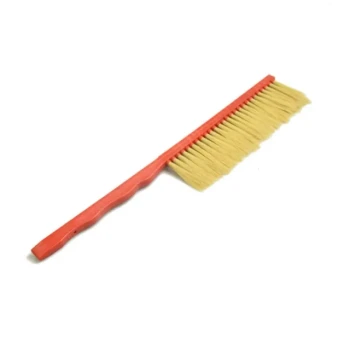
The primary technical benefit of using a 100-needle Pin-test Brush is the ability to deliver simultaneous, uniform mechanical damage across a large sample size of brood cells. Unlike manual single-needle methods, this tool standardizes the mortality event, effectively eliminating time-based variables and human error from the data collection process. By puncturing 100 cells instantly, it establishes a precise "Time Zero" for measuring the hygienic response efficiency of a honeybee colony.
Core Takeaway The 100-needle Pin-test Brush transforms the pin-killed brood assay from a manual, variable-prone task into a standardized scientific process. By synchronizing larval death, it ensures that any variance in cleaning speed is attributed solely to the colony's genetic hygienic behavior, not the testing methodology.
The Mechanics of Standardized Testing
The validity of hygiene behavior assessments relies entirely on the consistency of the stimulus provided to the colony. The 100-needle brush addresses the mechanical inconsistencies inherent in manual testing.
Eliminating Time-Based Variables
Manual testing requires a technician to prick cells one by one, which creates a time lag between the first and last puncture.
The 100-needle brush engages the entire sample area simultaneously. This synchronization ensures that the 24-hour removal clock starts at the exact same moment for every larva in the test group.
Ensuring Uniform Damage Intensity
Human fatigue or slight variations in hand angle can lead to inconsistent puncture depths when using single pins.
The brush design enforces a uniform depth and angle of entry for all 100 needles. This guarantees that every larva receives an identical "standardized stimulus," preventing data skew caused by partially damaged or missed larvae.
Simulating Natural Mortality Scenarios
The goal of the assay is to mimic natural brood failure to trigger the colony's cleanup response.
By delivering consistent mechanical damage, the brush effectively simulates a sudden onset of larval mortality. This provides a clear, high-intensity signal to the colony, allowing for an accurate measurement of their cleaning efficiency.
Implications for Genetic Selection
Beyond the physical mechanics, using a standardized brush has significant downstream effects on breeding programs and stock selection.
Quantifying Social Immunity
Social immunity refers to the collective defensive behaviors of the colony, specifically their ability to detect and remove threats.
The 100-needle brush allows beekeepers to objectively quantify this trait. By calculating the percentage of cleared cells within 24 hours against a known baseline of 100, you obtain a hard metric for the colony's "sanitation" speed.
Screening for Disease Resistance
Hygienic behavior is a heritable trait closely linked to resistance against brood diseases like chalkbrood and American Foulbrood.
Using this high-throughput tool allows breeders to rapidly screen multiple colonies. It identifies stocks that possess the genetic ability to uncap and remove diseased individuals before infection spreads.
Understanding the Trade-offs
While the 100-needle brush offers superior consistency, it is important to recognize the limitations and requirements of the method.
Destructive Sampling
This method is inherently destructive; it intentionally terminates 100 developing bees per test.
While necessary for data collection, this represents a loss of resources for the colony. It should be applied judiciously, specifically when selecting breeder queens or assessing critical stock health.
Requirement for Brood Pattern Density
The tool requires a solid, contiguous patch of capped brood to function correctly.
If a queen has a "spotty" laying pattern with many empty cells, the 100-needle brush may not hit 100 larvae. This can complicate the calculation of percentages if the user does not verify exactly how many cells contained viable larvae prior to piercing.
Making the Right Choice for Your Goal
The decision to use a 100-needle Pin-test Brush depends on the scale and precision required by your operation.
- If your primary focus is Commercial Breeding: Use the brush to screen large numbers of colonies rapidly, ensuring that your "hygienic" designation is based on standardized, comparable data.
- If your primary focus is Small-Scale Observation: A single pin may suffice, but acknowledge that the variability in puncture timing will make your data less scientifically rigorous than the brush method.
Summary: The 100-needle Pin-test Brush is the definitive tool for converting subjective observations of hive cleanliness into objective, quantifiable genetic data.
Summary Table:
| Feature | 100-Needle Pin-test Brush | Manual Single-Needle Method |
|---|---|---|
| Puncture Timing | Simultaneous (100 cells at once) | Sequential (Time lag between cells) |
| Stimulus Uniformity | High (Fixed depth and angle) | Low (Subject to human fatigue/error) |
| Data Precision | Precise "Time Zero" for assays | Variable start times for cleaning |
| Efficiency | High-throughput for commercial use | Slow; suitable for small-scale only |
| Primary Metric | Quantitative Social Immunity | Qualitative Observation |
Elevate Your Breeding Precision with HONESTBEE
Are you looking to quantify the social immunity of your colonies with scientific accuracy? HONESTBEE specializes in supporting commercial apiaries and distributors with high-quality beekeeping machinery and essential tools designed for professional standards.
Our 100-needle Pin-test Brushes allow you to rapidly screen for disease-resistant genetics, ensuring your stock meets the highest hygiene benchmarks. Beyond specialized hardware like hive-making and honey-filling machines, we provide the comprehensive wholesale solutions and consumables your business needs to thrive.
Ready to upgrade your apiary’s efficiency? Contact us today to explore our full spectrum of beekeeping equipment and industrial tools.
References
- Piotr Dziechciarz, Krzysztof Olszewski. Dead Brood of Apis mellifera Is Removed More Effectively from Small-Cell Combs Than from Standard-Cell Combs. DOI: 10.3390/ani12040418
This article is also based on technical information from HonestBee Knowledge Base .
Related Products
People Also Ask
- What is the specific function of a bee brush? Ensure Pure Harvests and Colony Welfare During Honey Extraction
- What is the purpose of using a bee brush during the inspection of hive components? Safe & Precise Hive Management
- What problem does a bee brush solve? Protect Your Colony with Gentle Precision Tools
- What are the key features of a popular bee brush? Essential Design for Bee Safety and Hive Hygiene
- What are the key characteristics of the bristles on a bee brush? Master Gentle and Efficient Bee Removal