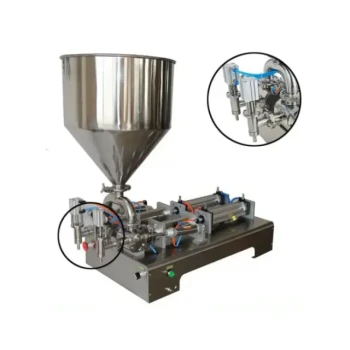
To establish a complete, automated honey production line, you must integrate the filler with four specific auxiliary machines: a honey bottle unscrambler, a bottle washing machine, a capping machine, and a labeling machine. These components work in unison to transform raw packaging into a market-ready product without manual intervention.
Core Takeaway While the filler is the heart of the operation, the auxiliary equipment ensures the entire process—from empty bottle to shelf-ready product—maintains high hygiene standards and operational speed. This mechanization is essential for reducing labor costs and preventing secondary contamination.
The Anatomy of an Automated Line
To move beyond simple filling and achieve a scalable production workflow, you must address the handling of the container before and after the fill.
Sorting the Containers
The process begins with the honey bottle unscrambler.
This machine takes bulk, disorganized containers and orients them correctly onto the conveyor belt. It ensures a steady, consistent flow of bottles into the system, eliminating the bottleneck of manual loading.
Ensuring Food Safety
Before any product enters the container, it must pass through a bottle washing machine.
This step is critical for maintaining the high hygiene standards required for food products. It removes dust or debris from storage, ensuring the vessel is sterile before the honey is introduced.
Sealing the Product
Once the honey filler has dispensed the precise volume, the container moves immediately to the capping machine.
This unit applies and tightens the jar lids or bottle caps. rapid sealing is vital to prevent airborne contamination and preserve the freshness of the honey.
Finalizing for Retail
The final stage involves the labeling machine.
This equipment applies branding, nutritional information, and compliance data to the container. It ensures a professional finish that enhances market competitiveness.
The Strategic Value of Integration
Connecting these machines creates a closed-loop system with distinct advantages over standalone filling.
Hygiene and Contamination Control
Automated lines significantly reduce human contact with the product.
By mechanically moving bottles from washing to filling to capping, you prevent secondary contamination. This protects the integrity of the honey and ensures it meets safety regulations.
Consistency and Efficiency
Auxiliary machines standardize the physical handling of the product.
While the filler ensures volume consistency, the full line ensures production timing consistency. This mechanization drastically reduces labor costs associated with manual sorting, capping, and labeling.
Understanding the Trade-offs
While a complete line offers efficiency, it introduces new complexities that must be managed.
Increased Maintenance Demands
Adding four auxiliary machines increases the number of moving parts in your facility.
You must plan for a stricter maintenance schedule to prevent one machine from halting the entire line. If the capper fails, the filler cannot operate effectively.
Space and Capital Requirements
A full production line requires a significantly larger physical footprint than a standalone filler.
You must ensure your facility has the floor space for the conveyors and machinery, as well as the electrical infrastructure to support simultaneous operation.
Making the Right Choice for Your Goal
Selecting the right configuration depends on your current scale and future growth targets.
- If your primary focus is high-volume market entry: Invest in the full auxiliary suite (unscrambler, washer, capper, labeler) to maximize speed and minimize per-unit labor costs.
- If your primary focus is budget conservation: Prioritize the capping machine alongside the filler to ensure seal integrity, while handling sorting and labeling manually until revenue supports further automation.
True efficiency comes not just from filling jars quickly, but from creating a seamless, sanitary path from the washer to the warehouse.
Summary Table:
| Machine Type | Primary Function | Value to Production |
|---|---|---|
| Bottle Unscrambler | Automatically orients and feeds containers | Eliminates manual loading bottlenecks |
| Bottle Washing Machine | Sterilizes and removes debris from containers | Ensures food safety and hygiene standards |
| Capping Machine | Securely seals containers post-filling | Prevents contamination and preserves freshness |
| Labeling Machine | Applies branding and compliance data | Enhances retail professionalism and speed |
Scale Your Honey Business with HONESTBEE Professional Automation
Transitioning from manual filling to a complete, automated production line is the key to maximizing efficiency and ensuring product integrity. HONESTBEE specializes in supporting commercial apiaries and distributors with our comprehensive wholesale range of beekeeping equipment. From high-precision honey-filling machines to a full suite of auxiliary hardware like bottle unscramblers and cappers, we provide the tools you need to reduce labor costs and eliminate contamination risks.
Whether you are expanding your facility or starting a new distribution hub, our team is ready to design a solution tailored to your production goals. Contact HONESTBEE today to build your high-performance honey production line.
Related Products
- Fully Automatic Honey Filling Packaging Machine for Processing Line
- Precision Durable Efficient HONESTBEE Rotary Honey Filling Machine
- Small Honey Filling Machine Sachet Packing Equipment Single Nozzle
- Economy Small Honey Filling Machine Honey Bottle Filler Packaging Machine
- Precision Automated Packaging Turntable Honey Spoon Filling Sealing Packing Machine
People Also Ask
- Why are fully automatic honey filling and packaging lines essential? Boost Your Honey's Market Value and Quality
- What is a fully-automatic honey filler? Streamline Your Production with High-Precision Automation
- How do automated honey filling and packaging machines affect profitability? Boost Margins with HONESTBEE Technology
- How do automated honey filling and packaging machines contribute to the market value of honey products? Maximize Your ROI
- How do industrial-grade automated honey filling and packaging machines mitigate the risk of physical contamination?