High royal jelly production is a coordinated biological and operational advantage. In genetically superior nurse bees, royal jelly output is supported by increased activity in pathways for protein synthesis, amino acid metabolism, lipid and sugar metabolism, and oxidative energy production. Specialized grafting, queen-rearing, feeding, harvesting, and cold-chain tools help apiaries align colony management with this biology, allowing high-potential bees to produce more royal jelly consistently while protecting quality.
Genetics establishes the production ceiling, but management and equipment determine how much of that potential becomes saleable royal jelly. The best results come from combining high-yield bee lines, nutritionally supported nurse bees, precisely timed grafting and harvest cycles, and hygienic processing.
What Drives Royal Jelly Production in Nurse Bees
Nurse bees have an unusually high metabolic workload
Royal jelly is a protein-rich glandular secretion produced primarily by the hypopharyngeal and mandibular glands of young nurse bees. Producing it at commercial volumes requires sustained protein assembly, energy generation, secretion, and cellular maintenance.
High-yielding lines therefore show more than a simple increase in one gene. They exhibit coordinated changes across several metabolic and cellular pathways that support intensive gland activity.
Protein synthesis pathways supply the secretion machinery
Up-regulation of ribosome-related pathways increases the cell’s capacity to assemble the proteins found in royal jelly. Proteasome activity also helps manage protein quality by removing damaged or misfolded proteins during high-output secretion.
This matters because nurse bees must continuously synthesize and export glandular proteins. A colony with stronger protein-production capacity can potentially sustain greater output per nurse bee.
Amino acid metabolism supports royal jelly formation
Amino acids are the building blocks of the proteins secreted into royal jelly. Enhanced amino acid metabolism helps nurse bees obtain, process, and direct these building blocks toward glandular production.
This pathway is particularly dependent on colony nutrition. Adequate access to pollen or a suitable high-protein feed supports the biological resources required for sustained secretion.
Sugar and fatty acid metabolism provide energy and cellular materials
Royal jelly production consumes substantial energy. Up-regulated sugar metabolism helps supply that energy, while fatty acid metabolism contributes to energy storage, membrane maintenance, and other cellular functions associated with active secretion.
These pathways help explain why high-yield production is not simply a matter of adding more larvae. Nurse bees must have the energy and metabolic resources to maintain gland activity throughout the rearing cycle.
Oxidative processes support high cellular activity
Increased oxidative metabolism helps generate the energy required for protein synthesis and secretion. High-yielding nurse bees also show greater mitochondrial density in gland cells, indicating an adaptation for intensive energy production.
This benefit must be balanced with cellular protection. Heat shock proteins such as HSP60 and HSP90 help protect protein folding and secretion machinery under demanding physiological conditions.
Dop2 and hex71 are important validated markers
The dopamine receptor type D2 gene, Dop2, is associated with the regulatory systems that help coordinate nurse-bee behavior and gland activity. Its up-regulation is one molecular feature observed in high royal jelly-producing bees.
The hex71 hexamerin storage protein gene supports the storage and management of nutrients needed during intensive production. Together, Dop2 and hex71 help illustrate that high output depends on both biological regulation and resource allocation.
How Nutrition and Bee Age Unlock Genetic Potential
Gland development determines secretory capacity
High-yielding royal jelly lines commonly have larger and more numerous hypopharyngeal gland acini, longer glands, greater secretory activity, and higher mitochondrial density than standard honey-production lines.
These structural differences give selected lines a stronger physiological foundation for producing royal jelly. However, the glands still require appropriate nutrition and colony conditions to operate at that capacity.
Protein feed supports nurse-bee glands
A high-protein feed based on honey and pollen, delivered through specialized feeders, can stimulate development of the hypopharyngeal and mandibular glands. Consistent nutrition is especially important when natural pollen or nectar is limited.
Feeders also help maintain a positive rearing drive during queen-rearing periods. For commercial apiaries, this provides more predictable production than relying solely on variable forage conditions.
The nurse-bee age window must be managed precisely
Hypopharyngeal gland activity is generally strongest in young nurse bees, with a particularly productive window around 6 to 12 days of age. A broader operational range of approximately 4 to 15 days can be useful, but production planning should prioritize the peak period whenever possible.
Grafting and harvest schedules should therefore be synchronized with the availability of this nurse-bee population. Equipment cannot compensate for a colony that lacks enough appropriately aged nurses at the time of production.
How Specialized Tools Convert Biology into Production
Precision grafting tools increase production consistency
Grafting needles and related queen-rearing consumables allow operators to transfer selected larvae into artificial queen cups with greater speed and uniformity. This creates a repeatable production system based on high-yield maternal lines.
For distributors and commercial apiaries, precision tools are operationally important because they reduce variation between batches. They also support the testing and expansion of specialized royal jelly bee strains.
Artificial queen cups and cell bar frames organize scale
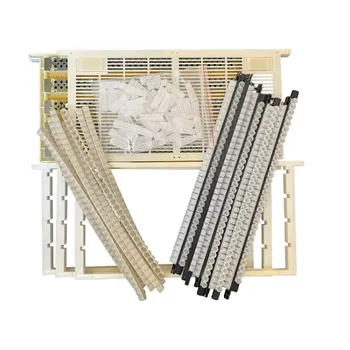
Artificial queen cups provide standardized locations for larval transfer and royal jelly accumulation. Cell bar frames arrange these cups efficiently, making it easier to manage large numbers of developing cells within production colonies.
This organization improves labor efficiency and supports high-frequency harvesting. It also helps apiary teams coordinate grafting, nurse-bee management, inspection, and collection across multiple colonies.
Queen-rearing systems support repeatable colony management
Queen-rearing frames and associated hive components help producers maintain colonies structured for repeated larval introduction and royal jelly collection. They create a controlled production environment rather than requiring operators to improvise within standard honey-production equipment.
For wholesale and B2B sourcing, a complete system is often more valuable than isolated tools. Compatibility between frames, cups, grafting instruments, feeders, and harvesting devices reduces delays and simplifies staff training.
Harvesting equipment improves hygiene and throughput
Efficient extraction devices help remove royal jelly from cells quickly and consistently. Hygienic designs reduce contamination risks and limit unnecessary exposure during collection.
This is particularly important for high-frequency production, where slow or poorly standardized harvesting can negate the advantage of a genetically superior colony. The equipment should support clean handling, repeatable workflows, and rapid transfer to controlled storage.
Cold-chain and processing systems protect product quality
Royal jelly is biologically active and sensitive to handling conditions. Specialized processing equipment and cold-chain protocols help preserve its stability after collection.
Commercial processors should also be able to monitor core indicators such as 10-hydroxy-2-decenoic acid (10-HDA), pH, and moisture. These measurements support batch consistency and help verify that processing has not compromised the product.
Understanding the Trade-offs
Genetics does not replace colony management
Selective breeding can dramatically increase potential yield, with specialized lines reported to produce many times more royal jelly than standard lines. However, genetic potential is only realized when colonies have enough young nurse bees, suitable nutrition, and correctly timed production cycles.
Treating genetics as a standalone solution often leads to disappointing results. The colony environment must match the demands of the selected line.
More production can increase nutritional and labor demands
High-output colonies consume resources rapidly because gland development and secretion require protein, sugars, and metabolic energy. They also require more frequent inspections, grafting, harvesting, sanitation, and recordkeeping.
Apiaries should evaluate equipment purchases against labor capacity and feed availability. A larger production system is not automatically more profitable if collection and processing cannot keep pace.
Feeding requires control, not simply volume
Feeders are valuable when natural forage is insufficient or when the production schedule demands consistent nutrition. Excessive, poorly managed, or contaminated feed can create operational and product-quality problems.
Feeding programs should be standardized, monitored, and aligned with the colony’s developmental stage. The objective is to support nurse-bee gland activity without disrupting normal colony management.
High-frequency harvesting can create quality risks
Frequent collection increases throughput but also raises the importance of hygienic handling, rapid cooling, and equipment cleaning. Delays between harvest and stabilization can reduce product consistency.
Processing systems should therefore be selected as part of the production workflow, not added as an afterthought. A fast grafting operation paired with inadequate extraction or storage capacity creates a bottleneck.
A broad product portfolio must still be technically compatible
One-stop sourcing is useful only when the components work together. Grafting tools, cell bars, queen cups, feeders, frames, extraction devices, and cold-chain equipment should be evaluated for compatibility, durability, cleaning requirements, and replacement availability.
For distributors and resellers, technical expertise and rapid fulfillment add value when they help customers build a complete, workable system rather than purchase disconnected products.
Making the Right Choice for Your Goal
A practical sourcing strategy should connect the biological objective—maintaining highly productive nurse bees—with the equipment required to manage, harvest, and preserve their output.
- If your primary focus is maximizing colony yield: Use high-potential royal jelly lines, maintain a strong population of 6- to 12-day-old nurse bees, and support them with consistent high-protein nutrition.
- If your primary focus is scaling commercial production: Combine precision grafting tools, artificial queen cups, cell bar frames, queen-rearing components, and efficient harvesting devices into one compatible workflow.
- If your primary focus is product quality: Prioritize hygienic extraction, rapid cooling, cold-chain handling, and standardized checks for 10-HDA, pH, and moisture.
- If your primary focus is distribution or resale: Offer a full-spectrum product portfolio backed by compatibility guidance, responsive customer service, reliable stock, and fast order fulfillment.
- If your primary focus is operational efficiency: Select durable, easy-to-clean tools that reduce handling time and allow frequent grafting and harvesting without creating processing bottlenecks.
When biology, colony management, and specialized equipment are designed as one system, apiaries can convert genetic potential into reliable, high-quality royal jelly production.
Summary Table:
| Pathway | Role in Royal Jelly Production |
|---|---|
| Protein synthesis | Supplies the machinery for producing royal jelly proteins. |
| Amino acid metabolism | Provides building blocks for protein synthesis. |
| Sugar and fatty acid metabolism | Generate energy and support cellular functions. |
| Oxidative processes | Fuel high cellular activity and energy production. |
| Dop2 and hex71 markers | Associated with regulation and nutrient storage. |
Unlock your apiary's full royal jelly potential with HONESTBEE's premium grafting tools, queen-rearing systems, and hygienic harvesting equipment. Our comprehensive wholesale portfolio, rapid delivery, and expert support help you maximize yield and quality. Contact us today to optimize your production!
Related Products
- No Grafting Queen Rearing Kit: System for Royal Jelly Production and Queen Rearing
- HONESTBEE Improved No Grafting Queen Rearing Kit For Queen Rearing and Royal Jelly Production
- Plastic Chinese Queen Grafting Tool for Bee Queen Rearing
- Automated Rotary Bottle Unscrambler for Honey Production Line
- All-Stainless Steel Pivoting Honey Uncapping Fork for Beekeeping
People Also Ask
- What is the primary function of a queen rearing kit? Eliminate Manual Grafting for Superior Bee Breeding
- How do specialized queen rearing kits and queen management tools improve the success rate of bee colony expansion?
- What are some alternative methods to grafting for queen cell production? Discover Graft-Free Queen Rearing Systems
- Are queen rearing systems generally suitable for all honeybee species? Master Efficient Breeding Methods
- Are queen rearing systems suitable for all beekeepers? Modern Tools for Every Experience Level