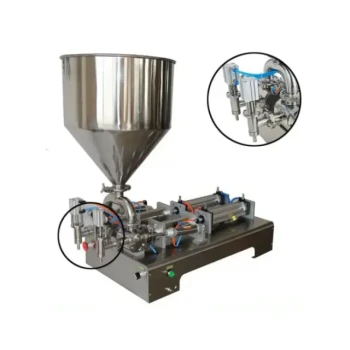
Selecting the right honey filling machine is a critical decision that impacts your production efficiency, product quality, and long-term profitability. To make an informed choice, you must evaluate the machine's filling accuracy for consistent volume, its operational speed relative to your production targets, and its flexibility in handling various container sizes. Additionally, you must prioritize construction quality—specifically food-grade stainless steel for hygiene—along with the manufacturer's capacity to provide automation options, technical support, and warranty coverage.
Core Takeaway While production speed often drives the initial search, the long-term value of a honey filling machine is defined by its precision and hygiene standards. Prioritizing filling accuracy and food-grade construction minimizes product waste and ensures safety, which are foundational to protecting your brand's reputation.
Ensuring Hygiene and Durability
Material Construction
The most critical non-negotiable factor is the construction material. You must ensure the machine is built from food-grade stainless steel.
Corrosion Resistance
Honey is acidic and requires equipment that resists corrosion over time. High-quality stainless steel ensures the machine remains hygienic and durable, preventing contamination and extending the asset's lifespan.
Ease of Maintenance
Evaluate how easily the machine can be disassembled and cleaned. A design that facilitates rapid cleaning helps maintain strict hygiene standards and minimizes downtime between production runs.
Evaluating Performance and Efficiency
Filling Accuracy
Precision is paramount to avoid giving away free product or under-filling jars. You must assess the machine's ability to deliver consistent fill volumes repeatedly, regardless of minor fluctuations in the honey's viscosity.
Production Speed and Capacity
Analyze your daily production requirements against the machine's rated speed. You need a system that meets your current targets while offering enough headroom to handle peak seasons without becoming a bottleneck.
Automation Level
Determine whether a semi-automatic or fully automatic system suits your labor model. Semi-automatic models are cost-effective for smaller operations, while fully automatic systems significantly reduce labor costs for high-volume factories.
Operational Flexibility
Container Versatility
Your machine should not limit your marketing strategy. Verify the equipment's capacity to adjust to different container sizes, shapes, and materials, from standard glass jars to squeeze bottles or sachets.
Product Viscosity Handling
Honey viscosity changes with temperature and type. The machine must offer adjustable settings to handle these variations smoothly without compromising speed or accuracy.
Navigating Common Trade-offs
Upfront Cost vs. Long-Term Efficiency
Fully automatic machines command a higher initial price but deliver lower per-unit labor costs. Conversely, semi-automatic machines save capital upfront but may limit your ability to scale rapidly without adding manual labor.
Versatility vs. Specialization
Machines designed for a specific container type (like honey sticks) are often highly efficient but lack versatility. A "universal" filler offers flexibility for various jar sizes but may require more time to calibrate when switching between formats.
Making the Right Choice for Your Goal
To select the best machine, align the technical specifications with your specific business stage and goals.
- If your primary focus is Scalability: Prioritize a fully automatic system with high throughput capacity to minimize labor costs as your volume increases.
- If your primary focus is Budget and Flexibility: Choose a semi-automatic machine with adjustable settings that allows you to fill various jar sizes without a massive capital investment.
- If your primary focus is Quality Assurance: Focus heavily on filling accuracy specifications and easy-to-clean stainless steel construction to ensure every jar meets strict weight and hygiene standards.
Ultimately, the best machine is one that balances your current production reality with the reliability required for future growth.
Summary Table:
| Evaluation Criterion | Key Consideration | Why It Matters |
|---|---|---|
| Material Quality | Food-grade stainless steel | Ensures hygiene and resists honey's natural acidity. |
| Filling Accuracy | Consistent volume precision | Prevents product giveaway and ensures regulatory compliance. |
| Automation Level | Semi-auto vs. Fully automatic | Balances upfront capital investment with long-term labor costs. |
| Versatility | Container size and viscosity | Allows for diverse product lines and handling different honey types. |
| Maintenance | Ease of disassembly | Reduces downtime and ensures strict food safety standards. |
Scale Your Honey Production with HONESTBEE
Choosing the right equipment is the foundation of a successful honey business. At HONESTBEE, we specialize in empowering commercial apiaries and distributors with high-performance honey-filling machines, hive-making machinery, and a full spectrum of beekeeping tools.
Whether you need specialized hardware or essential industry consumables, our comprehensive wholesale offerings are designed to enhance your efficiency and product quality. Partner with us to access professional-grade equipment that grows with your brand.
Ready to optimize your honey processing line?
Contact HONESTBEE Today for a Custom Solution
Related Products
- Precision Durable Efficient HONESTBEE Rotary Honey Filling Machine
- Semi Automatic Small Honey Bottle Filling Machine Honey Filler
- Economy Small Honey Filling Machine Honey Bottle Filler Packaging Machine
- Fully Automatic Honey Filling Packaging Machine for Processing Line
- Commercial Rotary Honey Filling Machine for Production
People Also Ask
- How do honey filling and processing machines aid native bee product conservation? Boost Value with HONESTBEE Technology
- What is a key feature of the new generation of the honey filling machine? The Advanced Electronic Control Unit
- What are the common types of bottling machines used for honey? Choosing the Right Solution for Your Apiary
- What quality control role does professional honey filling equipment perform? Ensure Consistency and Product Stability
- How do high-precision honey filling machines ensure quality? Optimize Your Commercial Production with HONESTBEE