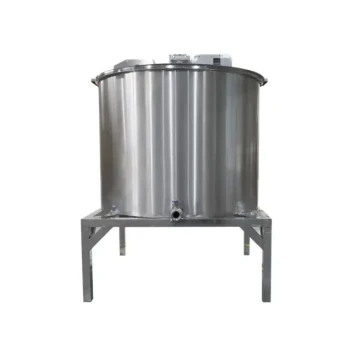
Honey collection centers operate as the critical logistical bridge between dispersed, individual apiaries and the standardized demands of international markets. These facilities serve two primary purposes: providing the specific hardware necessary for large-scale storage and primary processing, and executing the logistical function of consolidating fragmented production into export-grade lots.
The central value of a collection center is the transformation of variable, raw local production into a stable, tradeable commodity. By centralizing storage and quality screening, these nodes minimize physical product loss and provide the technical infrastructure required to meet high-end market entry standards.
Essential Hardware Infrastructure
Standardized Storage Solutions
The foundational hardware of a collection center consists of standardized storage drums and temperature-controlled environments.
This equipment allows for the accumulation of significant volume while ensuring the physical and chemical characteristics of the honey remain stable after leaving the apiary. Proper storage hardware is the first line of defense against spoilage and quality degradation.
Primary Processing and Filtration
Collection centers are equipped with primary processing equipment, specifically preliminary filtration systems and automatic filling machines.
Filtration removes physical impurities (wax, debris) without altering the honey's composition. Automatic filling hardware performs precise measurement and packaging under sterile conditions, effectively preventing secondary contamination that often occurs during manual handling.
Quality Evaluation Tools
To function as a gatekeeper for the supply chain, these centers utilize basic testing tools for initial quality screening.
This hardware enables the facility to conduct export-grade evaluations on-site. By identifying unqualified products immediately, the center filters out low-quality batches before they enter the broader logistics chain, preserving the reputation of the region.
Logistical Functions and Supply Chain Strategy
Overcoming Geographical Fragmentation
Logistically, collection centers serve as consolidation hubs that reduce the physical distance between remote beekeepers and major markets.
By aggregating production at a central point, producers in isolated regions can overcome geographical barriers. This allows them to bypass low-price local buyers and connect directly with higher-value cooperatives and distributors.
Optimization of Transportation
These centers significantly lower overall transportation costs through volume consolidation.
Instead of individual beekeepers transporting small quantities over long distances, specialized logistics vehicles move heavy equipment and consolidated honey shipments between the center and distribution points. This increases logistical efficiency and ensures fragile products are handled correctly during transit.
Standardization and Traceability
A critical logistical function is the standardization of packaging and product identification.
Using uniform, food-grade containers improves stacking efficiency and reduces breakage rates during shipping. Furthermore, this standardization creates the physical infrastructure necessary for product traceability, a non-negotiable requirement for entering high-end international markets.
Operational Requirements and Trade-offs
The Necessity of Strict Hygiene
While collection centers offer efficiency, they introduce a critical point of failure regarding contamination.
Because large volumes of honey from different sources are aggregated here, the sanitation of the "automatic filling machines" and storage drums is paramount. A failure in sterile protocols at this node can contaminate an entire regional shipment, negating the value of the infrastructure.
Balancing Volume vs. Quality Control
There is an inherent tension between throughput volume and rigorous screening.
Collection centers must maintain strict acceptance criteria using their testing tools. If the focus shifts too heavily toward logistics speed (moving volume) rather than utilizing the quality control nodes to filter unqualified products, the center ceases to add value and simply moves lower-grade product more efficiently.
Making the Right Choice for Your Goal
To leverage honey collection centers effectively, you must align your operational focus with your market objectives.
- If your primary focus is accessing international markets: Prioritize centers equipped with advanced temperature control and standardized grading hardware to ensure your product maintains chemical stability during export.
- If your primary focus is economic sustainability for local producers: Focus on the logistical capability of the center to consolidate volume, allowing you to bypass local middlemen and negotiate with larger distributors.
Ultimately, the collection center is not just a warehouse, but a technical filter that converts raw agricultural output into a verified commercial asset.
Summary Table:
| Feature Category | Essential Components | Strategic Function |
|---|---|---|
| Hardware | Standardized Storage Drums, Filtration Systems | Prevents spoilage, removes impurities, and ensures chemical stability. |
| Equipment | Automatic Filling Machines, Testing Tools | Enables sterile packaging and on-site export-grade quality screening. |
| Logistics | Consolidation Hubs, Specialized Transport | Reduces transportation costs and bridges the gap between remote apiaries and global markets. |
| Compliance | Food-grade Containers, Traceability Systems | Standardizes packaging to meet international trade regulations and safety standards. |
Scale Your Honey Production with HONESTBEE
Transform your raw honey production into a high-value commercial enterprise. HONESTBEE empowers commercial apiaries and distributors with the professional-grade infrastructure needed to dominate the market. From hive-making and honey-filling machines to specialized beekeeping tools and hardware, we provide the full spectrum of equipment necessary to run a world-class collection center.
Ready to enhance your efficiency and reach international standards? Contact HONESTBEE today to discover how our wholesale machinery and industry consumables can optimize your supply chain.
References
- Margarita Rosales González, Amada Rubio Herrera. Apicultura y organizaciones de apicultores entre los mayas de Yucatán. DOI: 10.19130/iifl.ecm.2010.35.27
This article is also based on technical information from HonestBee Knowledge Base .
Related Products
- Double Nozzle Small Honey Filling Machine Honey Sachet Packing Packaging Equipment
- HONESTBEE 2 Frame Manual Acrylic Honey Extractor Beekeeping Equipment
- electric honey extractor honey centrifuge 3 frame honey extractor stainless steel honey frame extractor
- Honey Concentrating Vacuum Heating Thickening Machine Dehumidifier for Honey
- Food Grade Plastic Honey Bucket Pail for Beekeeping
People Also Ask
- What value do retail packaging equipment and filling technologies provide in the honey distribution process? Maximize ROI
- How does industrial honey-filling machinery support Robinia pseudoacacia stands? Maximize Your Acacia Honey Yield
- How does high-precision honey filling equipment protect honey's biological activity? Safeguard Purity & Premium Value
- What is honey filling equipment used for? Optimize Your Bottling with Precision Automation
- What role does precision filling equipment play in cost control? Maximize Honey Profits & Market Growth