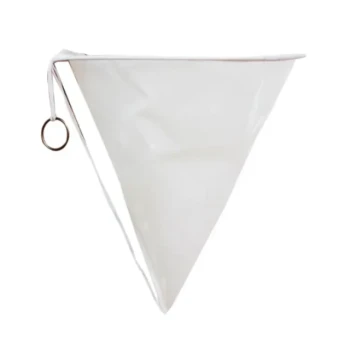
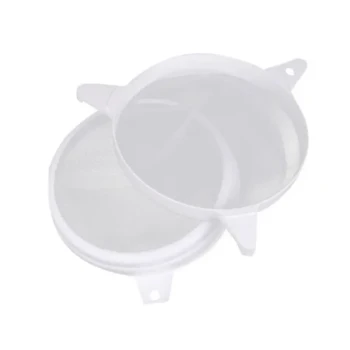
Honey filtration equipment ranges from simple stainless-steel sieves to high-capacity vacuum and pressure systems. Basic mesh filters remove wax particles, pollen, bee debris, and comb fragments, while settling tanks provide additional gravity-based separation. For apiaries processing honey from hundreds of hives, multi-bucket vacuum filtration systems offer faster flow, staged filtration, and fewer interruptions from clogging.
The right system depends on throughput and product requirements: sieves and filter cloth suit smaller operations, settling tanks add gentle clarification, and vacuum-assisted multi-bucket systems are better suited to continuous commercial processing.
Honey Filtration Equipment Options
Stainless-Steel Mesh Sieves
Stainless-steel mesh sieves are the simplest filtration option for raw honey discharged from an extractor. They capture visible wax particles, pollen clusters, bee fragments, and larger hive debris before the honey enters a tank or bottling line.
Their corrosion resistance and straightforward cleaning make them practical for beekeepers, wholesalers, and smaller processing operations.
Filter Cloth and High-Density Sieves
Clean filter cloth and finer-density sieves provide a flexible option when a tighter physical filter is required. They can be used as standalone filters or as a secondary stage after coarse screening.
These tools are relatively economical and easy to source, but they generally require manual handling and frequent cleaning as debris accumulates.
Settling and Decanting Tanks
Settling tanks use gravity to separate suspended particles after initial filtration. Heavier impurities settle at the bottom, allowing clearer honey to be drawn from the upper portion of the tank.
This is a gentle process that can improve visual clarity without relying solely on fine filtration. However, it requires holding time and sufficient tank capacity, so it is less suitable as the only solution for high-speed processing.
Multi-Bucket Vacuum Filtration Systems
Multi-bucket vacuum systems use several filtration stages with progressively finer mesh sizes. A vacuum creates a pressure differential that pulls honey through the filters more quickly than gravity alone.
The staged arrangement allows coarse debris to be removed before the honey reaches finer filters. This helps distribute the debris load and reduces the risk that one fine filter will block prematurely.
High-Pressure Diatomaceous Earth Units
High-pressure diatomaceous earth filtration systems are another option for operations requiring more intensive fine filtration. They use a filter aid to support separation from the honey stream.
These units may be appropriate for specialized commercial processing, but they require more equipment knowledge, process control, and cleaning discipline than mesh or cloth filtration.
Why Vacuum Assistance Matters at High Capacity
Faster Honey Movement
Vacuum pressure accelerates honey flow through the filter media. This reduces the processing time compared with relying on gravity or manually feeding honey through a sieve.
For commercial apiaries, the benefit is not simply speed at one filter. It is the ability to keep honey moving between extraction, filtration, holding, and filling stages.
Better Support for Continuous Flow
Apiaries managing hundreds of hives can generate more raw honey than a basic sieve can process comfortably. A multi-bucket vacuum system is designed to maintain a more consistent flow while handling larger volumes of debris-laden honey.
This makes it better suited to semi-commercial and commercial operations than a single manual filter.
Reduced Filter Clogging
Tiered mesh sizes prevent large wax fragments and hive debris from immediately loading the finest filter. The coarse stages handle larger particles first, while finer stages complete the clarification process.
Vacuum assistance also helps sustain throughput as the filters begin to collect debris. It does not eliminate the need for cleaning or filter replacement, but it can reduce disruptive stoppages.
Improved Workflow Integration
Vacuum filtration can be positioned between the extractor and a holding or settling tank. This creates a more organized processing sequence and reduces repeated manual transfers.
For distributors and resellers, systems that integrate with extractors, tanks, and bottling equipment can offer greater value than isolated filtration components.
Matching Equipment to Processing Volume
Small and Hobby Apiaries
A stainless-steel sieve or filter cloth is often adequate for modest extraction volumes. A settling tank can be added when the operator wants additional gravity-based clarification.
The priorities at this scale are low cost, easy cleaning, and simple operation.
Semi-Commercial Apiaries
Semi-commercial operations may benefit from a combination of coarse screening, finer mesh filtration, and a settling tank. If extraction volumes regularly overwhelm gravity-fed equipment, a small vacuum-assisted system can improve workflow.
The correct choice depends on actual daily throughput, honey viscosity, and the amount of wax and debris entering the filter.
Commercial Apiaries and Processing Centers
Commercial facilities generally need staged filtration and a design that supports sustained flow. Multi-bucket vacuum systems are particularly relevant where frequent manual clearing would interrupt extraction or filling.
High-pressure diatomaceous earth units may be considered when the process requires specialized fine filtration, but they should be evaluated against operating complexity and maintenance requirements.
How Filtration Fits Into a Complete Processing Line
Upstream Extraction and Separation
Honey extractors and spinners separate honey from comb and wax, but the discharged honey remains raw and contains suspended debris. Filtration is therefore a necessary downstream step rather than a replacement for extraction equipment.
Corrosion-free extractors, holding tanks, and filtration units should be selected as a coordinated system.
Filtration and Settling Together
Physical filtration removes particles by size, while settling tanks use gravity to allow remaining heavier material to separate. Using both methods can provide a more consistent appearance than relying on a single coarse filter.
This combination is especially useful when buyers require clearer, more uniform honey for wholesale or retail presentation.
Holding, Liquefaction, and Heat Management
Some processing lines also include holding tanks, liquefaction equipment, and heat exchangers. These components should be matched carefully so filtration does not become a bottleneck between extraction and later handling stages.
Equipment selection should account for the honey’s viscosity, because thicker honey generally moves more slowly through fine filters.
Understanding the Trade-offs
Simple Equipment Has Lower Complexity
Sieves and filter cloth are inexpensive, easy to understand, and suitable for many small operations. Their limitations are manual labor, limited capacity, and a greater likelihood of interruption when debris builds up.
They are usually the most practical entry-level products, but not always the best long-term choice for growing apiaries.
Vacuum Systems Require More Maintenance
A vacuum-assisted system improves throughput but adds pumps, seals, connections, multiple filter baskets, and cleaning requirements. Operators must monitor the system for leaks, overloaded filters, and hygiene issues.
The system should be designed for accessible disassembly and efficient sanitation rather than maximum complexity alone.
Finer Filtration Is Not Automatically Better
Very fine filtration can improve visual clarity, but equipment should be selected according to the desired product specification. Excessive filtration may remove more suspended material than a buyer expects from a minimally processed raw honey product.
Distributors should confirm the customer’s filtration, labeling, and product-positioning requirements before recommending a unit.
Diatomaceous Earth Systems Need Process Control
High-pressure diatomaceous earth units can provide intensive filtration, but they involve filter-aid handling and more specialized operating procedures. They may be excessive for beekeepers who only need to remove visible hive debris.
They are best evaluated for facilities with the volume, technical staff, and product requirements to justify them.
Selecting Equipment for B2B Supply
Evaluate Capacity Before Comparing Features
The most important starting points are the number of hives, expected extraction volume, peak-season flow rate, and acceptable downtime. A system that suits a small apiary may become a bottleneck for a commercial customer.
Suppliers should size filtration equipment around the full workflow, not just the extractor outlet.
Prioritize One-Stop Compatibility
A complete offering can include extractors, spinners, sieves, vacuum filtration units, settling tanks, holding tanks, and related liquefaction or heat-exchange equipment. Compatibility between these components simplifies installation and reduces sourcing risk.
This is particularly valuable for wholesalers, resellers, and distributors serving customers who want one coordinated purchase.
Confirm Service and Fulfillment Capability
For commercial buyers, technical advice, replacement filter availability, responsive communication, and fast order fulfillment can be as important as the initial equipment specification.
A strong supplier should be able to clarify capacity, filter stages, cleaning requirements, spare parts, and delivery timelines before the order is placed.
Making the Right Choice for Your Goal
Match the equipment recommendation to the customer’s processing volume, desired product characteristics, and tolerance for manual handling.
- If your primary focus is small-batch processing: Choose stainless-steel sieves or filter cloth, with a settling tank when additional gravity clarification is needed.
- If your primary focus is semi-commercial growth: Choose staged filtration with sufficient tank capacity, adding vacuum assistance when gravity-fed processing becomes a recurring bottleneck.
- If your primary focus is high-capacity continuous flow: Choose a multi-bucket vacuum filtration system with tiered mesh sizes to accelerate throughput and reduce clogging-related interruptions.
- If your primary focus is intensive fine filtration: Evaluate a high-pressure diatomaceous earth unit, provided the operation can support its added process and maintenance requirements.
- If your primary focus is B2B sourcing: Work with a supplier able to provide a coordinated product portfolio, rapid technical response, spare-part support, and efficient delivery.
The best filtration solution is the one that removes the required debris while keeping the entire honey-processing line clean, continuous, and commercially practical.
Summary Table:
| Equipment Type | Best For | Key Benefit |
|---|---|---|
| Stainless-Steel Mesh Sieves | Small apiaries | Simple, low-cost debris removal |
| Filter Cloth | Small to medium | Flexible, economical fine filtration |
| Settling Tanks | All scales | Gravity-based gentle clarification |
| Multi-Bucket Vacuum Systems | Commercial processing | High throughput, reduced clogging |
| Diatomaceous Earth Units | Specialized fine filtration | Intensive clarity, precise control |
Ready to upgrade your honey filtration line? At HONESTBEE, we cater to commercial apiaries and distributors with a comprehensive wholesale offering. Our portfolio includes specialized filtration systems, extractors, and complete processing equipment. Benefit from our one-stop sourcing, rapid response, and dedicated support. Contact us today to discuss your capacity needs and get a tailored solution. Get in touch now.
Related Products
- Electric Double Wall Honey Filtering Machine Purifier Equipment for Honey Processing Plant
- Professional Stainless Steel Honey Filtering Machine with Water Bath Heating for Beekeeping
- 0.5T Capacity Honey Dehumidifier Dryer with Vacuum Heating and Thickening Filtering Machine
- Honey Concentrating and Filtering Dehumidifier Machine 2T Capacity for Honey
- Professional Stainless Steel Honey Filter with Support Handle
People Also Ask
- What is the process of filtering honey? A Guide to Clean, Pure, and Market-Ready Honey
- What types of equipment are used in honey filtering? Build an Efficient System for Pure, Marketable Honey
- What is the overall importance of using the right equipment in honey filtering? Boost Quality & Marketability
- What are the benefits of drying honey filtering equipment after use? Protect Your Honey Quality & Equipment Investment
- How should honey filtering equipment be properly maintained? Extend Equipment Life & Protect Honey Purity