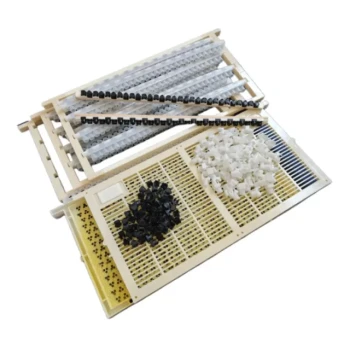
Grafting is a specialized technique used in beekeeping to artificially propagate queen bees. It is defined by the manual transfer of young larvae from their original worker cells into specially prepared artificial queen cups.
The Core Insight Grafting allows a beekeeper to control the destiny of a honeybee larva. By moving a larva intended to be a worker into a queen cell, you trigger the colony to raise it as a reproductive queen, enabling controlled breeding and stock expansion.
The Mechanics of Grafting
The Transfer Process
The fundamental action of grafting is the manual relocation of a larva.
A beekeeper selects very young larvae that were originally laid in standard worker cells. Using a specialized tool, the beekeeper lifts the larva out of its comb.
Changing the Larva's Destiny
Once removed, the larva is placed into an artificial queen cell (often a plastic or wax cup).
This physical move changes the context for the nurse bees. Because the larva is now in a queen cup, the colony is triggered to feed and care for it specifically to develop into a queen rather than a sterile worker.
The Strategic Purpose
Intentional Queen Rearing
The primary goal of grafting is raising queens on a schedule determined by the beekeeper, rather than the bees.
Natural queen rearing often happens unpredictably during swarming or supercedure. Grafting allows for the systematic production of queens for new colonies or to replace old queens.
Standardization
Using artificial queen cells standardizes the process.
It allows the beekeeper to organize multiple queen cells on a single frame, making the management of the developing queens efficient and scalable.
Understanding the Trade-offs
High Dexterity Required
"Manually transferring" larvae is a delicate operation.
It requires significant hand-eye coordination, good lighting, and steady hands. Even slight mishandling can damage the fragile larva or deprive it of necessary moisture.
Equipment and Preparation
Unlike natural methods, grafting requires specific equipment.
You must have artificial cups and grafting tools ready. Furthermore, the timing must be precise; the larvae must be at the exact right age for the transfer to successfully result in a high-quality queen.
Making the Right Choice for Your Goal
If you are considering incorporating grafting into your apiary management, consider your specific objectives:
- If your primary focus is large-scale expansion: Grafting is essential because it allows you to mass-produce queens from your best genetic stock systematically.
- If your primary focus is replacing a single queen: The complexity of manual transfer may be unnecessary compared to simpler split methods, unless you wish to learn the skill.
Mastering the physical skill of grafting places the genetic future of your apiary directly in your hands.
Summary Table:
| Feature | Grafting Details |
|---|---|
| Core Action | Manual transfer of larvae from worker cells to queen cups |
| Primary Goal | Systematic queen rearing and genetic stock expansion |
| Key Tooling | Grafting tools, artificial queen cups, and cell frames |
| Larva Age | Very young (typically less than 24-48 hours old) |
| Skill Level | High (requires dexterity and precision) |
Scale Your Apiary with Professional Solutions from HONESTBEE
Unlock the full potential of your commercial beekeeping operation with high-precision tools and machinery. At HONESTBEE, we specialize in supporting commercial apiaries and distributors with a comprehensive wholesale portfolio.
Whether you need delicate grafting tools and queen-rearing equipment to manage your genetics, or industrial-grade hive-making and honey-filling machines to streamline your production, we provide the full spectrum of essential hardware and consumables.
Ready to elevate your beekeeping business? Contact us today to discuss your wholesale needs and see how our industry-leading equipment can drive your success.
Related Products
- Plastic Beekeeping Honey Bee Larvae Grafting Tools for Queen Rearing and Chinese Grafting
- Black 2 Pack Beekeeper Queen Grafting Tool for Bee Queen Larva Transferring Needle
- Retractable Chinese Queen Rearing Grafting Tools Equipment
- Stainless Steel Queen Grafting Tool for Beekeeping and Bee Queen Grafting
- Stainless Steel Beekeeping Queen Grafting Tool for Honey Bee Rearing
People Also Ask
- How do larvae grafting tools and royal jelly production kits contribute to a diversified bee product strategy?
- What happens if a larva is grafted too late? Avoid Scrub Queens and Failed Rearing
- What is the primary function of a Professional Bee Larvae Grafting Tool in queen rearing? Enhance Breeding Efficiency
- What is the grafting method of queen rearing? Master Controlled Queen Production for Your Apiary
- What is the primary function and technical requirement of a larvae grafting tool? Master Precision Queen Rearing