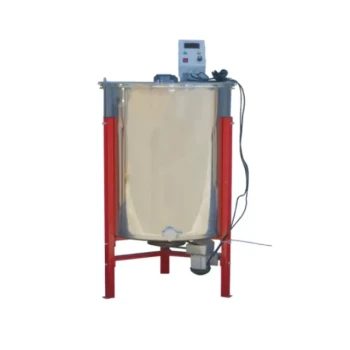
To safely stop the vacuum pump on your honey concentrating equipment, you must strictly follow a three-step sequence to avoid mechanical damage or product contamination. First, close the pump's inlet valve, then shut off the electrical power supply, and finally, turn off the water source.
The order of operations is critical. You must isolate the vacuum pressure first, cut the power second, and stop the water flow last to ensure the system remains protected.
Detailed Shutdown Procedure
Step 1: Isolate the Vacuum Pressure
The first step is always to close the inlet valve of the pump.
This disconnects the pump from the honey concentration tank. Doing this while the pump is still running maintains the vacuum inside the tank and prevents pressure equalization from occurring through the pump lines.
Step 2: Cut the Electrical Power
Once the valve is secured, shut off the power supply to the vacuum pump.
The motor will cease operation. Because the inlet valve is already closed, the pump will stop without fighting against the vacuum pressure of the main tank.
Step 3: Secure the Utilities
Lastly, close the water source.
The vacuum pump requires water for sealing and cooling during operation. You should only stop the water flow after the motor has completely stopped to ensure the internal components remain lubricated and cool during the shutdown process.
Understanding the Risks and Trade-offs
Avoiding Backflow Contamination
If you stop the motor or the water supply before closing the inlet valve, you risk backflow.
The vacuum existing in the honey tank is powerful. If the pump stops while connected, that vacuum can suck water or pump fluids back into your honey, ruining the batch.
Preventing Mechanical Overheating
Never shut off the water source while the pump is still powered.
Running the pump without water, even for a short period, can damage the seals and overheat the unit. The water must remain on until the mechanical rotation has ceased.
Operational Best Practices
To ensure the longevity of your equipment and the quality of your honey, apply these guidelines based on your immediate goal:
- If your primary focus is Equipment Longevity: Strict adherence to turning the water off last prevents dry-running and protects internal seals from heat damage.
- If your primary focus is Product Safety: Prioritize closing the inlet valve first to physically prevent any non-sterile pump fluids from being sucked back into the honey tank.
Mastering this simple "Valve, Power, Water" sequence is the most effective way to prevent costly repairs and product loss.
Summary Table:
| Step | Action | Purpose |
|---|---|---|
| 1 | Close Inlet Valve | Isolate vacuum tank and prevent product backflow |
| 2 | Cut Electrical Power | Stop motor rotation once lines are safely isolated |
| 3 | Turn Off Water | Ensure seals stay cooled and lubricated until fully stopped |
Maximize Your Apiary's Efficiency with HONESTBEE
Proper maintenance is just the start of a productive harvest. At HONESTBEE, we specialize in empowering commercial apiaries and distributors with high-performance beekeeping machinery and equipment. From precision honey-filling machines to advanced honey concentrating systems, we provide the full spectrum of tools needed to scale your operations.
Why choose HONESTBEE?
- Wholesale Excellence: Comprehensive supply of hardware, consumables, and hive-making machinery.
- Industry Expertise: Tailored solutions designed for the unique demands of large-scale honey production.
- Cultural Merchandise: A wide array of honey-themed products to expand your brand's reach.
Ready to upgrade your facility with professional-grade equipment? Contact our expert team today to discuss how our wholesale solutions can drive your success!
Related Products
- Honey Concentrating Vacuum Heating Thickening Machine Dehumidifier for Honey
- 0.5T Capacity Honey Dehumidifier Dryer with Vacuum Heating and Thickening Filtering Machine
- Honey Concentrating and Filtering Dehumidifier Machine 2T Capacity for Honey
- Honey Convey Pump Screw Honey Pump for Viscous Liquid
- Honey Convey Pump Economy Gear Pump for Viscous Liquid
People Also Ask
- What should be observed during the feeding process of the honey concentrator? Master Honey Processing Efficiency
- What are the advantages of using a honey concentrator machine in apiculture? Boost Quality & Shelf Life
- What are the benefits of a honey concentrator? Elevate Your Honey Quality and Market Value
- What electrical safety precaution is necessary when operating the honey concentrating equipment? Essential Grounding Tips
- What are the main functions of the honey concentrating equipment? Essential Machinery for Commercial Quality