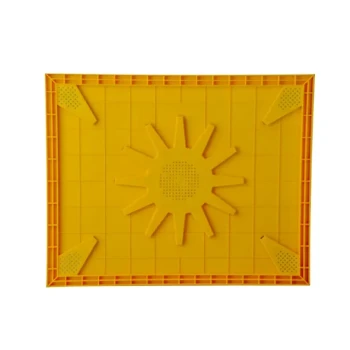
The fundamental design principle behind combining Sticky Boards with plastic mesh covers is selective physical filtration based on size. This system utilizes a precisely sized aperture to create a mechanical barrier that separates parasites from their hosts. The mesh allows smaller Varroa mites to fall through onto the adhesive surface below, while simultaneously preventing larger honeybees from contacting the glue or interfering with the sample.
The Sticky Board and mesh combination transforms mite monitoring from a snapshot sampling technique into a passive, continuous observation method. By mechanically isolating falling mites from the active colony, beekeepers can obtain reliable infestation metrics without disrupting hive activity or harming a single bee.
The Mechanics of Selective Separation
The Function of Aperture Sizing
The core engineering concept relies on the specific dimensions of the mesh grid. The openings are calibrated to be large enough for falling mites to pass through unimpeded.
However, these same openings are too small for honeybees to traverse. This ensures that the biological target (the mite) is captured, while the colony workforce remains separated from the monitoring medium.
Preventing Contact with Adhesive
Sticky Boards rely on strong adhesives to trap mites effectively. Without a cover, this adhesive would pose a significant risk to the bees themselves.
The plastic mesh acts as a safety shield. It suspends the bees above the "danger zone," ensuring that no live bees become stuck to the monitoring plate.
Optimizing Data Integrity
Eliminating Hygienic Interference
Honeybees are naturally hygienic and will attempt to remove foreign debris or dead pests from the hive. If bees had access to the sticky board, they might attempt to clean it.
The mesh cover prevents this hygienic behavior from skewing the data. By keeping the bees away from the fallen mites, the system ensures that the "mite drop" remains undisturbed until the beekeeper counts it.
Enabling Continuous Monitoring
Because the system is non-invasive and safe for the bees, it allows for long-term deployment. It does not require the colony to be opened or manipulated during the data collection phase.
This allows for the collection of continuous data rather than a momentary snapshot. Beekeepers can assess infestation trends over time, providing a more reliable picture of colony health.
Understanding the Trade-offs
Passive vs. Active Sampling
This design relies on the natural fall rate of mites or mites dropping due to treatments. It is a passive collection method.
Consequently, it requires a duration of time to gather meaningful data. Unlike "wash" methods that give an immediate count, this design requires a waiting period for the mites to accumulate.
Reliance on Gravity
The effectiveness of the separation depends on gravity. Mites must fall directly through the mesh to be counted.
If the mesh becomes clogged with excessive hive debris (wax cappings or pollen), the aperture may become blocked. This could theoretically prevent mites from reaching the adhesive, requiring the beekeeper to ensure the mesh remains clear.
Making the Right Choice for Your Goal
When deciding on a monitoring strategy, consider how the design of the Sticky Board impacts your objectives.
- If your primary focus is Non-Invasive Management: This is the ideal solution, as the physical barrier allows for data collection without killing bees or disrupting the colony structure.
- If your primary focus is Trend Analysis: The continuous nature of the data source allows you to track infestation spikes over days or weeks, rather than relying on a single moment in time.
By leveraging simple physics to separate the pest from the pollinator, this design offers a safe, sustainable window into the parasitic load of your apiary.
Summary Table:
| Feature | Design Principle | Benefit to Beekeeper |
|---|---|---|
| Aperture Sizing | Selective physical filtration | Captures mites while preventing bee contact with adhesive |
| Physical Barrier | Mechanical isolation | Protects bees from glue and prevents hygienic removal of data |
| Data Collection | Passive, continuous observation | Provides long-term infestation trends without killing bees |
| Installation | Non-invasive placement | Enables monitoring without colony disruption or hive opening |
Elevate Your Apiary Management with HONESTBEE
Precision monitoring is the first step toward a healthy colony. As a premier partner for commercial apiaries and distributors, HONESTBEE provides the professional-grade tools you need to scale your operations.
We offer a comprehensive wholesale portfolio, including:
- Advanced Monitoring Tools: High-quality Sticky Boards and mesh systems.
- Beekeeping Machinery: Specialized hive-making and honey-filling equipment.
- Industry Consumables: A full spectrum of essential hardware and merchandise.
Ready to enhance your efficiency and secure your honey yields? Contact us today to discuss our wholesale solutions and discover how our expertise can drive your success.
References
- Danielle Downey, Mark L. Winston. Honey bee colony mortality and productivitywith single and dual infestations of parasitic mite species. DOI: 10.1051/apido:2001144
This article is also based on technical information from HonestBee Knowledge Base .
Related Products
- Langstroth Screen Bottom Board for Beekeeping Wholesale
- Varroa Easy Check Mite Tester Kit Counter Alcohol Wash Jar
- Compact Circular Bee Mite Treatment Dispenser
- HONESTBEE Multi Exit Plastic Bee Escape Board for Efficient Honey Harvesting
People Also Ask
- What is the primary function of a standard screen bottom board when assessing honeybee grooming behavior? - Key Mite Data
- What is the primary function of a screen bottom board? Achieve Accurate Varroa Mite Assessment in Your Apiary
- Why is the combination of a screen bottom board and a sticky trap board essential for monitoring Varroa mite? Guide
- What role do screen bottom boards and monitoring inserts play in assessing Varroa mite mortality and maintaining hive hygiene in Langstroth hives?
- Why might a screen bottom board be less effective for pest control? Understanding the 'Mixed Sunlight' Complication