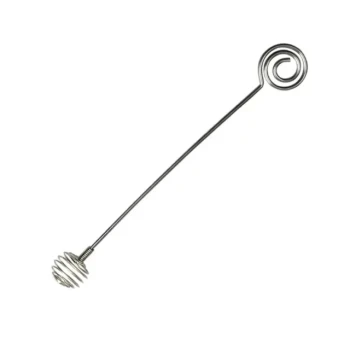
The primary function of a constant temperature stirring device in honey processing is to liquefy and homogenize raw material without degrading its quality. specifically, this equipment mechanically stirs and melts crystallized, non-mature honey while maintaining a strictly controlled temperature of 40°C. This ensures the material reaches a uniform liquid state suitable for subsequent processing, such as proportional mixing with water.
The device solves the critical challenge of preparing crystallized honey for production. It achieves a uniform consistency required for mixing while strictly limiting heat exposure to preserve the honey's volatile components and enzymatic activity.
The Role of Controlled Agitation and Heating
Achieving Physical Uniformity
Raw, non-mature honey often arrives in a crystallized or semi-solid state.
The stirring device uses mechanical agitation to break down these crystal structures. This creates a homogeneous liquid foundation, which is an absolute prerequisite before any water can be proportionally added for further processing.
The 40°C Temperature Threshold
Temperature control is the defining feature of this equipment.
The device maintains the honey at exactly 40°C. This specific temperature is high enough to effectively melt crystals but low enough to avoid the chemical changes associated with "cooking" the product.
Preserving Chemical Integrity
Protecting Volatile Components
Honey contains delicate aromatic compounds that define its flavor and scent profile.
Uncontrolled heating causes these volatile components to evaporate or degrade. By capping the temperature at 40°C, the stirring device retains the sensory qualities that distinguish high-quality ripened honey.
Safeguarding Enzyme Activity
Enzymes are the biologically active proteins that give honey its nutritional and medicinal value.
These enzymes are highly sensitive to thermal stress and can be denatured by high heat. The constant temperature stirring device ensures the phase change from solid to liquid occurs without destroying this critical enzyme activity.
Understanding the Trade-offs
The Balance Between Speed and Quality
There is an inherent tension between processing speed and product integrity.
Higher temperatures would melt crystals faster, increasing throughput. However, the strict adherence to 40°C sacrifices speed to prevent thermal damage, prioritizing the biological value of the final product over rapid processing.
Precision vs. Equipment Complexity
Using a constant temperature device adds a layer of technical complexity compared to simple heating elements.
It requires precise sensors and calibration to ensure the heat is distributed evenly during stirring. If the stirring mechanism fails while heat is applied, localized "hot spots" could still occur, potentially damaging portions of the batch.
Making the Right Choice for Your Goals
To maximize the utility of a constant temperature stirring device, consider your specific production objectives:
- If your primary focus is Product Potency: Ensure the device is calibrated strictly to 40°C to maximize the retention of heat-sensitive enzymes and volatiles.
- If your primary focus is Process Efficiency: Monitor the stirring speed to ensure rapid, uniform heat distribution, allowing the honey to liquefy as quickly as possible within the safe temperature limit.
Precision in this stage lays the groundwork for a high-quality, biologically active final product.
Summary Table:
| Feature | Function/Benefit | Importance for Honey |
|---|---|---|
| Mechanical Stirring | Breaks down crystal structures | Creates a homogeneous liquid base for processing |
| 40°C Constant Heat | Controlled melting threshold | Prevents thermal degradation and "cooking" effect |
| Volatile Retention | Preserves aromatic compounds | Maintains the original flavor and scent profile |
| Enzyme Protection | Safeguards biological activity | Ensures nutritional and medicinal value remains intact |
| Uniform Heat | Eliminates localized hot spots | Prevents uneven quality across the honey batch |
Elevate Your Honey Production with HONESTBEE Solutions
Precision at the raw material stage is the secret to premium ripened honey. At HONESTBEE, we empower commercial apiaries and distributors with professional-grade beekeeping tools and industrial machinery designed for excellence.
From honey-filling machines and hive-making hardware to advanced processing equipment, our comprehensive wholesale portfolio covers everything you need to scale your operations. Partner with us to ensure your honey retains its natural enzymes and superior quality through every stage of production.
Ready to optimize your facility? Contact our experts today to discuss our full spectrum of beekeeping equipment and consumables!
References
- Nana Guo, Yazhou Zhao. An effective and economic method to produce re-ripe honey with honeybee colonies. DOI: 10.1590/fst.23618
This article is also based on technical information from HonestBee Knowledge Base .
Related Products
- Automatic Continuous Heat Sealing Machine
- Double Wall Honey Heating Stirring Homogenizer Mixing Machine with Various Capacity
- Professional Thermostatic Conical Honey Melter
- Modern Stainless Steel Honey Dipper Stirrer
- Modern Honeycomb Pattern Wooden Honey Dipper for Stirring and Drizzling
People Also Ask
- How is a heat sealer used in the production of honey sticks? Master the Art of Leak-Proof Sealing
- What is a sealing machine called? Choose the Right Heat Sealer for Your Packaging
- How do I choose a heat sealer? A Guide to Matching the Right Machine to Your Needs
- What is the function of sealing machines? Ensure Product Integrity and Extend Shelf Life
- What is a sealing machine? Protect Your Product Quality and Brand Reputation