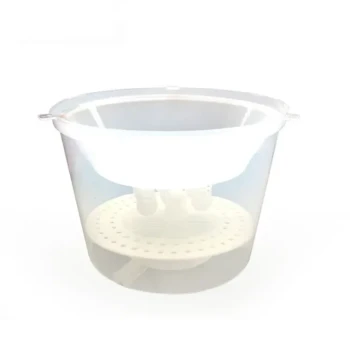
The primary function of an industrial pollen trap is to serve as a mechanical filter that automates the collection of biological samples for environmental analysis. Installed directly at the beehive entrance, the device uses grids with precise apertures to physically strip pollen loads from worker bees as they return from foraging. This enables the efficient, non-destructive acquisition of raw pollen required to measure and monitor the enrichment of radionuclides like Cesium-137.
By transforming the beehive into a passive sampling station, industrial pollen traps allow researchers to directly compare radioactive contamination levels across different nectar plants and soil fertilizer treatments without harming the bee colony.
Mechanisms of Action
Strategic Placement and Design
The trap is engineered to fit the entrance of the hive, forcing all returning foragers to navigate through it. This ensures that the sampling represents the full range of the colony's foraging radius.
The Grid System
The core mechanism involves grids with specific apertures. These holes are sized precisely to allow the worker bee to pass through but are too narrow for the pollen pellets attached to their hind legs.
Physical Stripping
As the bee squeezes through the grid, the pollen load is mechanically knocked off. This dislodged pollen falls into a collection tray, securing the sample before it can be consumed or stored inside the hive.
Monitoring Radionuclide Enrichment
Targeting Cesium-137
The primary reference highlights the trap’s specific utility in monitoring Cesium-137. By collecting the pollen before it enters the hive's metabolic cycle, researchers get a direct reading of the isotope's presence in the environment.
Comparative Analysis
The data collected allows for granular comparisons. Researchers can analyze how enrichment levels vary between different species of nectar plants.
Assessing Soil Treatments
The traps also facilitate the study of agricultural variables. They provide the data needed to observe how different fertilizer treatments influence the uptake of radionuclides into the pollen.
Operational Considerations and Trade-offs
Non-Destructive Sampling
A major advantage of this method is that it is non-destructive. It allows for continuous monitoring of the environment without requiring the sacrifice of the bees or the destruction of the hive structure.
Efficiency vs. Colony Health
While the trap is described as efficient for "industrial" or large-scale collection, it physically removes the colony's protein source. Continuous use without breaks could potentially stress the colony by depriving it of essential nutrition.
Specificity of Apertures
The success of the monitoring depends entirely on the grid precision. Incorrect aperture sizing could either fail to collect sufficient samples or impede the bees enough to cause physical harm.
Making the Right Choice for Your Goal
When designing a monitoring program for radionuclides in apiculture, consider the following objectives:
- If your primary focus is environmental mapping: Use these traps to aggregate data across wide areas to identify specific hotspots of Cesium-137.
- If your primary focus is agricultural impact: Deploy traps in controlled zones to compare how different fertilizer regimes affect radionuclide uptake in specific nectar plants.
This technology bridges the gap between biological foraging and analytical chemistry, providing a clear window into environmental health.
Summary Table:
| Feature | Function in Radionuclide Monitoring |
|---|---|
| Mechanism | Mechanical grids strip pollen loads from foraging bees without harm. |
| Target Isotope | Primarily used to track Cesium-137 enrichment in environmental samples. |
| Data Application | Compares contamination across nectar plants and soil fertilizer treatments. |
| Sampling Type | Non-destructive, passive bio-sampling at the hive entrance. |
| Efficiency | Automates large-scale sample collection for industrial-grade analysis. |
Scaling Your Apiary Operations with HONESTBEE
For commercial apiaries and global distributors, efficiency in data collection and hive management is paramount. HONESTBEE provides a comprehensive suite of professional beekeeping tools, from high-precision pollen traps for environmental monitoring to advanced honey-filling and hive-making machinery.
Whether you are managing a large-scale commercial operation or supplying the industry with essential consumables and specialized hardware, our wholesale solutions are designed to optimize your productivity and honey yield.
Ready to elevate your beekeeping business? Contact us today to explore our full spectrum of industrial equipment and find out how our expertise can drive your success.
References
- Sergey Razanov, Мykola Komynar. INTENSITY OF CESIUM-137 ACCUMULATION IN PRODUCTS BY HONEY BEES AT THE APPLICATION OF MINERAL FERTILIZERS IN CONDITIONS OF RADIOACTIVELY CONTAMINATED SOILS NORTHERN POLISSYA. DOI: 10.37128/2707-5826-2021-4-15
This article is also based on technical information from HonestBee Knowledge Base .
Related Products
- Removable Plastic Pollen Trap With Ventilated Tray for Bees Pollen Collector
- 30 cm Plastic Entrance Hole Bee Pollen Trap and Collector
- Plastic Bee Pollen Trap Strips Comb Catcher Collector
- High-Efficiency Diamond Maze Bee Escape for Clearing Supers
- Professional Multi-Component Bucket Wasp Trap
People Also Ask
- What are the design principles and advantages of pollen traps in the collection of bee pollen? Boost Your Apiary Yield
- What is the function of professional pollen traps in evaluating honey plants? Quantifying Pollination and Crop Potential
- What functions do pollen traps serve for bee bread production? Optimize Your Raw Material Collection
- What maintenance and pest prevention measures should be taken for pollen traps? Protect Your Hive and Harvest Quality
- How does the use of pollen traps in honeybee hives enhance crop fertilization? Boost Your Yield Through Induced Activity