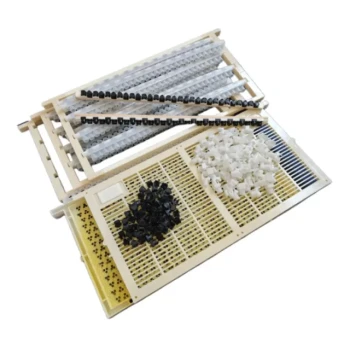
Transparent gelatin capsules serve a critical function as artificial brood cells in the laboratory rearing of honey bees. They create an isolated, independent microenvironment that allows researchers to precisely control experimental variables—such as the introduction of parasites like Varroa destructor—while enabling the continuous, non-invasive observation of the bee's physiological development from larva to adult.
By replacing opaque wax cells with transparent capsules, researchers gain a clear window into the entire metamorphic cycle, allowing for precise pathogen testing and physiological monitoring without disrupting the delicate developmental process.
The Role of the Capsule as an Artificial Cell
Creating an Independent Microenvironment
The primary technical function of the gelatin capsule is to act as an artificial brood cell.
In a natural hive, larvae share a crowded environment where cross-contamination can occur easily. The capsule isolates each individual, ensuring that the specific conditions applied to one subject do not inadvertently affect another.
Facilitating Real-Time Observation
The defining feature of these capsules is their transparency.
Traditional observation methods often require opening a hive or cutting into wax cells, which can be destructive. Clear capsules allow researchers to monitor physiological changes continuously—from the larval stage through pupation to adult emergence—without any physical interference.
Advantages for Experimental Controls
Precise Pathogen Inoculation
The capsules are particularly valuable for studies involving the parasitic mite Varroa destructor.
Because the environment is enclosed, researchers can introduce a specific, known quantity of mites to the developing bee. This allows for exact measurement of the parasite's impact on the host, eliminating the ambiguity often found in field studies.
Preservation of Natural Development
Despite being artificial, the capsule is designed to support the natural progression of the honey bee's life cycle.
By removing the need for invasive handling during observation, the capsule reduces stress on the developing bee. This ensures that the data collected reflects true physiological responses rather than reactions to external disturbance.
Considerations and Trade-offs
Mechanical Handling Requirements
While the capsule protects the larva during development, the initial transfer process introduces risk.
As noted in supplementary protocols, moving delicate 2-day-old larvae from the honeycomb to the capsule requires specialized grafting tools. Success relies heavily on the researcher's ability to perform this transfer without causing physical mechanical damage, which determines the baseline survival rate before the experiment even begins.
Environmental Management
The capsule provides containment, but it does not self-regulate temperature or humidity like a biological hive.
The artificial rearing environment must be carefully maintained to mimic hive conditions. If the external incubator settings fluctuate, the protection offered by the capsule cannot compensate for the environmental stress.
Optimizing Your Research Approach
To effectively utilize transparent gelatin capsules in your artificial rearing projects, consider your specific experimental goals:
- If your primary focus is Pathogen Screening: Utilize the capsule's isolation to introduce precise inoculations of Varroa destructor without risk of cross-contamination.
- If your primary focus is Developmental Biology: Leverage the transparency of the capsule to document real-time morphological changes without disturbing the specimen.
Used correctly, these capsules transform the complex, concealed process of honey bee metamorphosis into a visible, controllable, and measurable variable.
Summary Table:
| Feature | Function in Artificial Rearing | Primary Research Benefit |
|---|---|---|
| Transparency | Enables non-invasive visual monitoring | Continuous observation of metamorphosis without disruption |
| Isolation | Creates an independent microenvironment | Prevents cross-contamination and ensures control accuracy |
| Enclosure | Facilitates precise pathogen inoculation | Allows for exact measurement of Varroa mite impact |
| Biocompatibility | Mimics natural brood cell dimensions | Supports natural development from larva to adult emergence |
Elevate Your Commercial Apiary and Research Operations with HONESTBEE
At HONESTBEE, we understand the precision required in modern apiculture, whether in the field or the laboratory. As a premier partner for commercial apiaries and distributors, we provide a comprehensive wholesale range designed to optimize every stage of your honey bee management.
From specialized hardware like hive-making machinery and honey-filling systems to essential industry consumables and honey-themed cultural merchandise, we offer the high-quality tools you need to succeed. Our portfolio is built to support the rigorous demands of large-scale operations and researchers alike.
Ready to scale your beekeeping capabilities? Contact us today to explore our wholesale equipment solutions and see how HONESTBEE can bring industry-leading efficiency to your business.
References
- Desiderato Annoscia, Francesco Nazzi. Elucidating the mechanisms underlying the beneficial health effects of dietary pollen on honey bees (Apis mellifera) infested by Varroa mite ectoparasites. DOI: 10.1038/s41598-017-06488-2
This article is also based on technical information from HonestBee Knowledge Base .
Related Products
- Plastic Beekeeping Honey Bee Larvae Grafting Tools for Queen Rearing and Chinese Grafting
- Stainless Steel Beekeeping Queen Grafting Tool for Honey Bee Rearing
- Twin Queen Styrofoam Honey Bee Nucs Mating and Breeding Box
- Plastic Chinese Queen Grafting Tool for Bee Queen Rearing
- Black 2 Pack Beekeeper Queen Grafting Tool for Bee Queen Larva Transferring Needle
People Also Ask
- How do larvae grafting tools and royal jelly production kits contribute to a diversified bee product strategy?
- What happens if a larva is grafted too late? Avoid Scrub Queens and Failed Rearing
- What is the primary function of a Professional Bee Larvae Grafting Tool in queen rearing? Enhance Breeding Efficiency
- What is the grafting method of queen rearing? Master Controlled Queen Production for Your Apiary
- What is the primary function and technical requirement of a larvae grafting tool? Master Precision Queen Rearing