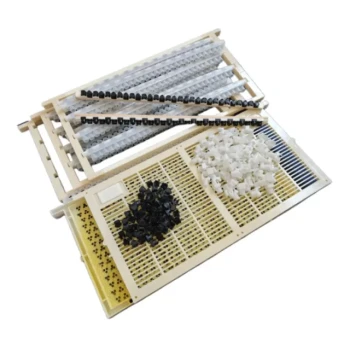
Specialized queen rearing and colony splitting tools are the fundamental drivers that transition beekeeping from a passive, subsistence activity to a scalable, systematic industry. By replacing reliance on unpredictable wild swarm capture with controlled artificial breeding, these tools allow operations to proactively expand apiary size while simultaneously improving genetic stock for higher production efficiency.
By shifting from opportunistic gathering to controlled reproduction, these tools enable the precise management of growth rates and genetic quality—the two essential requirements for achieving commercial scalability.
Moving Beyond Reliance on Nature
The Shift to Systematic Breeding
Without specialized tools, beekeepers are often forced to rely on catching wild swarms to replace losses or expand. This method is unpredictable and limits growth to the whims of nature.
Specialized tools enable systematic population breeding, allowing the beekeeper to determine exactly when and how many new colonies are created.
Proactive Apiary Expansion
Scalability requires predictability. Tools for controlled colony division allow beekeepers to proactively expand their apiary size according to a business plan rather than environmental luck.
This control transforms the apiary from a collection of hives into a managed production facility capable of meeting specific growth targets.
Mechanisms of Scalability
Enhancing Production Efficiency
Quantity alone does not equal successful scaling; the quality of the bees matters. Queen rearing tools enable selective breeding for superior traits, such as disease resistance, gentleness, or high honey production.
By propagating these specific traits, beekeepers ensure that every new unit added to the operation is as efficient as possible, maximizing the utilization of local nectar resources.
Standardizing Technical Workflows
Scalability creates complexity, which must be managed through standardization. Specialized tools convert complex biological tasks into manageable, technical workflows.
Using uniform equipment for splitting and rearing creates a repeatable process, allowing labor to be utilized more efficiently as the operation grows.
Reducing Labor Constraints
As apiaries scale, labor becomes the primary bottleneck. Specialized tools and machinery significantly reduce labor intensity, allowing a single technician to manage a larger number of hives.
This shift improves the output-to-time ratio, enabling the business to counteract rising labor costs while maintaining high standards of hive management.
Understanding the Trade-offs
The Requirement for Technical Expertise
Access to tools does not guarantee success; they serve as a physical foundation that requires knowledge to operate. Advanced breeding techniques require a higher level of technical training than basic hive management.
Without the skills to use these tools effectively, there is a risk of technical regression or equipment abandonment.
Supply Chain Dependencies
Moving toward a mechanized, tool-dependent model creates a reliance on the supply chain. A stable supply of consumables and maintenance parts is crucial.
If a beekeeper scales up using specialized equipment but lacks consistent access to replacements or repair services, the operation faces significant sustainability risks.
Making the Right Choice for Your Goal
To effectively scale your operation, you must align your tool investment with your specific production objectives.
- If your primary focus is Rapid Numerical Growth: Prioritize colony splitting tools and standardized hive bodies to maximize the speed of physical expansion.
- If your primary focus is Efficiency and Yield: Focus heavily on queen rearing tools to implement selective breeding, ensuring that your existing hive count produces maximum output.
Control over reproduction is the single most critical factor in converting a hobbyist apiary into a commercial enterprise.
Summary Table:
| Factor | Manual/Opportunistic Beekeeping | Tool-Enabled Commercial Scaling |
|---|---|---|
| Expansion Method | Relies on wild swarm capture | Proactive, controlled colony division |
| Genetic Quality | Unpredictable / Wild traits | Selective breeding for high yield/resistance |
| Growth Rate | Limited by nature | Scalable according to business plans |
| Labor Efficiency | High manual effort per hive | Standardized workflows & reduced intensity |
| Operational Goal | Subsistence / Hobbyist | Commercial production & systematic growth |
Transform Your Beekeeping Operation with HONESTBEE
Ready to scale from a hobbyist apiary to a thriving commercial enterprise? HONESTBEE is your strategic partner in growth. We empower commercial apiaries and distributors with a comprehensive wholesale portfolio, ranging from specialized queen rearing tools and hive-making machinery to high-efficiency honey-filling systems and essential consumables.
By choosing HONESTBEE, you gain access to the precision equipment needed to standardize your workflows, improve genetic stock, and maximize honey production. Don't let your growth be limited by nature—take control of your production efficiency today.
Contact HONESTBEE to explore our wholesale solutions and elevate your apiary's scalability.
References
- Lotta Fabricius Kristiansen, Nguyen Van Niem. Development of<i>Apis cerana</i>Beekeeping in Rural Areas of Northern Vietnam 2009–2012. DOI: 10.1080/0005772x.2013.11417559
This article is also based on technical information from HonestBee Knowledge Base .
Related Products
- Retractable Chinese Queen Rearing Grafting Tools Equipment
- Plastic Chinese Queen Grafting Tool for Bee Queen Rearing
- Stainless Steel Queen Grafting Tool for Beekeeping and Bee Queen Grafting
- Stainless Steel Beekeeping Queen Grafting Tool for Honey Bee Rearing
- Plastic Beekeeping Honey Bee Larvae Grafting Tools for Queen Rearing and Chinese Grafting
People Also Ask
- Which specialized tools are necessary for implementing standardized queen rearing? Scale Your High-Yield Apiary
- Why are specialized queen rearing tools necessary to mitigate winter hive losses? Boost Apiary Survival and Recovery
- How do queen-rearing tools facilitate the sustainability and expansion of a commercial apiary? Drive Scalable Growth
- In what ways do modern queen rearing equipment and grafting tools improve competitiveness? Boost Breeding Success Rate
- What role do specialized queen rearing tools and consumables play in modern large-scale apiculture? Drive Production & Scale