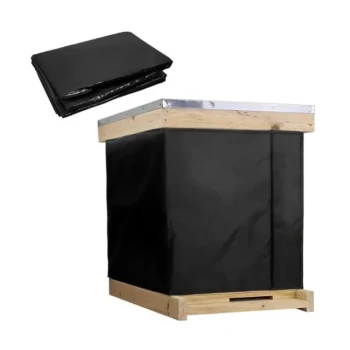
The primary mechanical role of sackcloth in solar-heated hives is moisture regulation. Placed directly over the hive frames, the material acts as a hygroscopic buffer that manages the intense microclimate created by solar heating. It absorbs the condensation generated by bee respiration and temperature gradients, specifically preventing cold water from dripping back onto the cluster.
The sackcloth functions as a breathable internal membrane. While solar heating provides warmth, the sackcloth manages the resulting moisture, preventing the lethal combination of dampness and cold that compromises colony survival.
The Mechanics of Moisture Management
In a solar-heated hive, the contrast between the warmed interior and the freezing exterior creates significant humidity challenges. The sackcloth addresses this through specific physical properties.
Absorbing Condensation
Solar heating creates steep temperature gradients. As warm air inside the hive meets the colder upper surfaces, moisture from bee respiration condenses rapidly.
The sackcloth is hygroscopic, meaning it actively attracts and holds water molecules. Instead of allowing moisture to accumulate on the inner cover, the cloth absorbs this excess humidity directly.
Preventing "Rain" and Heat Loss
The greatest danger to a winter cluster is not cold air, but cold water. If condensation forms on a solid surface above the bees, it eventually drips down.
This "hive rain" wets the bees, destroying their insulation and causing rapid heat loss. The sackcloth acts as a sponge, holding the moisture in suspension so it cannot drip onto the colony.
Biological and Sanitary Implications
Beyond simple mechanics, the sackcloth plays a vital role in maintaining the biological integrity of the hive environment.
Inhibiting Pathogen Growth
A damp environment is a breeding ground for disease. Excess moisture promotes the growth of fungi, mold, and bacteria.
By maintaining a drier internal atmosphere, the sackcloth inhibits these pathogens. This preserves a sanitary environment essential for the health of the brood and the adult bees.
Breathability and Airflow
Unlike plastic barriers, sackcloth is porous. It allows for the passive exchange of gases.
This breathability ensures that while moisture is absorbed, air can still circulate. This prevents the "stifling" effect often seen with non-permeable insulation methods.
Understanding the Trade-offs
While sackcloth is effective, it is not a "set and forget" solution. It is part of a dynamic system that requires balance.
The Saturation Point
Sackcloth has a finite capacity for holding water. If the hive lacks adequate upper ventilation, the cloth can become fully saturated.
A saturated cloth acts like a wet blanket, drawing heat away from the cluster rather than preserving it.
Interaction with External Wrapping
External protection, such as wrapping the hive in black plastic, helps retain heat and block wind. However, these external wraps must include ventilation holes.
If the external wrap seals the hive too tightly, the sackcloth cannot release its stored moisture into the environment, rendering it ineffective.
Making the Right Choice for Your Goal
When implementing sackcloth in a solar-heated system, consider your specific objectives to maximize survival rates.
- If your primary focus is preventing condensation drip: Ensure the material selected is highly hygroscopic (natural fibers) rather than synthetic, to maximize absorption capacity.
- If your primary focus is long-term hygiene: Monitor the cloth for saturation regularly; if it cannot dry out via hive ventilation, it becomes a vector for mold rather than a shield against it.
The effectiveness of a solar-heated hive relies not just on generating heat, but on using materials like sackcloth to intelligently manage the moisture that heat creates.
Summary Table:
| Feature | Mechanical Function | Key Benefit for Beekeepers |
|---|---|---|
| Hygroscopic Absorption | Attracts and holds moisture from bee respiration | Prevents lethal cold water dripping on the cluster |
| Breathability | Allows passive gas exchange and airflow | Prevents the stifling effect of non-permeable barriers |
| Sanitary Barrier | Maintains a dry internal atmosphere | Inhibits the growth of fungi, mold, and pathogens |
| Thermal Buffer | Manages microclimate gradients | Prevents heat loss caused by dampness and "hive rain" |
Optimize Your Apiary's Winter Survival with HONESTBEE
At HONESTBEE, we understand that successful wintering requires more than just heat—it requires professional-grade moisture management. We cater specifically to commercial apiaries and distributors, providing a comprehensive wholesale selection of high-quality beekeeping tools and equipment.
From specialized hive-making machinery and honey-filling systems to essential consumables and cultural merchandise, our portfolio is designed to enhance your operational efficiency and hive productivity. Whether you are scaling your commercial operations or looking for a reliable supply partner for distribution, we offer the expertise and hardware you need.
Ready to elevate your beekeeping business? Contact HONESTBEE Today to explore our wholesale solutions and secure the best equipment for your apiary.
References
- M. A. Al-Rajhi. Warming Beehives with Solar Energy Stored in Water. DOI: 10.19159/tutad.1126564
This article is also based on technical information from HonestBee Knowledge Base .
Related Products
- Solar Beeswax Melter Easy Solar Wax Melter for Beeswax
- Professional Insulated Plastic Bee Hives
- Professional Insulated Winter Hive Wrap for Beekeeping
- Inner Beehive Cover for Beekeeping Bee Hive Inner Cover
- Wholesales Dadant Size Wooden Bee Hives for Beekeeping
People Also Ask
- How does a solar melter work to process beeswax? The Eco-Friendly Way to Pure Wax
- What is a solar wax melter and how does it work? Harness the Sun for Pure Beeswax
- What are the benefits of using a solar wax melter? Harness the Sun for Pure, Cost-Effective Beeswax
- What is the purpose of a solar wax melter in beekeeping? Sustainable Wax Processing for Modern Apiaries
- How does a solar-powered frame wax melter work? Harness the Sun for Sustainable Beekeeping