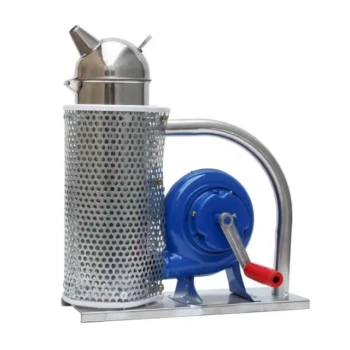
The operating mechanism of an industrial-grade beekeeping smoker relies on a dual biological disruption. It functions by producing a controlled, mild smoke that temporarily masks the alarm pheromones honeybees use to coordinate defensive attacks. Simultaneously, this smoke triggers an innate "fire instinct" within the colony, compelling the bees to consume honey and significantly lowering their aggression levels.
The smoker serves as a critical interface between the operator and the hive, neutralizing defensive behaviors without harming the colony. By disrupting chemical communication and inducing a feeding response, it transforms a volatile environment into a controlled workspace for standardized honey harvesting.
The Biological Response Mechanism
Disrupting Chemical Communication
Honeybees rely heavily on chemical signals, specifically alarm pheromones, to alert the colony to threats. When a hive is disturbed, guard bees release these signals to trigger a collective defense.
The primary function of the smoker is to blanket the area in mild smoke. This physically masks the pheromones, effectively jamming the colony's communication network and preventing the spread of aggression.
Triggering the Survival Instinct
The smoke simulates the early signs of a forest fire. This triggers an ancient survival instinct in the bees to prepare for potential evacuation.
Instead of attacking, the bees prioritize resources. They retreat into the hive to gorge on stored honey, preparing to carry their food reserves with them if they are forced to flee.
Physical Limitation of Aggression
The act of consuming honey has a direct physical impact on the bees' ability to attack. As they ingest honey, their abdomens become distended and less flexible.
This physiological change makes it mechanically difficult for the bees to bend their bodies to sting. Consequently, the colony becomes physically more docile and easier to manage.
Why It Matters for Industrial Harvesting
Operational Efficiency and Speed
In an industrial setting, speed and accuracy are paramount. By inducing a calm state, the smoker allows technicians to perform harvesting tasks rapidly.
It enables the standardized removal of honey frames with minimal resistance, reducing the likelihood of mechanical damage to the hive structure or accidental injury to the bees.
Ensuring Operator Safety
The device is a vital safety tool for human operators. By neutralizing the colony's defensive response, it drastically reduces the risk of stings.
This allows beekeepers to focus on the technical aspects of extraction rather than defense, ensuring the process runs smoothly.
Colony Retention and Sustainability
Using a professional smoker is essential for sustainable apiary management. Primitive methods, such as burning straw, can result in a 100 percent absconding rate, where the entire colony abandons the hive.
In contrast, the controlled use of an industrial smoker maintains a colony retention rate of approximately 96.9 percent. This ensures the long-term viability of the hive for future production cycles.
Operational Considerations and Constraints
The Importance of Smoke Temperature
The smoke generated must be "cool" or "cold." While the goal is to trigger a fire instinct, the smoke itself must not be hot enough to singe or harm the bees.
Industrial-grade smokers are designed to produce this specific type of low-temperature smoke to ensure it acts as a signal, not a weapon.
The Temporary Nature of the Effect
It is critical to understand that the smoker's effect is transient. It temporarily masks pheromones and distracts the bees, but it does not permanently sedate them.
Operators must work efficiently within this window of docility to complete the harvesting process before the colony's normal behavior resumes.
Making the Right Choice for Your Goals
To maximize the effectiveness of your harvesting operations, apply the smoker with specific intent:
- If your primary focus is Operator Safety: Prioritize the initial application of smoke to effectively break the transmission of alarm pheromones before opening the hive.
- If your primary focus is Colony Sustainability: Ensure the smoke is cool and controlled to prevent absconding and maintain high retention rates (aiming for >96%).
- If your primary focus is Process Efficiency: Use the smoker to induce the feeding response, creating a window of physical docility that allows for rapid, standardized frame removal.
Mastering the use of the smoker is the difference between a chaotic extraction and a streamlined, professional harvest.
Summary Table:
| Feature | Mechanism | Impact on Honey Harvesting |
|---|---|---|
| Pheromone Masking | Disrupts alarm chemical signals | Prevents coordinated colony defense and aggression |
| Survival Instinct | Induces honey gorging (fire reflex) | Bees become physically docile and less likely to sting |
| Cool Smoke Tech | Regulated low-temperature output | Protects bee health and maintains 96.9% retention rate |
| Operational Window | Transient biological distraction | Enables rapid, standardized frame removal and safety |
Elevate Your Commercial Apiary with HONESTBEE Professional Equipment
Maximize your operational efficiency and colony sustainability with premium tools designed for the modern beekeeping industry. At HONESTBEE, we specialize in supporting commercial apiaries and distributors with a complete wholesale range of:
- Precision Machinery: Advanced hive-making and honey-filling machines.
- Industrial Hardware: Heavy-duty smokers, beekeeping tools, and extraction equipment.
- Industry Consumables: A wide array of essential supplies for large-scale production.
- Cultural Merchandise: Unique honey-themed products to expand your brand portfolio.
Whether you are scaling your honey production or looking for a reliable wholesale partner for high-quality beekeeping gear, our team is ready to deliver tailored solutions that drive your success.
Contact HONESTBEE Today to Discuss Your Wholesale Needs
References
- Richard Okyere-Amoateng, Simon Abugre. Enhancing the Viability of the Modified Taungya System through Bee Keeping. DOI: 10.1080/10549811.2021.1884573
This article is also based on technical information from HonestBee Knowledge Base .
Related Products
- Professional Bee Smoker with Elongated Spout and Durable Bellows for Beekeeping
- Heavy-Duty Bee Smoker with Durable Plastic Bellows for Beekeeping
- Miniature Stainless Steel Bee Smoker for Beekeeping
- Stainless Steel Honey Bee Smoker Hive and Honeycomb Smoker for Beekeeping
- Heavy Duty Manual Bee Smoker Blower for Beekeeping
People Also Ask
- What roles do bee smokers and precision tools play in honey harvesting? Master Safety and Quality Control
- Why is a professional bee smoker considered an essential tool for hive management and safety? Master Colony Control.
- Why is the use of professional bee smokers and specialized fuel essential? Protect Honey Purity & Colony Safety
- Why is a professional Smoker essential during routine apiary inspections? Enhance Safety and Operational Efficiency
- Why is a professional bee smoker essential for hive maintenance? Master Colony Control & Safety