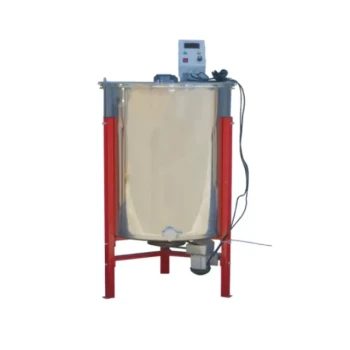
The primary physical function of a centrifuge is to utilize high-speed rotation to generate centrifugal force, which actively drives the sedimentation of pollen particles. This mechanical force separates microscopic grains from a diluted honey solution by pushing them to the bottom of the container. This process is essential for converting a liquid with low pollen density into a solid, high-concentration precipitate.
The centrifuge acts as a mechanical accelerator, replacing the slow process of natural gravity with intense rotational force. This ensures that even trace amounts of pollen scattered through large volumes of liquid are effectively recovered and enriched for analysis.
The Mechanics of Separation
Generating Centrifugal Force
The core mechanism involves high-speed rotation. This movement creates a powerful centrifugal force that acts upon the suspended particles within the sample.
Accelerating Sedimentation
In a standard solution, tiny pollen grains settle very slowly. The centrifuge overcomes this by forcing the sedimentation of these particles, driving them rapidly to the bottom of the tube.
Creating the Precipitate
The physical outcome of this process is the separation of the sample into two parts. You are left with a liquid supernatant (which is discarded) and a high-concentration precipitate at the bottom, which contains the target pollen.
Why Concentration is Critical
Recovering Trace Amounts
Honey samples often contain pollen in trace amounts that are difficult to detect in their natural state. Centrifugation allows for the processing of large volumes of liquid to recover these scarce particles.
Enabling Microscopic Analysis
To perform accurate identification, you need a sufficient number of grains in a single field of view. This physical concentration is the prerequisite that enables the capture and counting of pollen under a microscope.
Facilitating Statistical Data
Beyond simple detection, scientific analysis requires frequency distribution statistics. The centrifuge ensures enough data points are collected to make these statistics statistically valid.
Understanding Process Dependencies
The Necessity of Dilution
A common misunderstanding is that honey is centrifuged directly. The process relies on a diluted honey solution (often using distilled water) to lower the viscosity, allowing the pollen to move freely and settle under centrifugal force.
Volume vs. Yield
This process highlights a trade-off between volume and yield. You must process large volumes of liquid to obtain a relatively small, but usable, amount of enriched pollen sediment.
Making the Right Choice for Your Goal
To effectively utilize a centrifuge in honey analysis, consider your specific analytical objectives:
- If your primary focus is Efficiency: Utilize the centrifuge to rapidly settle pollen from large volumes, saving hours compared to gravity settling.
- If your primary focus is Statistical Accuracy: Ensure the centrifugation is sufficient to recover trace elements, as this enrichment is required for valid frequency distribution statistics.
- If your primary focus is Sample Preparation: Remember that proper dilution with distilled water is a physical prerequisite for the centrifugal force to work effectively.
The centrifuge is not just a separator; it is the fundamental tool that transforms a dilute liquid into a quantifiable data set.
Summary Table:
| Process Element | Mechanical Action | Physical Result |
|---|---|---|
| High-Speed Rotation | Generates Centrifugal Force | Overcomes liquid viscosity |
| Sedimentation | Drives particles downward | Rapid separation from supernatant |
| Concentration | Enriches trace amounts | Forms a solid, high-density precipitate |
| Dilution | Lowers honey viscosity | Allows free movement of pollen grains |
Maximize Your Honey Quality Analysis with HONESTBEE
At HONESTBEE, we understand that precision is the backbone of a successful commercial apiary and distribution business. Whether you are a large-scale producer or a specialized distributor, our comprehensive range of beekeeping machinery, honey-filling equipment, and laboratory-grade tools is designed to streamline your operations and ensure the highest product standards.
From industrial honey processing lines to essential consumables and honey-themed cultural merchandise, we provide the total solution for your business growth. Don't leave your pollen data to chance—partner with the industry experts.
Contact HONESTBEE Today for Wholesale Solutions
References
- Reynaldo González-Sandoval, Francisco Alberto Palemón. ANÁLISIS PALINOLÓGICO DE LOS RECURSOS FLORALES UTILIZADOS POR Apis mellifera L. (HYMENOPTERA:APIDAE) EN CUATRO MUNICIPIOS DEL ESTADO DE GUERRERO, MÉXICO. DOI: 10.56369/tsaes.1837
This article is also based on technical information from HonestBee Knowledge Base .
Related Products
- Honey Concentrating and Filtering Dehumidifier Machine 2T Capacity for Honey
- Honey Concentrating Vacuum Heating Thickening Machine Dehumidifier for Honey
- electric honey extractor honey centrifuge 3 frame honey extractor stainless steel honey frame extractor
- Manual Hand Crank 4 Frame Honey Extractor Centrifuge for Beekeeping
- Professional 4 Frame Self Reversing Electric Honey Extractor for Beekeeping
People Also Ask
- What heating methods can be used with the honey concentrating equipment? Electric vs. Boiler Options
- How does honey filtration and processing machinery transform raw honey? Scale Your Production for Global Markets
- What electrical safety precaution is necessary when operating the honey concentrating equipment? Essential Grounding Tips
- What are the main functions of the honey concentrating equipment? Essential Machinery for Commercial Quality
- What maintenance should be performed when the honey concentrating equipment is not in use? Key Safety & Care Tips