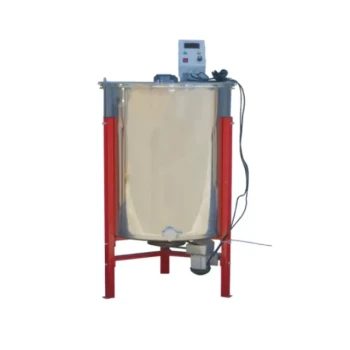
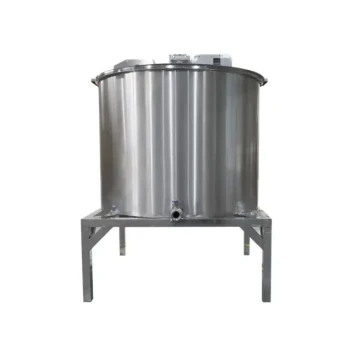
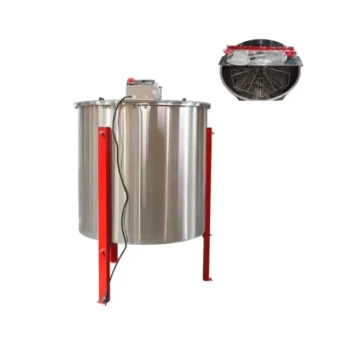
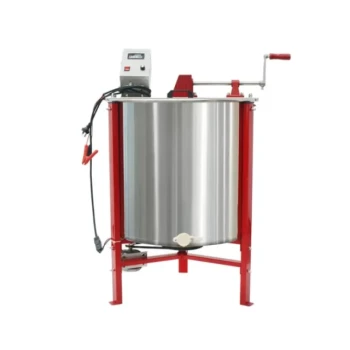
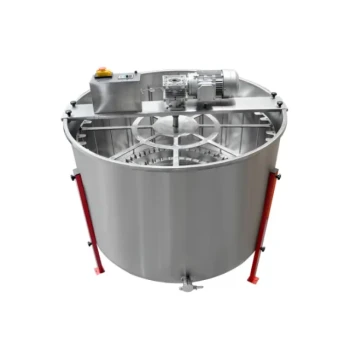
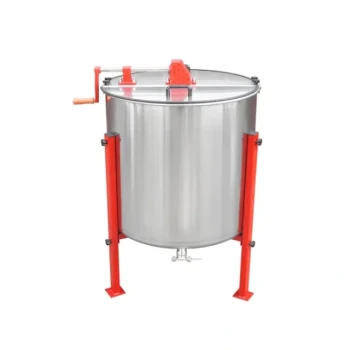
The primary function of an industrial-grade centrifuge in honey pretreatment is mechanical separation. By utilizing high-speed rotation, these machines generate sufficient centrifugal force to detach liquid honey from the honeycomb frames. This process effectively isolates the honey while leaving the physical structure of the wax comb intact.
Core Takeaway Industrial centrifugation serves as the bridge between raw hive material and processed honey. It maximizes extraction efficiency and removes large-particle impurities early in the process, ensuring downstream filtration stages operate smoothly without clogging.
The Mechanics of Separation
Utilizing Centrifugal Force
The core mechanism involves spinning the honeycomb frames at high speeds.
The resulting centrifugal force drives the viscous honey out of the comb cells and against the walls of the extractor.
Preservation of the Honeycomb
Unlike crushing methods, centrifugation is a non-destructive process.
It allows the wax frames to retain their physical structure, meaning they can often be reused in the hive, which saves bees the energy required to rebuild the comb.
Strategic Role in the Workflow
Preliminary Filtration
The centrifuge acts as the first line of defense against contaminants.
During the spin cycle, large-particle impurities are separated from the liquid honey, preventing them from entering the finer stages of processing.
Preparing for Fine Filtration
By removing bulk debris immediately, the centrifuge reduces the load on subsequent filtration systems.
This ensures that later steps, such as passing the honey through fine sieves or filters, proceed without frequent blockages or efficiency losses.
Distinguishing Industrial from Laboratory Use
Extraction vs. Sedimentation
It is critical to distinguish between the industrial-grade units mentioned in your query and laboratory centrifuges.
Industrial units focus on extraction: separating honey from the frame to increase yield and prepare the bulk product.
The Laboratory Counterpart
As noted in technical documentation, laboratory centrifuges serve a completely different purpose: sedimentation.
Lab units use rotational force to concentrate microscopic elements—such as pollen, fungal spores, and algae—to the bottom of a test tube for analysis, rather than extracting honey from a frame.
Understanding the Trade-offs
Efficiency vs. Complexity
While centrifugation offers superior extraction rates compared to gravity draining, it introduces mechanical complexity.
Operators must balance rotational speed; too slow results in lost yield, while excessive speed could potentially stress the equipment or the wax frames.
Not a Sterilization Step
It is important to note that while centrifugation removes large physical debris, it does not sterilize the honey.
Microbial control relies on other protocols, such as using sterile sampling bags and maintaining cold storage at 4°C, rather than the mechanical action of the centrifuge itself.
Making the Right Choice for Your Goal
To optimize your honey processing workflow, align your equipment use with your specific objective:
- If your primary focus is maximum yield: Prioritize industrial centrifugation to extract the highest volume of honey from frames without destroying the wax structure.
- If your primary focus is microscopic analysis: Ensure you are using a laboratory centrifuge to sediment pollen and spores, as the industrial unit is too coarse for this task.
Industrial centrifugation is the definitive method for balancing high-volume extraction with the preservation of raw hive materials.
Summary Table:
| Feature | Industrial Honey Centrifuge | Laboratory Centrifuge |
|---|---|---|
| Primary Function | Mechanical Extraction (Honey from Comb) | Sedimentation (Concentrating Particles) |
| Key Outcome | High Yield & Large Particle Removal | Microscopic Analysis (Pollen/Spores) |
| Impact on Comb | Non-destructive (Reusable frames) | N/A (Test tube based) |
| Workflow Role | Preliminary Filtration & Bulk Processing | Quality Control & Scientific Testing |
Elevate Your Honey Production with HONESTBEE
Are you looking to scale your apiary operations or expand your distribution of professional beekeeping supplies? HONESTBEE is your strategic partner for success. We provide commercial apiaries and distributors with a comprehensive wholesale portfolio, ranging from high-efficiency industrial honey extractors and filling machines to essential industry consumables and hive-making equipment.
Our specialized machinery ensures you achieve maximum yield and maintain the highest product standards. Contact us today to discover how our end-to-end beekeeping solutions and honey-themed cultural merchandise can drive growth for your business!
References
- Livia Feitosa Pereira Ferreira, Maria Célia Pires Costa. Sensorial, physicist-chemistries and microbiological analyses of samples of honeys produced for Apis mellifera in the region of the Cocais Maranhenses, Maranhão State, Brazil. DOI: 10.33448/rsd-v10i7.16495
This article is also based on technical information from HonestBee Knowledge Base .
Related Products
- Manual Hand Crank 4 Frame Honey Extractor Centrifuge for Beekeeping
- electric honey extractor honey centrifuge 3 frame honey extractor stainless steel honey frame extractor
- HONESTBEE 72 Frame Industrial Electric Honey Extractor for Beekeeping
- Professional 4 Frame Self Reversing Electric Honey Extractor for Beekeeping
- Commercial 48-Frame Stainless Steel Honey Extractor
People Also Ask
- What are some tips for achieving efficient honey extraction with a centrifuge extractor? Maximize Your Yield & Efficiency
- What is the proper procedure for maintaining a centrifuge honey extractor? Expert Tips for Longevity and Hygiene
- What are the advantages of using a centrifuge honey extractor? Maximize Yields and Protect Your Honeycombs
- Which type of honey extractor is generally more durable? Focus on Material & Build Quality for Longevity
- What is a manual honey extractor? The Essential Guide to Cost-Effective Beekeeping for Beginners