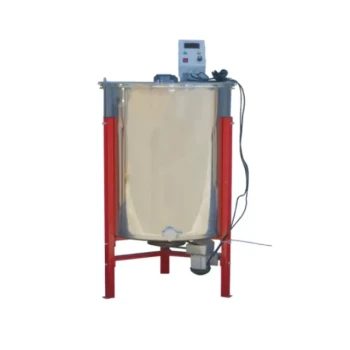
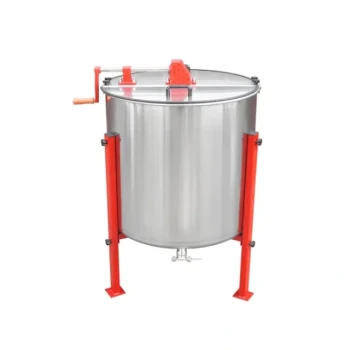
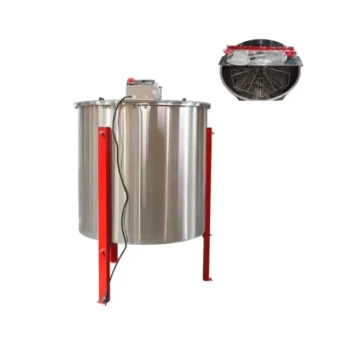
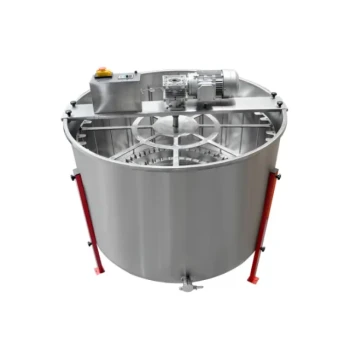
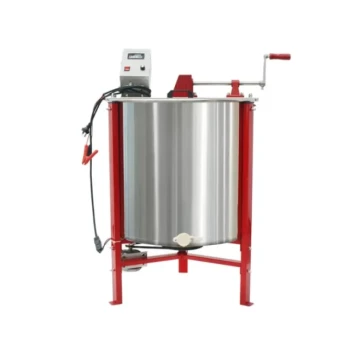
The primary role of a centrifugal honey extractor is to separate honey from the honeycomb using high-speed rotation while preserving the structural integrity of the wax. This mechanized process uses centrifugal force to fling honey out of the cells, allowing the empty, intact combs to be returned to the hive for immediate reuse.
The centrifugal honey extractor serves as the cornerstone of modern harvesting by enabling non-destructive extraction. By preserving the wax combs, it eliminates the need for bees to expend energy rebuilding their hive, which significantly shortens production cycles and maximizes total honey yield for commercial operations.
The Mechanics of Centrifugal Separation
High-Speed Centrifugal Force
The extractor operates by spinning honey-filled frames at high speeds within a drum or vat. This rotation generates centrifugal force, which pulls the liquid honey out of the uncapped cells and flings it against the inner wall of the extractor.
Preservation of the Wax Comb
Unlike traditional crushing methods, centrifugal extraction does not destroy the physical structure of the beeswax combs. This is the primary technical advantage of the equipment, as it allows the "skeleton" of the hive's storage system to remain perfectly intact.
Gravity-Fed Collection
Once the honey hits the extractor walls, it flows downward to a collection point, usually a honey gate or valve. This allows for a hygienic and efficient transfer of raw honey into settling tanks or storage containers without exposing the product to excessive manual handling.
Driving Operational Efficiency in Commercial Apiaries
Reducing Biological Energy Expenditure
Producing beeswax is energy-intensive for a bee colony; bees must consume significant amounts of honey to secrete a small amount of wax. By returning intact combs to the hive, beekeepers save the colony from this labor, allowing the bees to focus entirely on foraging and nectar collection.
Shortening the Production Cycle
Because the bees do not have to rebuild the hive's infrastructure from scratch, the turnaround time between harvests is greatly reduced. This allows commercial apiaries to achieve higher collection frequencies during peak nectar flows, directly impacting the bottom line.
Maximizing Yield and Profitability
For B2B distributors and large-scale producers, the efficiency of a centrifugal extractor is a key driver of ROI. Higher throughput and reduced hive maintenance costs make this equipment the "core hardware" for any scalable honey production business.
Understanding the Trade-offs and Technical Limits
The Risk of Comb "Blowouts"
If the rotation speed is increased too rapidly or if the combs are fragile, the centrifugal force can cause the wax to collapse, known as a "blowout." Skilled operators must balance extraction speed with the structural limits of the wax to avoid losing the reuse benefit.
Radial vs. Tangential Configurations
There are different internal configurations, such as radial and tangential designs, which offer different trade-offs in terms of speed and how many times a frame must be flipped. Choosing the wrong configuration for a specific hive type can lead to inefficient extraction or increased labor costs.
Manual vs. Electric Constraints
While manual extractors are cost-effective for hobbyists, they lack the consistency and throughput required for commercial success. Electric models provide the stable RPMs necessary for high-volume fulfillment but require a higher initial capital investment and access to power.
Making the Right Choice for Your Goal
As a distributor or wholesaler, selecting the right centrifugal extractor portfolio is essential for meeting the diverse needs of your client base.
- If your primary focus is supporting commercial-scale operations: Prioritize high-capacity electric radial extractors that emphasize rapid throughput and mechanized efficiency.
- If your primary focus is serving hobbyists or specialty boutiques: Offer durable manual stainless steel units that provide a balance of cost-effectiveness and high-quality honey preservation.
- If your primary focus is supply chain reliability and rapid fulfillment: Partner with a one-stop source that offers a full-spectrum product portfolio and ultra-fast delivery to minimize lead times for your customers.
By leveraging centrifugal technology, honey producers can transform a labor-intensive biological process into a streamlined, high-yield industrial harvest.
Summary Table:
| Feature | Primary Function & Impact |
|---|---|
| Core Mechanism | Uses centrifugal force to fling honey from uncapped cells without crushing the comb. |
| Comb Preservation | Keeps beeswax structures intact, allowing bees to focus on foraging instead of rebuilding. |
| Operational Speed | High-speed rotation significantly reduces extraction time compared to manual crushing. |
| Economic Value | Increases total honey yield and ROI by shortening the interval between harvests. |
| Quality Control | Enables hygienic, gravity-fed collection with minimal manual handling and oxygen exposure. |
Scale Your Business with HONESTBEE’s One-Stop Beekeeping Solutions
Are you a distributor or B2B reseller looking to dominate the apiary market? HONESTBEE is your strategic partner, offering a comprehensive wholesale portfolio designed for commercial success. From high-capacity centrifugal extractors and honey-filling machines to specialized hive-making hardware and essential consumables, we provide the full spectrum of equipment your clients demand.
Why Choose HONESTBEE?
- Deep Industry Expertise: Professional-grade tools tailored for commercial apiaries.
- Rapid Fulfillment: Ultra-fast delivery and efficient order processing to keep your stock moving.
- Comprehensive Sourcing: One-stop access to everything from heavy machinery to cultural merchandise.
- Distributor Support: Dedicated customer service and competitive wholesale pricing to maximize your profit margins.
Ready to enhance your product lineup with premium beekeeping technology?
Contact HONESTBEE Today to Request a Quote
References
- Rohini Sharma, Mangla Ram Bajiya. Honey, its Quality and Composition and their Responsible Factors. DOI: 10.23910/1.2023.3278a
This article is also based on technical information from HonestBee Knowledge Base .
Related Products
- electric honey extractor honey centrifuge 3 frame honey extractor stainless steel honey frame extractor
- Manual Hand Crank 4 Frame Honey Extractor Centrifuge for Beekeeping
- Professional 4 Frame Self Reversing Electric Honey Extractor for Beekeeping
- 24 Frame Honey Extractor Commercial Radial Honey Frame Extraction Machine
- Electric 4 Frame Tangential Honey Extractor
People Also Ask
- What are the characteristics of electric honey extractors? Boost Your Apiary Efficiency with Automated Technology
- What are the disadvantages of using an electric honey extractor? Weighing Cost, Power, and Comb Safety
- What are the advantages of an electric honey extractor? Boost Efficiency and Scale Your Honey Production
- What are the technical advantages of electric honey extractors? Maximize Yield and Protect Your Bee Colony
- How does an electric honey extractor affect the quality of honey? Preserve Flavor & Purity with Precision Extraction