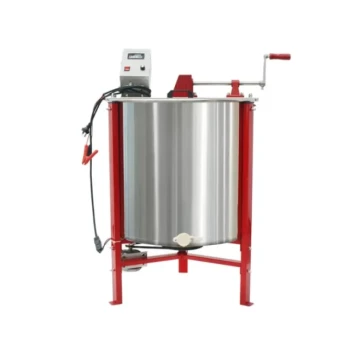
For beekeeping operations managing multiple hives, the recommended baseline is a honey extractor capable of holding at least four frames. This capacity is essential to streamline the extraction process and significantly improve time efficiency. While smaller units are available, a four-frame model prevents the processing bottlenecks common with smaller equipment.
The goal of selecting extractor capacity is to minimize the ratio of "handling time" to "spinning time." Moving to a four-frame or larger model allows you to process a significant volume of honey in fewer batches, transforming a labor-intensive chore into an efficient workflow.
Matching Capacity to Apiary Size
To maximize efficiency, you must match your equipment not just to your current hive count, but to your projected growth.
The Hobbyist Threshold (Up to 4 Hives)
For very small operations or hobbyists managing up to four hives, a 2-frame extractor is generally sufficient. At this scale, the time spent swapping frames is manageable regarding the total volume of honey produced.
The "Multiple Hive" Standard (Up to 8 Hives)
Once you expand beyond four hives, the workflow requirements change. For beekeepers with up to eight hives, a 4-frame extractor is the recommended standard. This capacity aligns with the primary recommendation to streamline operations and reduce the total hours spent in the honey house.
Scaling for Production (10+ Hives)
For larger-scale operations managing more than 10 hives, efficiency becomes critical to avoid burnout. In these scenarios, it is recommended to upgrade to 8-frame or 9-frame models. These larger units allow for substantial throughput, enabling you to finish the harvest in a reasonable timeframe.
The Efficiency Principles
Understanding why capacity matters helps justify the investment in larger equipment.
Reducing Batch Cycles
Every extraction cycle involves uncapping frames, loading the machine, spinning, stopping, and unloading. A 4-frame extractor literally cuts the number of required spin cycles in half compared to a 2-frame unit.
Minimizing Interruptions
Larger extractors generally hold more extracted honey at the bottom of the drum before needing to be drained. This minimizes the frequency of interruptions required to open the gate and strain the honey, allowing for a more continuous workflow.
Understanding the Trade-offs
While "bigger is usually better" for efficiency, there are practical limitations you must consider before purchasing the largest unit available.
Storage and Footprint
Higher capacity extractors represent a significant increase in physical size. You must ensure you have adequate floor space not only to operate the machine but to store it during the off-season.
Cost vs. Usage Frequency
Extractors are often used only once or twice a year. You must weigh the higher upfront cost of an 8-frame or 9-frame model against the actual hours saved. For someone strictly staying at 5-6 hives, a 4-frame unit offers the best balance of cost to performance.
Making the Right Choice for Your Goals
Select your extractor based on where your apiary will be in two years, not where it is today.
- If your primary focus is a small hobby (Under 4 hives): A 2-frame extractor is a cost-effective choice that handles low volumes well.
- If your primary focus is efficiency and growth (Up to 8 hives): A 4-frame extractor is the ideal workhorse to streamline your process and save time.
- If your primary focus is semi-commercial production (10+ hives): An 8-frame or 9-frame extractor is necessary to handle high volumes without workflow bottlenecks.
Buy the capacity that turns your harvest into a celebration of your hard work, rather than an endurance test.
Summary Table:
| Operation Size | Recommended Capacity | Efficiency Level | Best Suited For |
|---|---|---|---|
| Hobbyist (1-4 Hives) | 2-Frame Extractor | Basic | Low-volume hobby use |
| Standard (5-8 Hives) | 4-Frame Extractor | High | Streamlining labor & growth |
| Production (10+ Hives) | 8-9 Frame Extractor | Professional | High-throughput operations |
Scale Your Honey Production with HONESTBEE
Are you ready to transform your honey harvest from a labor-intensive chore into a high-efficiency operation? At HONESTBEE, we specialize in empowering commercial apiaries and distributors with the professional-grade tools they need to succeed.
From high-capacity honey extractors and honey-filling machines to specialized hive-making hardware and essential industry consumables, our comprehensive wholesale portfolio is designed for those who mean business.
Why partner with HONESTBEE?
- Full Spectrum Supply: Access everything from heavy machinery to honey-themed cultural merchandise.
- Industry Expertise: We cater specifically to the needs of large-scale beekeeping operations and global distributors.
- Quality & Durability: Our equipment is built to withstand the demands of commercial use.
Take your apiary to the next level—Contact us today to discuss our wholesale offerings and discover how we can support your growth.
Related Products
- HONESTBEE 72 Frame Industrial Electric Honey Extractor for Beekeeping
- Commercial Electric 12 Frame Honey Extractor Spinner Motorized Honey Extractor
- HONESTBEE 3-Frame Manual Acrylic Honey Extractor
- electric honey extractor honey centrifuge 3 frame honey extractor stainless steel honey frame extractor
- HONESTBEE 6 Frame Self Reversing Electric Honey Extractor for Beekeeping
People Also Ask
- What is the importance of balancing honeycomb frames within a honey extractor? Ensure Stability and Protect Machinery
- How is honey separated from the frames after they are uncapped? Efficient Extraction Methods for High Yields
- What are the main benefits of using a honey extractor? Maximize Yields and Protect Your Honeycomb
- What are the recommended methods for removing honey from the honeycomb? Top Extraction Techniques for Maximum Efficiency
- How do manual honey extractors compare to electric honey extractors? Choosing the Right Tool for Your Apiary Growth