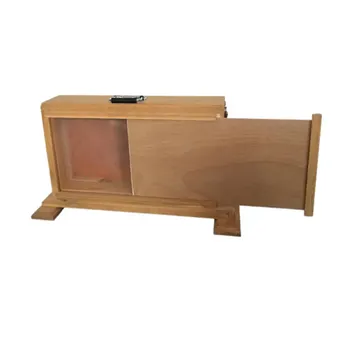
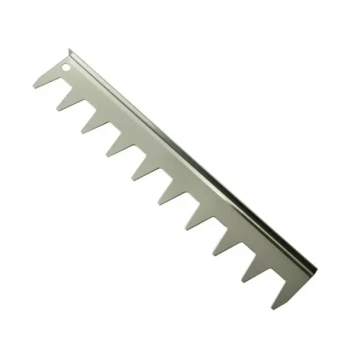
For a standard removable-box Langstroth hive, use one full-depth brood box below a half-depth honey super, with a queen excluder between them. Equip the brood box with a frame feeder and nine Hoffman frames fitted with foundation, leaving space for nucleus frames. Fit the honey super with eight Manley frames and foundation to support efficient comb building and honey extraction.
The recommended setup is a full-depth brood chamber for colony growth, a half-depth super for honey storage, and a queen excluder to keep the queen in the brood area. The exact number of frames depends on whether the equipment is designed for an eight-frame or ten-frame box.
How the Recommended Configuration Works
The Full-Depth Brood Box
The full-depth box is positioned at the bottom of the hive and provides the primary space for brood rearing. Its greater internal height accommodates deep frames, which give the colony room to establish its nest.
Install nine Hoffman frames with foundation in the brood box, together with a frame feeder for sugar syrup. This arrangement can preserve a working space for nucleus frames while supplying feed during colony establishment or periods of limited forage.
The Half-Depth Honey Super
Place the half-depth super above the brood box for honey storage. A shallower box produces lighter honey-filled units than a deep box, making it more practical for inspection, transport, and harvesting.
The recommended super uses eight Manley frames with foundation. Manley frames are commonly selected for honey production because their design supports comb building and can simplify extraction and handling.
The Queen Excluder
Position the queen excluder between the brood box and the honey super. Its purpose is to restrict the queen to the brood chamber while allowing worker bees to move into the super and store honey.
The excluder should be compatible with the hive dimensions and installed level. Poor fit, damaged equipment, or excessive gaps can reduce its effectiveness and interfere with bee movement.
Choosing the Correct Frame Count
Eight-Frame Equipment
An eight-frame Langstroth box is lighter and easier to lift, particularly when filled with honey. This can be a practical choice for beekeepers who prioritize handling efficiency or for distributors serving customers with physical or operational lifting constraints.
The super configuration described in the primary setup uses eight Manley frames. Confirm that the box, frame rests, and frame spacing are all designed for eight-frame equipment before ordering or assembling components.
Ten-Frame Equipment
Ten-frame boxes provide greater internal capacity per box and remain a widely used Langstroth format. A ten-frame brood box may be configured with nine Hoffman frames plus a feeder when the design calls for additional working space.
Frame counts should not be mixed casually between eight-frame and ten-frame equipment. Box width, frame rests, spacers, and covers must match the selected format to maintain correct bee space and reliable operation.
Frame Dimensions and Types
Langstroth frames are available in deep, medium, and shallow sizes. Deep frames are approximately 9-1/8 inches high, medium frames approximately 6-1/4 inches, and shallow frames approximately 5-3/8 inches.
The frame width is typically about 19-3/16 inches, with roughly 1.5 inches between frame centers. Frames may be made from wood or plastic, and foundation should match the selected frame and intended use.
Building a Complete Hive Package
Essential Hive Components
A functional Langstroth assembly generally includes:
- Bottom board
- Full-depth brood box
- Half-depth or shallow honey super
- Brood frames and honey-super frames
- Frame feeder
- Queen excluder
- Inner cover
- Top cover
- Entrance reducer or mouse guard
Offering these components as a compatible package helps distributors and resellers reduce ordering errors and simplify fulfillment. It also gives beekeepers confidence that the boxes, frames, covers, and accessories will work together.
Product Compatibility
The box height must match the frame depth. Deep frames belong in deep boxes, while shallow frames belong in shallow boxes; substituting incompatible sizes can prevent proper seating and compromise the hive's internal spacing.
For wholesale or repeat purchasing, specifications should identify the frame count, frame style, material, foundation type, box depth, and compatible cover dimensions. Clear product data improves quoting accuracy and reduces replacement orders.
Inspection and Handling
During inspection, work from the back of the hive so the entrance remains unobstructed. After removing the top cover and inner cover, remove an outside frame first and use the resulting space to slide the remaining frames for inspection.
Inspect both sides of each frame while holding it above the box, then return every frame in its original orientation and restore the original spacing. This method reduces the risk of crushing bees and helps protect the queen.
Understanding the Trade-offs
Deep Boxes Versus Shallow Supers
Deep boxes provide substantial brood-rearing capacity, which is why they are commonly used at the bottom of the hive. When filled with honey, however, deep boxes become heavy and difficult to lift.
Medium or shallow supers are usually more manageable for honey storage. The recommended full-depth brood box and half-depth super therefore balance colony capacity with easier honey handling.
Eight Frames Versus Ten Frames
Eight-frame equipment reduces the weight of each box but provides less capacity per box. Ten-frame equipment holds more frames but produces heavier units and may require greater lifting effort.
Neither format is universally superior. The correct choice depends on the beekeeper's handling preferences, production goals, replacement-equipment availability, and the format already used in the operation.
Frame Feeder Capacity
A frame feeder occupies space that could otherwise hold a brood frame. Its benefit is convenient syrup delivery, especially for new colonies or periods when supplemental feeding is required.
Before supplying or installing the feeder, verify that the remaining frame count and spacing are appropriate for the box. The feeder should not create excessive crowding or prevent frames from hanging correctly.
Foundation and Frame Materials
Wax foundation supports guided comb construction, while plastic frames or foundation can offer durability and consistent dimensions. Material selection affects purchasing cost, maintenance, beekeeper preference, and compatibility with extracting equipment.
For commercial supply, frame and foundation specifications should be stated clearly rather than treated as interchangeable. Small dimensional differences can create practical problems during assembly and extraction.
Making the Right Choice for Your Goal
The best configuration depends on the intended use, lifting requirements, and existing equipment standard.
- If your primary focus is standard brood production: Use a full-depth brood box with a frame feeder and nine Hoffman frames fitted with foundation.
- If your primary focus is efficient honey harvesting: Add a half-depth super with eight Manley frames and foundation above a queen excluder.
- If your primary focus is easier handling: Choose eight-frame equipment and use shallow or medium honey supers where compatible.
- If your primary focus is one-stop commercial sourcing: Specify a complete compatible package including the bottom board, boxes, frames, feeder, excluder, covers, and entrance accessories.
- If your primary focus is dependable repeat fulfillment: Standardize the box format, frame depth, frame count, materials, and cover dimensions across each product listing.
A well-matched Langstroth setup combines adequate brood space, manageable honey storage, compatible components, and a frame system suited to the beekeeper's operating priorities.
Summary Table:
| Component | Recommended Setup | Purpose |
|---|---|---|
| Brood Box | Full-depth with 9 Hoffman frames + frame feeder | Primary brood rearing space, allows colony growth |
| Honey Super | Half-depth with 8 Manley frames | Efficient honey storage, lighter handling |
| Queen Excluder | Placed between brood box and super | Keeps queen in brood area, allows workers to store honey |
| Frame Feeder | In brood box | Provides supplemental syrup feeding |
| Frames | Hoffman (brood), Manley (super) with foundation | Support comb building and honey extraction |
Upgrade your hive setup with HONESTBEE's premium beekeeping equipment. We offer a comprehensive range of Langstroth components, including boxes, frames, feeders, and queen excluders, all designed for compatibility and durability. As a one-stop supplier for commercial apiaries and distributors, we provide rapid responses, dedicated service, and ultra-fast delivery. Whether you need standard configurations or custom OEM/ODM solutions, we ensure top-quality and reliable supply. Contact us today to discuss your wholesale needs and experience the HONESTBEE advantage!
Related Products
- Professional Observation Hive: The Ultimate Portable Solution for Beekeeping Education, Exhibitions, and Colony Displays
- 5 Frame Langstroth Poly Nuc Corrugated Plastic Nuc Boxes
- Langstroth Honey Bee Box Hive Boxes for Different Depths
- High-Performance Langstroth Bee Hives for Global Professional Beekeeping
- Australian Langstroth Beehive Boxes for Beekeeping Wholesales
People Also Ask
- How does transitioning to modern hives boost honey yield? Increase production and product quality for your commercial apiary
- How do Langstroth and Dadant standard beehives compare regarding brood chamber management and component compatibility? Find the Perfect Fit for Your Apiary
- What are the primary differences between Langstroth, horizontal top bar, and Warré hive box designs when selecting beekeeping equipment? Choose the Right Hive for Your Apiary
- Why do commercial apiary operators transition from traditional hive structures, such as clay cylinders, to standardized Langstroth hive boxes? Discover Scalable Beekeeping Solutions
- How does transitioning from traditional local hives to modern frame beehives impact honey yields, and what equipment is needed to support this transition for commercial apiaries? Boost Productivity with the Right Gear